

While 88% of Artificial Intelligence (AI) agent pilots fail to reach production, the true cost of "pilot purgatory" is the missed opportunity for systemic transformation. Many leaders in the United Arab Emirates (UAE) have successfully tested isolated models, yet they encounter significant friction when scaling AI agents across an organization. It's a transition where uncoordinated tool adoption often leads to high technical debt and acute governance anxiety. You understand that a single successful test is not a strategy; it's a signal requiring a disciplined, architectural response.
This guide masters the strategic requirements to move from experimental bots to a scalable, outcome-guaranteed synthetic workforce. We'll apply the "Art of Problem Finding" to align Generative Artificial Intelligence (GenAI) capabilities with business outcomes. You'll gain a structured roadmap for agentic orchestration, ensuring your synthetic workers, such as the SARA or NOVA architectures, operate within a governed, audit-ready framework that prioritizes structural stability and radical progress.
Key Takeaways
- Learn to utilize "The Art of Problem Finding" framework to identify high-impact use cases that bypass the common 88% failure rate of Artificial Intelligence (AI) pilots.
- Master the architectural requirements for scaling AI agents across an organization, evolving from basic chat interfaces to resilient, task-oriented synthetic workers.
- Establish a robust corporate governance policy tailored to the regulatory landscape of the United Arab Emirates (UAE) to ensure audit-ready agentic autonomy.
- Future-proof your workforce with CPD (Continuing Professional Development) UK-certified coaching to facilitate high-level partnership between human leaders and agentic systems.
Scaling AI Agents: Beyond Pilot Purgatory through Strategic Problem Finding
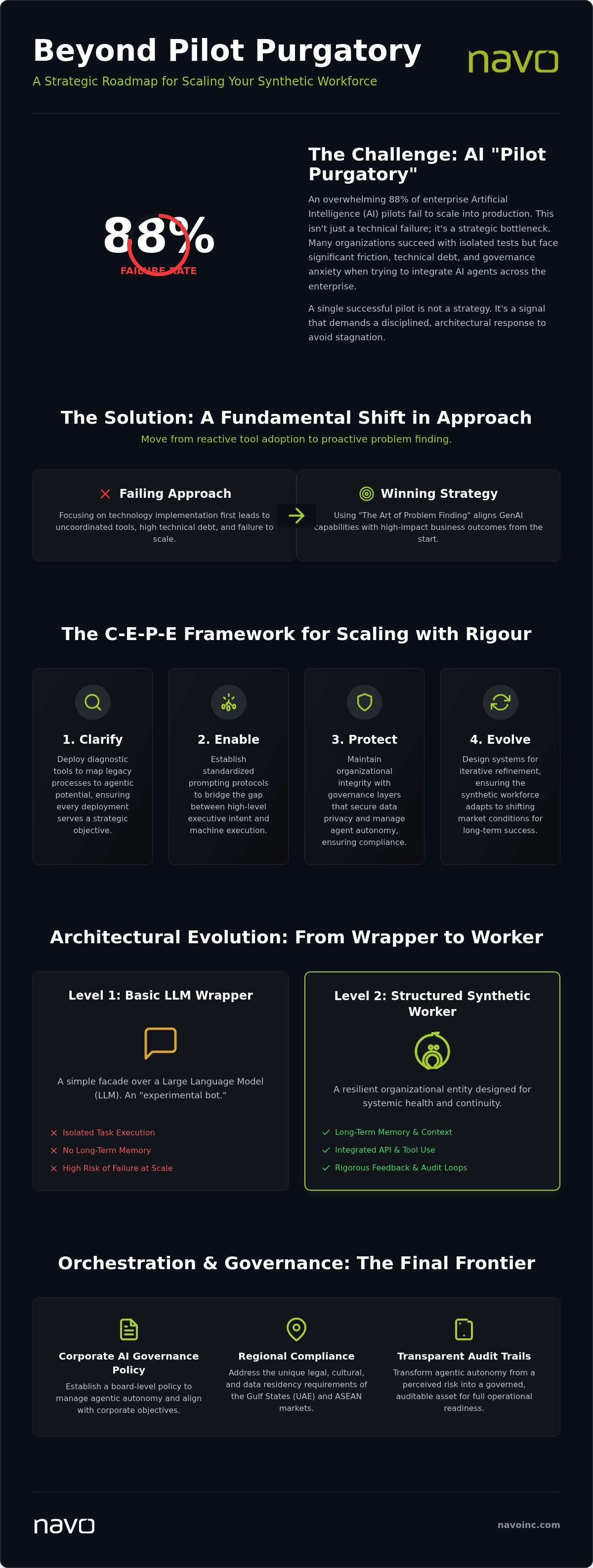
The phenomenon of "pilot purgatory" is a systemic reality for 88% of enterprise Artificial Intelligence (AI) initiatives. While successful departmental tests generate initial excitement, they often fail to transition into a cohesive workforce layer. This stagnation typically stems from a focus on technological implementation rather than foundational diagnosis. Scaling AI agents across an organization requires a shift from reactive automation to "The Art of Problem Finding." This framework identifies "Unknown Knowns," the latent insights buried in organizational data, to define high-impact roles for an Intelligent agent.
By positioning Generative Artificial Intelligence (GenAI) as a strategic co-thinking partner, Navo Inc. helps leaders move toward outcome-guaranteed results that impact the bottom line. This evolution replaces isolated, task-oriented bots with integrated systems capable of managing complex business logic with professional composure and analytical precision.
The Clarify-Enable-Protect-Evolve Framework for Initial Scaling
To navigate this transition with architectural rigour, we utilize a four-pillar approach designed for the unique regulatory environment of the Gulf states:
- Clarify: We deploy diagnostic tools to map legacy business processes to agentic potential, ensuring every deployment serves a strategic objective.
- Enable: High-level human-to-machine communication is established through standardized prompting protocols, bridging the gap between executive intent and machine execution.
- Protect: Organizational integrity is maintained via the Four-Class Information Model, a governance layer that secures data privacy while managing agentic autonomy. This ensures compliance with emerging standards in Dubai and Riyadh.
- Evolve: Systems are designed for iterative refinement, ensuring the synthetic workforce adapts to shifting market conditions. This evolutionary phase is critical for successfully scaling AI agents across an organization over the long term.
Architectural Rigour: Designing Synthetic Workers for Enterprise Resiliency
Success in scaling AI agents across an organization hinges on the transition from simple Large Language Model (LLM) wrappers to structured Synthetic Workers. A wrapper is merely a facade; a Synthetic Worker is a resilient organizational entity designed for systemic health and operational continuity. This evolution demands a deep understanding of strategic considerations for scaling AI, where long-term memory, API tool integration, and rigorous feedback loops form the core architectural pillars. Our proprietary SARA architecture provides the necessary validation for initial phases, whereas NOVA manages the orchestration of a production-ready synthetic workforce.
We implement "Machine-in-the-Loop" thinking to ensure human oversight remains present at critical approval gates. This maintains professional composure during complex organizational shifts, combining the persona of a battle-tested advisor with a bold technological pioneer. Leaders seeking to stabilize their AI roadmap may benefit from a structured architectural assessment to ensure long-term readiness and resilience.
The Anatomy of a Scalable AI Agent in 2026
Effective scaling requires assigning specific Key Performance Indicators (KPIs) and accountability to every synthetic entity. It's a move toward sophisticated workflow orchestration, where multiple agents connect into a cohesive workforce layer. To meet stringent Gulf Cooperation Council (GCC) and Singaporean regulatory standards, every interaction must generate a transparent audit trail. This auditability transforms agentic autonomy from a perceived risk into a governed asset, ensuring your synthetic workforce is both seasoned and contemporary.
Orchestrating the Synthetic Workforce: Governance and Operational Readiness
Orchestration is the final frontier of structural excellence. Scaling AI agents across an organization requires a board-level Agentic AI Governance Policy to manage the nuances of agentic autonomy. This isn't merely about technical guardrails but about establishing a Corporate AI Governance Policy that addresses the legal and cultural sensitivities of the Gulf states and ASEAN (Association of Southeast Asian Nations) markets. Data residency remains a critical factor; navigating the regulations of Dubai, Riyadh, and Singapore demands localized infrastructure that respects regional sovereignty.
While competitors focus on control planes, Navo Inc. prioritizes the human-machine partnership. We utilize CPD (Continuing Professional Development) UK-certified coaching to future-proof leadership, ensuring your team can co-think with synthetic workers. This shift moves the financial conversation from pilot expenditures to outcome-guaranteed net-profit metrics, ensuring that every deployment delivers measurable value.
Five Steps to Enterprise-Wide Agentic Deployment
Execution requires a methodical, resource-driven pace to ensure systemic health and long-term resilience:
- Step 1: Conduct a diagnostic readiness survey to identify cultural friction and technical gaps within the current infrastructure.
- Step 2: Deploy foundational governance frameworks and desensitization toolkits to prepare the workforce for agentic collaboration.
- Step 3: Build the first "Squad" of synthetic workers, utilizing SARA for specialized validation or NOVA for complex operational orchestration.
- Step 4: Execute the "Activation Arc" through executive coaching and masterclasses to align agentic capabilities with strategic goals.
- Step 5: Continuously evolve the system through outcome-based strategy consulting, ensuring the synthetic workforce scales in tandem with organizational growth.
Mastering the Synthetic Frontier for Sustainable Enterprise Growth
Transitioning from experimental pilots to a governed workforce layer requires a fundamental architectural evolution. Success lies in moving beyond simple wrappers toward structured synthetic workers like the SARA and NOVA architectures. By anchoring these deployments in the "Art of Problem Finding," leadership ensures that scaling AI agents across an organization becomes a driver of systemic health rather than technical debt.
This transformation is supported by CPD (Continuing Professional Development) UK-certified executive coaching and a commitment to outcome-guaranteed net-profit increases. It's a strategic partnership designed for the unique regulatory and cultural landscape of the United Arab Emirates (UAE) and the broader Gulf states.
Your organization is ready to move beyond the limitations of isolated tests into a future of disciplined, high-stakes innovation. With the right architectural rigour, the transition to a synthetic workforce is not just possible; it's inevitable.
Frequently Asked Questions
What is the primary difference between a standard AI chatbot and a scalable AI agent?
Standard chatbots are reactive interfaces limited to text generation and basic retrieval. Conversely, a scalable Artificial Intelligence (AI) agent is an autonomous entity capable of multi-step reasoning and tool integration. When scaling AI agents across an organization, these entities function as synthetic workers that execute complex workflows without constant prompting. They maintain structural stability through professional-grade architectures like NOVA, ensuring resilience at an enterprise level.
How does the "Art of Problem Finding" improve the success rate of AI scaling?
"The Art of Problem Finding" framework shifts the focus from technological deployment to diagnostic excellence. By identifying "Unknown Knowns" within organizational data, this methodology ensures that AI agents solve high-value systemic bottlenecks. This rigorous approach mitigates the risk of "pilot purgatory," where 88% of projects fail because they address symptoms rather than the underlying structural challenges that fundamentally drive net profit.
What are the legal and governance risks of scaling AI agents in the GCC and Singapore?
Scaling AI agents across an organization in the Gulf Cooperation Council (GCC) or Singapore necessitates strict adherence to localized data residency and privacy regulations. Key risks include unauthorized data exfiltration and lack of transparency in agentic decision-making. Navo Inc. addresses these through a Four-Class Information Model and robust audit trails, ensuring your synthetic workforce remains compliant with the evolving legal standards of Dubai and Riyadh.
Can AI agents be integrated with existing legacy Enterprise Resource Planning (ERP) systems?
Integration with legacy Enterprise Resource Planning (ERP) systems is achieved through sophisticated Application Programming Interface (API) orchestration. Our architectural approach ensures that synthetic workers interact with legacy databases securely. By implementing "Machine-in-the-Loop" protocols, we maintain human oversight at critical validation gates. This allows modern agentic systems to enhance older infrastructures without requiring a total system overhaul, preserving professional composure throughout the shift.
How do we measure the net-profit impact of a synthetic workforce?
Net-profit impact is measured by moving beyond surface-level efficiency to track tangible bottom-line outcomes. We evaluate the reduction in Operational Expenditure (OPEX) and the acceleration of revenue-generating cycles managed by the synthetic workforce. Navo Inc. provides a net-profit guarantee for enterprise consulting, utilizing rigorous financial modeling to ensure that the transition from pilot costs to full-scale deployment results in measurable, audit-ready fiscal growth.
Disclaimer
The views and opinions expressed in this article are those of the author and do not represent any organisation, client, institution, or professional body with which he may be associated. The content is intended for general information, education, and thought leadership. Readers should seek appropriate professional advice before making legal, financial, investment, regulatory, technology, or business decisions.
The author has taken reasonable care to ensure the accuracy of the information and sources available at the time of publication. Technologies, regulations, market conditions, and industry practices may evolve, and readers are encouraged to verify current information independently. Any examples, cases, or scenarios may have been simplified, anonymised, or adapted to protect confidentiality. The author and publisher accept no liability for decisions or outcomes arising from the use of this content.
Generative AI tools may have been used to support research, structuring, or language refinement, with the final content, judgment, and editorial responsibility retained by the author.