

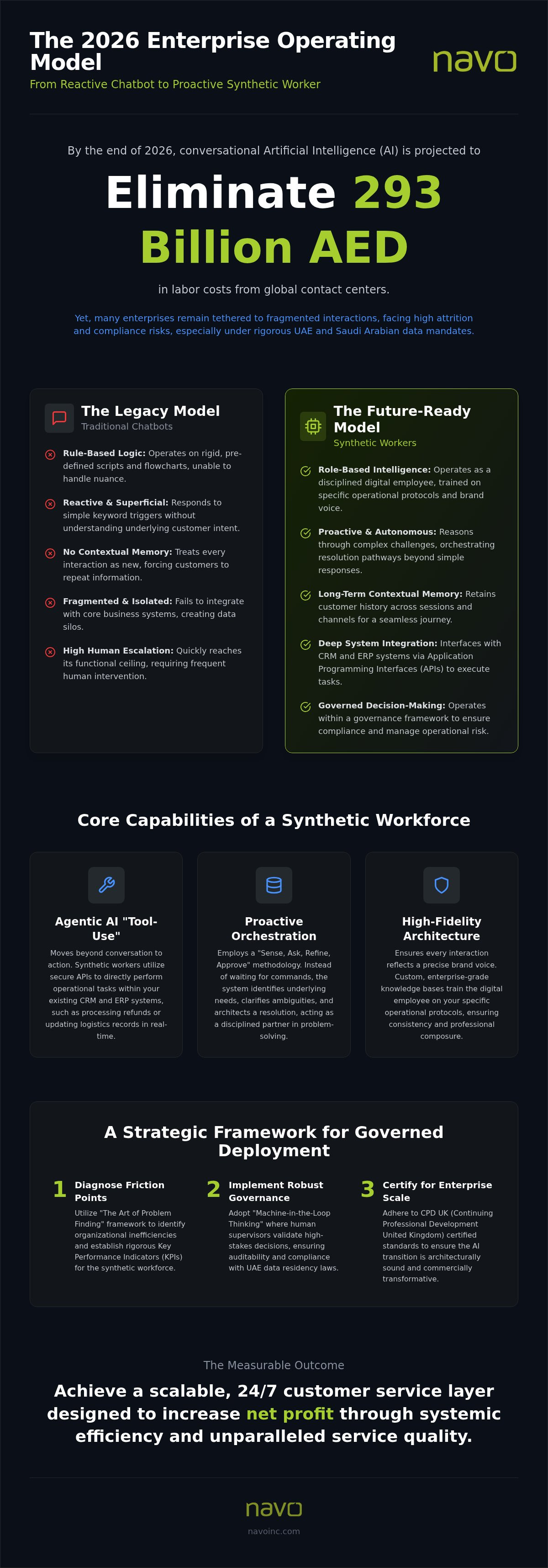
By the end of 2026, conversational Artificial Intelligence (AI) is projected to strip over 293 billion AED in labor costs from global contact centers, yet many enterprises remain tethered to fragmented, low-fidelity chatbot interactions. This disconnect highlights a critical evolutionary gap between basic automation and the deployment of a synthetic worker for customer service automation capable of sophisticated business logic. You've likely witnessed the persistent strain of high attrition within human support teams and the reputational risks of inconsistent service quality. In the UAE and Saudi Arabia, these operational pressures are intensified by rigorous data residency and privacy mandates that traditional, off-the-shelf solutions often fail to address with sufficient rigor.
You're seeking a transition from these reactive, superficial tools toward a governed, high-fidelity synthetic workforce that functions as a seamless extension of your corporate identity. This article provides a strategic roadmap for implementing a scalable, 24/7 customer service layer designed to increase net profit through systemic efficiency. We'll analyze the 2026 enterprise operating model, detailing how CPD UK (Continuing Professional Development United Kingdom) certified implementation standards ensure your AI transition is both architecturally sound and commercially transformative.
Key Takeaways
- Transition from rule-based chatbots to a role-based synthetic worker for customer service automation capable of executing multi-step workflows with contextual memory.
- Discover how Agentic AI (Artificial Intelligence) leverages "Tool-Use" capabilities to perform autonomous operational tasks within your existing Customer Relationship Management (CRM) systems.
- Utilize "The Art of Problem Finding" framework to diagnose organizational friction points and establish rigorous Key Performance Indicators (KPIs) for synthetic workforce performance.
- Implement robust governance structures that ensure full compliance with United Arab Emirates (UAE) data residency laws and regional regulatory mandates.
- Achieve measurable increases in net profit by adopting CPD UK (Continuing Professional Development United Kingdom) certified standards for enterprise-grade AI integration.
Beyond Chatbots: Defining the Synthetic Worker for Customer Service Automation
The traditional chatbot, once the hallmark of digital transformation, has reached its functional ceiling. For enterprises in Dubai and the broader Gulf region, the 2026 operating model demands more than scripted responses; it requires a synthetic worker for customer service automation. Unlike legacy Robotic Process Automation (RPA), which relies on static logic and rigid flowcharts, a synthetic worker is a role-based entity designed to operate within a sophisticated workforce layer. These AI agents don't just process data; they reason through complex organizational challenges as strategic co-thinking partners. To understand the structural shift required for this integration, executives should consult our Synthetic Workforce Development pillar. This evolution moves beyond simple task execution into the realm of autonomous decision-making and systemic health.
The Architecture of Role Fidelity
Synthetic workers achieve high-fidelity outcomes by utilizing custom, enterprise-grade knowledge bases that ensure every interaction reflects a precise brand voice. This isn't a generic language model; it's a disciplined digital employee trained on your specific operational protocols. Memory retention is a core component of this architecture. By maintaining context across multiple sessions, these agents eliminate the repetitive friction customers face during long-term support journeys. This continuity is essential for maintaining the professional composure and reliability expected in high-stakes Middle Eastern markets, where service quality is a primary differentiator.
From Reactive Support to Proactive Orchestration
The transition from reactive support to proactive orchestration marks the end of simple keyword triggers. Modern synthetic workers utilize a "Sense, Ask, Refine, and Approve" methodology to handle nuanced customer intents. Instead of waiting for a specific command, the system identifies the underlying need, clarifies ambiguities, and orchestrates a resolution pathway. This shift ensures that the synthetic worker for customer service automation acts as a disciplined architect of change. It's capable of navigating complex service environments without constant human intervention, allowing your human talent to focus on high-value strategic initiatives rather than repetitive ticket resolution.
Operationalising Agentic AI in Customer Operations
Operationalising a synthetic worker for customer service automation requires a departure from isolated chat interfaces toward deep systemic integration. These agents function by interfacing directly with existing Customer Relationship Management (CRM) and Enterprise Resource Planning (ERP) systems via secure Application Programming Interfaces (APIs). This connectivity transforms the AI from a passive responder into an active participant in business processes. Instead of merely explaining a policy, the agent utilizes "Tool-Use" capabilities to execute actions, such as processing a refund or updating a logistics record in real-time. Recent research from the U.S. GAO on AI Agents underscores that such autonomy requires rigorous oversight to manage operational risk. We implement "Machine-in-the-Loop Thinking," a governance model where human supervisors validate high-stakes decisions before final execution. For comprehensive orchestration frameworks, executives should review Navo Inc.'s Agentic AI Services.
Memory and Contextual Intelligence
A critical distinction exists between short-term session memory and long-term organizational memory. While session memory maintains the immediate dialogue, organizational memory allows a synthetic worker to recognize a returning customer's history across diverse geographies like Dubai, Singapore, or Mumbai. This persistent context ensures that a client's prior preferences or unresolved issues are immediately accessible, preventing redundant inquiries and reinforcing the brand's professional composure. It creates a seamless journey where the AI acts as a seasoned advisor rather than a forgetful bot.
The Six Lanes of Working Framework
Our proprietary "Six Lanes of Working" framework categorizes customer operations by complexity and risk. Lower lanes, involving basic information retrieval or standard status updates, are suitable for full synthetic autonomy. Higher lanes that demand complex problem-solving or high-value negotiations require human-augmented support. This methodical categorization allows leadership to deploy a synthetic worker for customer service automation where it generates maximum Return on Investment (ROI) without compromising service integrity. If you're ready to audit your current support architecture, consult with Navo Inc.'s strategic advisors to identify your high-impact lanes.
A Strategic Framework for Deployment: The Art of Problem Finding
Successful integration of a synthetic worker for customer service automation demands diagnostic rigor rather than mere technological enthusiasm. Organizations often succumb to the "automation trap," where inefficient legacy processes are simply accelerated by AI. Our four-step methodology ensures structural excellence through a disciplined approach:
- Step 1: Diagnostic Phase. We utilize sophisticated Return on Investment (ROI) calculators to pinpoint high-impact friction points within your current service architecture.
- Step 2: Role Definition. This involves designing the synthetic worker’s persona, specific permissions, and rigorous Key Performance Indicators (KPIs).
- Step 3: Governance Setup. We establish permitted-use boundaries and data handling safeguards aligned with regional mandates in the United Arab Emirates (UAE).
- Step 4: Pilot and Activation. Moving from conceptual analysis to a CPD UK (Continuing Professional Development United Kingdom) certified implementation.
Why Diagnosis Precedes Automation
We employ "The Art of Problem Finding" to confirm that the underlying business logic is sound before any code is deployed. This strategic phase prevents the automation of systemic errors. By applying a "Question-Economy Protocol," we identify ways to reduce unnecessary customer interactions at the source. Insights from MIT Sloan on Agentic AI suggest that businesses achieving the highest value focus on automating complex workflows rather than just surface-level tasks. This disciplined approach ensures that your synthetic workforce adds a genuine layer of intelligence to the enterprise.
Setting Approval Gates and Performance Metrics
Governance is not a passive constraint but a functional requirement for resilience. We implement dual-approval locks for any synthetic worker task involving sensitive customer data changes, ensuring human oversight remains an active safeguard. Every deployment is guided by a "Source of Truth" brief. This document acts as the definitive architectural plan, aligning the agent's behavior with corporate policy and operational reality. It transforms the AI from a black-box tool into a transparent, auditable component of your workforce.
Governing the Synthetic Workforce: Auditability and ROI
Effective governance is the primary differentiator between an experimental pilot and a resilient enterprise operating model. Deploying a synthetic worker for customer service automation requires a "Clarify-Enable-Protect-Evolve" architecture that ensures every digital agent operates within strictly defined legal and ethical boundaries. In the United Arab Emirates (UAE), this involves rigorous alignment with local data residency laws and regional regulatory mandates. This framework doesn't just constrain the AI; it empowers the organization to scale with confidence, knowing that risk-based decision paths are managed through a disciplined governance policy. Achieving this level of structural excellence requires leadership capable of overseeing complex technological shifts, which is why we emphasize the importance of CPD certified AI courses to secure necessary executive buy-in and operational alignment.
Ensuring Audit-Ready Outcomes
Modern synthetic workers provide a granular, transparent audit trail for every interaction and decision made. This transparency is vital for maintaining professional composure in highly regulated sectors. By utilizing a "Machine-in-the-Loop" approach, enterprises maintain human ownership mechanisms even within autonomous workflows. If a synthetic worker processes a complex refund or modifies a service contract, the underlying logic is recorded and available for immediate review. This auditability transforms the AI from an opaque tool into a trustworthy, accountable component of your workforce layer.
Measuring the Net-Profit Impact
We move beyond traditional metrics like Customer Satisfaction (CSAT) to focus on measurable increases in net profit. Deploying a synthetic worker for customer service automation allows organizations to reclaim significant portions of their budget by reducing "Poor Brief" waste, which often accounts for substantial operational leakage. By automating the diagnostic and resolution phases, enterprises see a direct correlation between agentic efficiency and bottom-line growth. In the competitive Gulf market, reclaiming even a small percentage of operational spend through systemic health can result in millions of د.إ (AED) in annual savings, providing the capital necessary for further innovation and evolution.
Architecting the Future of Resilient Customer Operations
The transition to a sophisticated synthetic workforce represents a fundamental shift in how enterprises manage high-stakes customer interactions. By moving beyond the limitations of first-generation chatbots, your organization can deploy a synthetic worker for customer service automation that understands complex business logic and maintains contextual fidelity. This evolution requires a disciplined adherence to "The Art of Problem Finding" to ensure that automation serves a clear strategic purpose rather than simply accelerating existing inefficiencies.
Navo Management Consultants brings a battle-tested perspective to this technological frontier. Our CPD UK (Continuing Professional Development United Kingdom) accredited transformation journey offers a steady, expert hand for organizations across Dubai, Singapore, and Bangalore. We provide outcome-guaranteed strategy consulting that prioritizes structural stability and measurable net-profit growth. It's time to replace operational friction with a governed, scalable workforce layer that reflects the intelligence and professional composure of your brand.
Your leadership in this space will define your brand's resilience in an increasingly automated economy. We look forward to helping you architect a future where technology and human expertise operate in perfect, profitable harmony.
Frequently Asked Questions
What is the difference between a chatbot and a synthetic worker for customer service?
A chatbot operates on reactive, rule-based scripts to deliver static information, whereas a synthetic worker for customer service automation functions as a role-based agent capable of reasoning and autonomous execution. Unlike legacy bots, these workers possess contextual memory and use internal tools to resolve complex issues without human intervention. This shift represents a transition from simple keyword matching to high-fidelity operational orchestration within your workforce layer.
How does a synthetic worker handle complex, multi-step customer inquiries?
Synthetic workers manage multi-step inquiries by utilizing agentic reasoning to decompose complex requests into a series of actionable sub-tasks. By applying a "Sense, Ask, Refine, and Approve" logic, the worker identifies the core intent, clarifies ambiguities with the user, and orchestrates the necessary internal processes. This ensures that sophisticated workflows, such as cross-border logistics adjustments or multi-factor account reconciliations, are handled with the same precision as a seasoned human consultant.
Is it possible to integrate synthetic workers with our existing CRM and ERP systems?
Integration is achieved through secure Application Programming Interfaces (APIs) that allow the synthetic worker to interact directly with your Customer Relationship Management (CRM) and Enterprise Resource Planning (ERP) systems. These "Tool-Use" capabilities enable the agent to perform real-time data updates and transactional tasks autonomously. This architectural synergy ensures that the synthetic workforce operates as a functional extension of your existing digital infrastructure rather than an isolated software silo.
What are the data privacy and governance requirements for AI agents in the Middle East?
Deployment in the Middle East requires strict adherence to United Arab Emirates (UAE) data residency laws and regional Personal Data Protection Laws (PDPL). We implement a "Clarify-Enable-Protect-Evolve" architecture to ensure that all data processing remains compliant with local sovereignty mandates. This governance framework manages risk-based decision paths and ensures that autonomous interactions are fully auditable and aligned with regional cultural norms and legal standards.
How do we measure the ROI of customer service automation in 2026?
Measuring Return on Investment (ROI) in 2026 involves analyzing the direct impact on net profit rather than relying solely on Customer Satisfaction (CSAT) scores. We evaluate the reclaimed budget from reduced "Poor Brief" waste and the systemic efficiency gains achieved through significantly higher first-contact resolution rates. This diagnostic approach allows leadership to see a clear correlation between the deployment of a synthetic worker for customer service automation and measurable bottom-line growth.
Can a synthetic worker retain memory of past customer interactions across different channels?
Synthetic workers utilize long-term organizational memory to maintain consistent context across diverse communication channels, including voice, chat, and email. This persistent intelligence ensures that a customer's history and preferences are recognized regardless of the touchpoint they choose. By eliminating the need for customers to repeat information, the enterprise reinforces its professional composure and provides a seamless, high-fidelity service experience that builds long-term trust and loyalty.
Disclaimer
The views and opinions expressed in this article are those of the author and do not represent any organisation, client, institution, or professional body with which he may be associated. The content is intended for general information, education, and thought leadership. Readers should seek appropriate professional advice before making legal, financial, investment, regulatory, technology, or business decisions.
The author has taken reasonable care to ensure the accuracy of the information and sources available at the time of publication. Technologies, regulations, market conditions, and industry practices may evolve, and readers are encouraged to verify current information independently. Any examples, cases, or scenarios may have been simplified, anonymised, or adapted to protect confidentiality. The author and publisher accept no liability for decisions or outcomes arising from the use of this content.
Generative AI tools may have been used to support research, structuring, or language refinement, with the final content, judgment, and editorial responsibility retained by the author.