

Why are the world's most capitalized financial institutions still treating Artificial Intelligence (AI) as a high-stakes experimental cost center rather than a predictable engine for growth? Despite allocating billions toward digital evolution, many executive teams find themselves stalled by AI transformation challenges in financial services that range from rigid regulatory frameworks to a fundamental "Problem Finding" deficit. You've likely seen the pattern: a promising pilot project consumes months of resources only to hit a wall when faced with the strict data sovereignty requirements of the Saudi Central Bank (SAMA) or the Central Bank of the United Arab Emirates (CBUAE). It's a frustrating cycle where the fear of confidentiality breaches leads to operational paralysis.
This playbook provides the strategic clarity needed to break that cycle by shifting the focus from technology adoption to governed, architectural excellence. You'll discover how a framework-led approach integrates a synthetic workforce alongside human talent to bridge persistent skill gaps. We'll explore a roadmap for 2026 that moves beyond the pilot phase into a state of measurable Return on Investment (ROI), ensuring your institution remains both compliant and competitive in an increasingly automated global market.
Key Takeaways
- Master the "Art of Problem Finding" to ensure technology investments address core operational friction rather than peripheral symptoms.
- Overcome AI transformation challenges in financial services by aligning deployment strategies with the rigorous standards of the Saudi Central Bank (SAMA) and the Central Bank of the United Arab Emirates (CBUAE).
- Orchestrate a synthetic workforce by deploying specialized agents like SARA to enhance client-briefing accuracy and operational throughput.
- Implement the "Clarify-Enable-Protect-Evolve" architecture to transition from experimental Generative Artificial Intelligence (GenAI) to a governed Agentic AI environment.
- Secure Banking, Financial Services, and Insurance (BFSI) resilience through outcome-guaranteed consulting that prioritizes measurable profit increases over vague digital metrics.
The 2026 Landscape: Why Financial AI Transformation Stalls
By 2026, the initial wave of excitement surrounding Generative Artificial Intelligence (GenAI) has matured into a more rigorous demand for operational accountability. The transition from experimental GenAI to governed Agentic AI represents a fundamental shift in how financial leaders perceive machine capability. While early iterations of AI were often relegated to content generation or basic data sorting, Agentic AI operates as an autonomous executor capable of managing complex workflows. However, many institutions within the Banking, Financial Services, and Insurance (BFSI) sector find their progress impeded by persistent AI transformation challenges in financial services. These obstacles are rarely about the technology itself; they're rooted in a failure to move beyond confidentiality paralysis and toward a state where AI serves as a strategic co-thinking partner.
The Cost of Misaligned AI Strategy
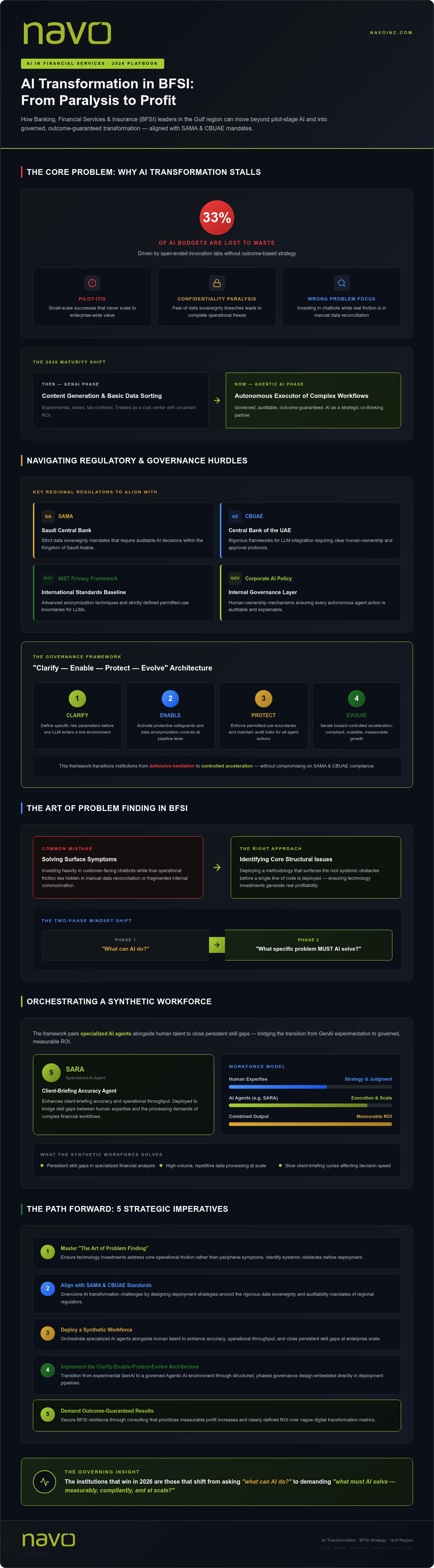
Data from global briefing reports indicates that approximately 33% of AI budgets are currently lost to waste. This inefficiency typically occurs when organizations fund open-ended innovation labs without a clear, outcome-based strategy. For financial leaders in Dubai and the wider Gulf region, this budget leakage is often the result of "pilot-itis," where small-scale successes fail to translate into enterprise-wide value. Transitioning from a utility-based mindset to one focused on systemic health requires a disciplined architectural response. It's about moving from the "what can AI do" phase to the "what specific problem must AI solve" phase to ensure resilience and measurable efficiency.
The Art of Problem Finding in BFSI
The primary reason most digital shifts fail is that they solve the wrong problems. In the high-stakes environment of Middle Eastern finance, surface-level symptoms often mask deeper structural issues. An institution might invest heavily in customer-facing chatbots while the true operational friction lies in manual data reconciliation or fragmented internal communication. To address these complexities, leaders must employ The Art of Problem Finding framework. This methodology prioritizes the identification of core systemic obstacles before a single line of code is deployed. By focusing on problem finding rather than just problem solving, executives can bypass the common AI transformation challenges in financial services and secure a pathway to genuine profitability.
Navigating Regulatory and Governance Hurdles
In the 2026 financial landscape, regulatory compliance is no longer a reactive checkbox but a foundational element of architectural design. For institutions operating under the jurisdiction of the Central Bank of the United Arab Emirates (CBUAE) or the Saudi Central Bank (SAMA), the primary AI transformation challenges in financial services often stem from a misalignment between rapid technological deployment and rigorous data sovereignty mandates. Navigating these complexities requires a robust Corporate AI Governance Policy that moves beyond generic digital guidelines. It's about establishing clear human-ownership mechanisms and approval protocols that ensure every action taken by an autonomous agent is auditable, explainable, and fully aligned with regional legal norms.
To bridge the gap between innovation and oversight, leaders should adopt the "Clarify-Enable-Protect-Evolve" architecture. This framework ensures that before any Large Language Models (LLMs) are integrated into live environments, the specific risk parameters are clarified and the protective safeguards are enabled. By prioritizing this structured approach, banks can transition from a state of defensive hesitation to one of controlled acceleration, ensuring that their AI initiatives are both resilient and compliant with the highest international and local standards.
Compliance by Design
Effective governance begins with data safeguards that align with the National Institute of Standards and Technology (NIST) Privacy Framework. Within the Banking, Financial Services, and Insurance (BFSI) sector, this involves implementing advanced anonymization techniques and strictly defined permitted-use boundaries for LLMs. By embedding these controls directly into the deployment pipeline, firms can mitigate the risks of data leakage while maintaining the high-speed processing capabilities that modern finance demands. If your institution is struggling to balance these competing priorities, a strategic review of your governance framework can provide the necessary clarity.
Governing the Agentic Era
As we move into an era dominated by synthetic workers, the focus of governance shifts toward managing risk-based decision paths. Unlike traditional software, autonomous agents require a dynamic oversight model that accounts for their evolving co-thinking capabilities. Establishing a transparent hierarchy of human-in-the-loop interventions is essential for maintaining systemic health and public trust. For a deeper analysis of these orchestration strategies, consult our executive reference on Mastering Agentic AI Services. This disciplined approach ensures that as your AI transformation challenges in financial services evolve, your governance structures remain sufficiently agile to protect the organization's integrity.
Orchestrating a Synthetic Workforce in Finance
The concept of a synthetic workforce represents the next evolutionary step in organizational design. It introduces a sophisticated layer of AI (Artificial Intelligence) agents that function not merely as software but as active participants in the institutional workflow. This transition is essential to address the AI transformation challenges in financial services, particularly the persistent gap between technological capability and operational throughput. By deploying specialized agents like SARA, firms can achieve unprecedented levels of client-briefing accuracy, ensuring that complex requirements are captured and processed without the traditional risk of human error.
Orchestration is managed through the "Six Lanes of Working" framework. This methodology optimizes human-machine collaboration by assigning specific cognitive and administrative tasks to the most efficient entity. For instance, NOVA serves as a project orchestration agent, maintaining momentum across cross-departmental initiatives by automating follow-ups and data synthesis. This shift from isolated pilot projects to a scalable, ROI (Return on Investment) driven architecture allows financial leaders in the Gulf to realize efficiency gains that were previously unattainable.
Operational Efficiency with AI Agents
Reducing the time-to-acceptance for complex financial products is a critical metric for 2026. By integrating agentic layers into the approval pipeline, banks can bypass traditional bottlenecks. These agents handle the heavy lifting of data verification and compliance cross-referencing, allowing human experts to focus on final decision-making. This systemic health approach ensures that the organization remains agile despite the increasing complexity of international finance.
SkillUp: Preparing the Human Workforce
A synthetic workforce is only as effective as the human leaders who guide it. Bridging the skill gap requires a commitment to rigorous, high-level education. Financial professionals must master the nuances of human-to-machine communication to maintain structural excellence. Our CPD Certified AI Course (Continuing Professional Development United Kingdom) provides the executive standard for this new era of leadership.
The Path Forward: Outcome-Guaranteed AI Strategy
Transitioning from experimental curiosity to systemic execution requires a fundamental redefinition of consulting engagement. In the 2026 landscape, the most effective way to address AI transformation challenges in financial services is through outcome-guaranteed models that prioritize structural excellence over vague digital promises. Financial leaders must demand a roadmap that links every technological shift to a measurable profit increase or efficiency gain. This disciplined approach ensures that the institution doesn't just adopt technology but integrates it as a core component of its competitive resilience.
A successful strategic roadmap prioritizes high-impact use cases where the synthesis of human intelligence and machine precision yields the highest return. It's about identifying the specific operational friction points that, once automated, catalyze broader organizational growth. C-suite (Chief Executive Level) leaders should begin with diagnostic tools and readiness surveys to establish a baseline of their current capabilities. This analytical rigor prevents budget waste and ensures that the transition from pilot to profit is both predictable and sustainable.
Measuring Transformation Success
Justifying enterprise-level spending on Artificial Intelligence (AI) requires the use of sophisticated Return on Investment (ROI) calculators. These tools move beyond simple cost-savings to capture the value of enhanced decision-making and accelerated workflows. Key Performance Indicators (KPIs) for synthetic worker productivity should include metrics such as decision accuracy, time-to-acceptance, and the reduction of manual reconciliation cycles. By quantifying these outputs, BFSI (Banking, Financial Services, and Insurance) organizations can build a compelling case for continued investment in agentic architectures.
Selecting a Strategic AI Partner
Selecting a partner for this journey requires a checklist that goes beyond the generic digital marathons often proposed by "Big 4" or "MBB" (McKinsey, BCG, and Bain) firms. Look for advisors who offer proprietary frameworks and a deep understanding of the regulatory nuances specific to the Gulf region. For a detailed roadmap on selecting the right expertise, consult The Executive Guide to GenAI Consulting. This strategic choice is the final piece of the puzzle in overcoming AI transformation challenges in financial services and securing long-term operational health.
Architecting the Future of Financial Resilience
The transition toward a fully autonomous operational layer is no longer a distant prospect but a current strategic imperative. Success in this era depends on moving beyond the "Problem Finding" deficit and establishing a governed framework that aligns with the rigorous standards of the Gulf's central banks. By integrating proprietary architectures like the SARA and NOVA agent frameworks, your institution can bypass common AI transformation challenges in financial services and secure a state of systemic health.
Navo Inc. provides the seasoned expertise required to navigate these high-stakes shifts. Our CPD UK-certified (Continuing Professional Development United Kingdom) leadership coaching and proven track record in Dubai ensure your executive team is equipped to lead a synthetic workforce with confidence. We focus on outcome-guaranteed strategies that ensure institutions shouldn't just adopt technology but must instead integrate Artificial Intelligence (AI) as a predictable engine for growth.
The path to 2026 is defined by those who prioritize structural excellence over digital trends. We're ready to partner with you to build a more resilient, AI-enabled future.
Frequently Asked Questions
What are the primary AI transformation challenges in financial services in 2026?
The primary AI transformation challenges in financial services involve navigating strict data residency regulations and overcoming a persistent "Problem Finding" deficit. Many institutions suffer from confidentiality paralysis, where fear of regulatory breach stalls innovation. Additionally, significant budget waste occurs when pilot programs are launched without a scalable architectural framework or a clear path to measurable Return on Investment (ROI).
How does Navo Inc. guarantee outcomes for financial AI consulting?
Navo Inc. guarantees outcomes by linking every consulting engagement to specific, measurable profit increases or operational efficiency gains. Unlike traditional models that prioritize billable hours, our framework-led approach ensures that Agentic AI (Artificial Intelligence) deployments are architected for systemic health. This results-driven methodology provides the C-suite (Chief Executive Level) with the financial predictability required for high-stakes digital shifts.
Is Agentic AI safe for use in highly regulated Gulf financial markets?
Agentic AI is entirely safe for Gulf markets when integrated through a "Compliance by Design" architecture that respects local sovereignty. By aligning deployments with the standards of the Saudi Central Bank (SAMA) and the Central Bank of the United Arab Emirates (CBUAE), institutions maintain rigorous auditability. A robust Corporate AI Governance Policy ensures that human-ownership mechanisms remain central to every autonomous decision path.
What is the "Art of Problem Finding" and why is it critical for finance?
The "Art of Problem Finding" is a proprietary framework that prioritizes the identification of core systemic obstacles before any technological solution is applied. In the Banking, Financial Services, and Insurance (BFSI) sector, leaders often solve surface symptoms while ignoring deeper structural friction. This framework is critical because it ensures that AI transformation challenges in financial services are addressed at their root, preventing the waste of capital on misaligned tools.
How can a synthetic workforce improve banking operational efficiency?
A synthetic workforce improves efficiency by deploying specialized agents like SARA and NOVA to manage complex, data-heavy workflows with absolute precision. These agents function as an autonomous operational layer, reducing time-to-acceptance for financial products and ensuring client-briefing accuracy. This orchestration allows human talent to shift their focus toward high-value strategic thinking, significantly increasing the institution's overall cognitive and operational throughput.
Disclaimer
The views and opinions expressed in this article are those of the author and do not represent any organisation, client, institution, or professional body with which he may be associated. The content is intended for general information, education, and thought leadership. Readers should seek appropriate professional advice before making legal, financial, investment, regulatory, technology, or business decisions.
The author has taken reasonable care to ensure the accuracy of the information and sources available at the time of publication. Technologies, regulations, market conditions, and industry practices may evolve, and readers are encouraged to verify current information independently. Any examples, cases, or scenarios may have been simplified, anonymised, or adapted to protect confidentiality. The author and publisher accept no liability for decisions or outcomes arising from the use of this content.
Generative AI tools may have been used to support research, structuring, or language refinement, with the final content, judgment, and editorial responsibility retained by the author.