

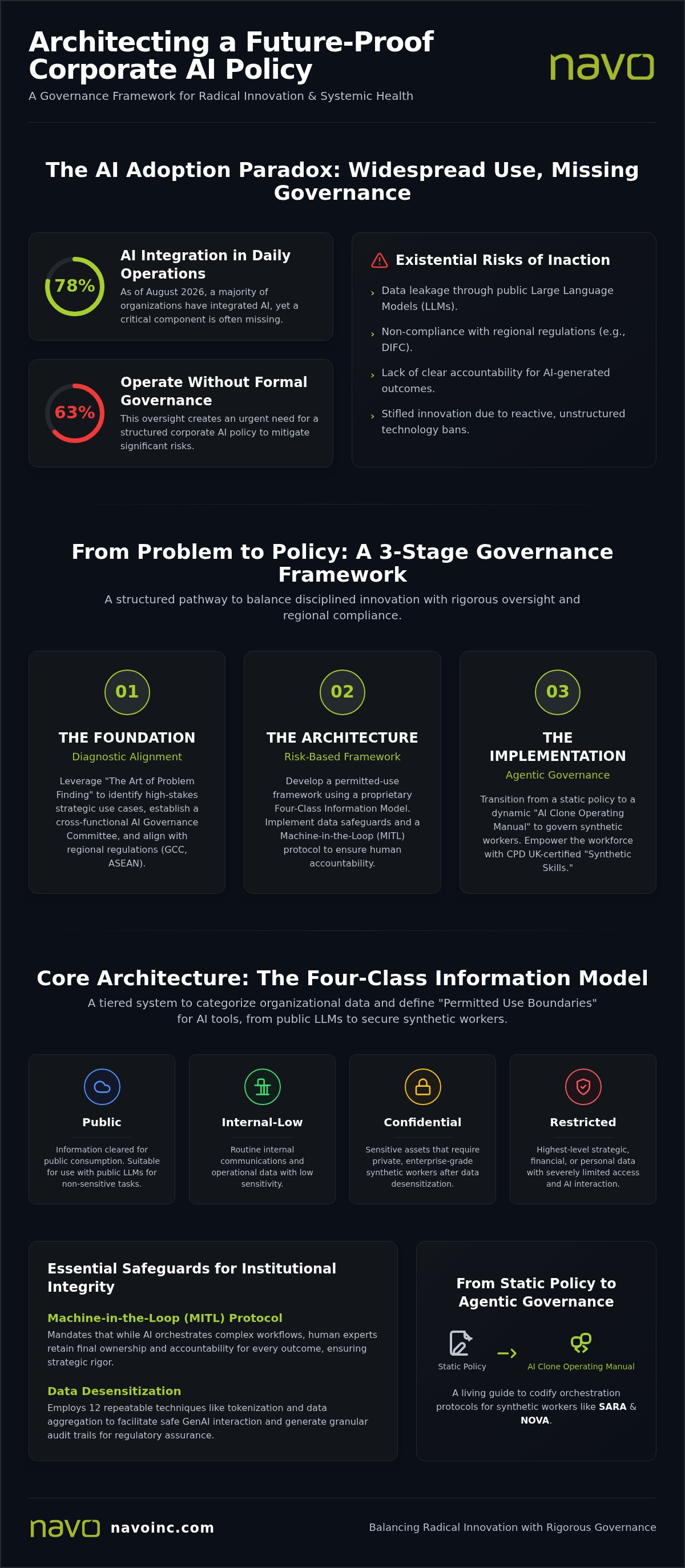
While 78% of organizations have integrated artificial intelligence into their daily operations as of August 2026, a staggering 63% are still operating without a formal governance structure. This oversight makes learning how to write a corporate AI policy an urgent priority to prevent data leakage through public Large Language Models (LLMs) and ensure compliance within the Dubai International Financial Centre (DIFC). Lack of clear accountability for AI-generated outcomes presents an existential risk to organizational stability and systemic health.
You likely recognize that reactive bans on technology stifle the very innovation required to remain competitive in the Middle East and ASEAN (Association of Southeast Asian Nations) markets. This guide provides a sophisticated framework to align corporate strategy with rigorous governance. We'll explore the "Art of Problem Finding" to identify systemic risks and establish a tiered usage model that prepares your workforce for synthetic workers like SARA and NOVA. By the end of this article, you'll master the architecture of a future-proofed policy that balances radical innovation with regional regulatory requirements.
Key Takeaways
- Leverage "The Art of Problem Finding" to identify where AI orchestration creates high-stakes strategic value rather than mere incremental efficiency.
- Master how to write a corporate AI policy that utilizes a proprietary Four-Class Information Model to secure sensitive data while enabling radical innovation.
- Evolve from static documentation to active orchestration by adopting an AI Clone Operating Manual for the deployment of synthetic workers like SARA and NOVA.
- Ensure rigorous compliance with UAE and ASEAN (Association of Southeast Asian Nations) regulations by equipping your workforce with CPD (Continuing Professional Development) UK-certified synthetic skills.
The Foundation: Diagnostic Alignment and the Art of Problem Finding
A corporate AI policy is not a static list of prohibitions; it is a living governance framework that calibrates Generative Artificial Intelligence (GenAI) capabilities with the organization’s specific risk appetite. Mastering how to write a corporate AI policy is essential since only 37% of organizations currently have formal governance in place, according to 2026 industry data. This gap necessitates moving beyond superficial adoption toward the "Art of Problem Finding." This proprietary framework allows leaders to identify high-stakes use cases where AI creates strategic consequence rather than just marginal efficiency gains. To lead this structural shift, organizations must establish a cross-functional AI Governance Committee (AIGC). This body, comprising Legal, Information Technology (IT), and Business Transformation leads, ensures that every deployment aligns with the broader corporate vision while maintaining systemic health through professional GenAI Consulting & Coaching.
Strategic Scoping for Regional Compliance
Effective policy architecture must account for the increasingly complex global regulatory landscape for AI. For enterprises operating within the Gulf Cooperation Council (GCC), this involves aligning objectives with the Saudi Data and AI Authority (SDAIA) and Singapore’s Model AI Governance Framework to maintain cross-border interoperability. Organizations should conduct an initial readiness survey to bridge the gap between executive ambition and frontline technical execution. This diagnostic phase distinguishes between internal productivity enhancements and the deployment of customer-facing agentic AI services, such as synthetic workers like SARA or NOVA. Establishing these boundaries ensures that radical innovation doesn't outpace the firm's capacity for rigorous oversight or regional compliance. It's about creating a roadmap that moves from vague experimentation to structured, outcome-guaranteed transformation.
The Architecture: Developing a Risk-Based Permitted-Use Framework
Building on the diagnostic work of the previous phase, the architecture of a robust policy relies on Navo’s proprietary Four-Class Information Model. This system categorizes organizational data into Public, Internal-Low, Confidential-Transformable, and Restricted tiers. When determining how to write a corporate AI policy, leaders must define rigid "Permitted Use Boundaries" that differentiate between open tools and secure environments. Public Large Language Models (LLMs) may suffice for non-sensitive tasks, but Confidential-Transformable assets require private, enterprise-grade synthetic workers. To maintain systemic health, we implement a Machine-in-the-Loop (MITL) protocol. This mandate ensures that while AI orchestrates complex workflows, human experts retain final ownership of every outcome. This methodology mirrors the strategic rigor found in this ten-step guide for developing an AI policy, ensuring that accountability remains a board-level priority.
Data Safeguards and Desensitization Protocols
Protecting institutional integrity requires sophisticated technical interventions. We mandate 12 repeatable desensitization techniques, such as tokenization and data aggregation, to facilitate safe interaction with Generative Artificial Intelligence (GenAI). These protocols generate the granular audit trails necessary for AI-driven decision-making, satisfying the stringent assurance requirements of Dubai’s regulatory environment. Our "Clarify-Enable-Protect-Evolve" framework provides the resilience needed as technology shifts toward autonomous agency. Firms seeking to transition from conceptual safety to operational profit should consider a bespoke governance review to secure their architecture. This structured pathway ensures that your policy isn't just a defensive shield but a catalyst for disciplined, radical innovation.
Implementation: From Static Policy to Agentic Governance
The final stage in mastering how to write a corporate AI policy involves shifting from a static document to an operational "AI Clone Operating Manual." This manual serves as the definitive structural guide for deploying synthetic workers like SARA and NOVA. It's not enough to simply permit use; organizations must codify the specific orchestration protocols that govern autonomous agents. To support this transition, we roll out Continuing Professional Development (CPD) UK-certified masterclasses. These sessions ensure the workforce possesses the "Synthetic Skills" required for responsible and effective AI partnership. By certifying these competencies, enterprises establish a verifiable benchmark for workforce literacy that exceeds generic industry standards.
When refining how to write a corporate AI policy for long-term success, we integrate specific Return on Investment (ROI) calculators and performance targets directly into the governance framework. This allows the AI Governance Committee (AIGC) to measure the strategic consequence of AI deployments in real-time. If an agentic workflow doesn't meet its efficiency or safety benchmarks, the policy provides the diagnostic tools necessary for immediate recalibration.
Ensuring Long-Term Resilience and Accountability
Resilience is maintained through scheduled quarterly reviews. These audits account for the rapid evolution of Agentic AI and updated global standards, such as the August 2026 enforcement of the European Union (EU) AI Act’s transparency obligations. We incorporate "Approval Gates" for high-stakes agents to mitigate autonomous drift or hallucination risks. Finally, we link policy adherence to corporate performance metrics and leadership Key Performance Indicators (KPIs). This ensures that AI governance is not a peripheral IT concern but a core component of executive accountability.
Architecting the Future of Agentic Orchestration
Establishing a sophisticated governance layer isn't a peripheral Information Technology (IT) function; it's a core strategic imperative for United Arab Emirates (UAE) enterprises. Applying the "Art of Problem Finding" allows your organization to identify high-stakes opportunities for synthetic workers while maintaining data integrity. You've explored the Four-Class Information Model and the transition to operational AI Clone Operating Manuals. Mastering how to write a corporate AI policy ensures your firm remains resilient against regulatory shifts and autonomous drift. Navo Inc. provides outcome-guaranteed strategy consulting and CPD (Continuing Professional Development) UK-certified masterclasses to bridge the gap between policy and profit. With proprietary Agentic AI Governance frameworks, your leadership can confidently navigate the 2026 technological landscape.
The path to systemic health and radical innovation starts with a single, disciplined step toward structural excellence.
Frequently Asked Questions
What are the essential components of a 2026 Corporate AI Policy?
A robust 2026 policy integrates a risk-based permitted-use framework with Navo’s Four-Class Information Model. It defines clear boundaries between public tools and private synthetic workers like SARA or NOVA. Essential components include data desensitization protocols, Machine-in-the-Loop (MITL) accountability, and a feedback loop linked to Return on Investment (ROI) targets. Understanding how to write a corporate AI policy requires moving beyond simple bans to structured orchestration.
How do Dubai and Singapore regulations impact AI policy drafting?
Organizations must align their policies with the Dubai International Financial Centre (DIFC) Data Protection Law and Singapore’s Model Artificial Intelligence (AI) Governance Framework. These jurisdictions prioritize transparency, cross-border data flow security, and algorithmic accountability. Drafting a policy for these markets involves implementing rigorous audit trails to satisfy regional assurance requirements. This ensures your governance structure remains compliant while enabling radical innovation across the Gulf Cooperation Council (GCC) and Association of Southeast Asian Nations (ASEAN) regions.
What is the difference between a 'Human-in-the-Loop' and 'Machine-in-the-Loop' approach?
Human-in-the-Loop involves active human intervention during the processing stage to correct individual outputs. In contrast, Machine-in-the-Loop (MITL) focuses on agentic orchestration where AI handles complex workflows while humans maintain final ownership of outcomes. MITL is the preferred standard for the Agentic Era. It allows synthetic workers to operate autonomously within predefined boundaries while ensuring institutional integrity remains under executive control.
How can we safely use confidential data with Generative AI tools?
Safe interaction with Generative Artificial Intelligence (GenAI) requires 12 repeatable desensitization techniques, including tokenization and data aggregation. These protocols ensure that confidential information is transformed before it interacts with Large Language Models (LLMs). By using private, enterprise-grade instances rather than public platforms, firms prevent data leakage. This structured approach is a foundational element when determining how to write a corporate AI policy for high-stakes environments.
Why is a CPD-certified AI course necessary for policy implementation?
Policy implementation fails without a workforce equipped with "Synthetic Skills." Continuing Professional Development (CPD) UK-certified masterclasses provide a verifiable benchmark for leadership and employee literacy. These courses move beyond basic tool usage to teach the strategic orchestration of synthetic workers. Certification ensures that accountability measures defined in your policy are understood and applied consistently across the entire organization.
What is the role of the Art of Problem Finding in AI governance?
The "Art of Problem Finding" is a proprietary framework used to identify use cases with significant strategic consequence. In AI governance, it prevents organizations from wasting resources on marginal efficiency gains. By diagnosing the root challenges of an enterprise, leaders can align their AI policy with high-impact goals. This ensures that the deployment of synthetic workers like SARA and NOVA results in measurable profit and structural excellence.
Disclaimer
The views and opinions expressed in this article are those of the author and do not represent any organisation, client, institution, or professional body with which he may be associated. The content is intended for general information, education, and thought leadership. Readers should seek appropriate professional advice before making legal, financial, investment, regulatory, technology, or business decisions.
The author has taken reasonable care to ensure the accuracy of the information and sources available at the time of publication. Technologies, regulations, market conditions, and industry practices may evolve, and readers are encouraged to verify current information independently. Any examples, cases, or scenarios may have been simplified, anonymised, or adapted to protect confidentiality. The author and publisher accept no liability for decisions or outcomes arising from the use of this content.
Generative AI tools may have been used to support research, structuring, or language refinement, with the final content, judgment, and editorial responsibility retained by the author.