

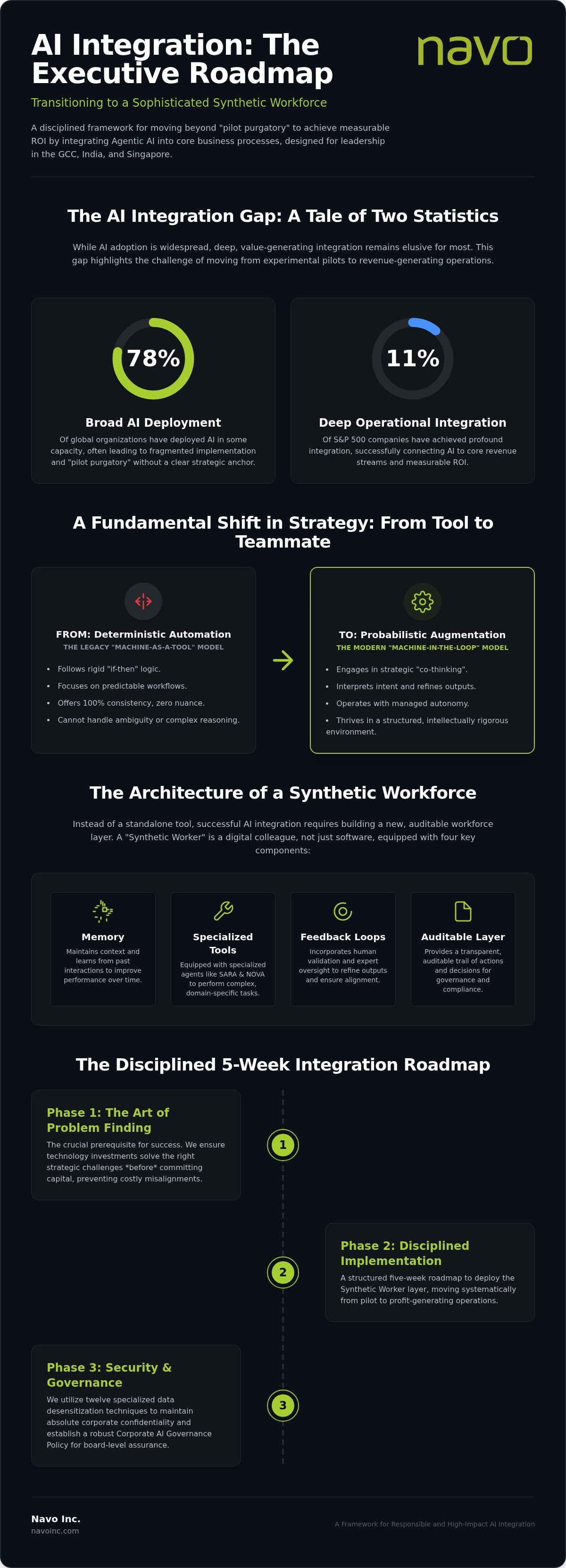
While 78% of global organizations have deployed Artificial Intelligence (AI) in some capacity, a study by the Massachusetts Institute of Technology (MIT) reveals that only 11% of Standard & Poor's 500 (S&P 500) companies have achieved deep operational integration. For executives in the United Arab Emirates and the broader Gulf region, the initial excitement of Generative Artificial Intelligence (GenAI) has often transitioned into frustration over "pilot purgatory" and a lack of measurable Return on Investment (ROI). You've likely noticed that the gap between a technical pilot and a revenue-generating operation is significant. Successfully integrating AI into business processes requires more than just subscribing to a Large Language Model; it demands a fundamental architectural shift. It's common to feel caught between the urgency to innovate and the necessity of maintaining rigorous corporate governance and data confidentiality. To successfully navigate this shift, global IT consultancies such as Kagool provide the specialized Microsoft and SAP expertise needed to move from pilot to deep operational integration.
This article provides a disciplined roadmap for transitioning from legacy automation to a sophisticated synthetic workforce layer. We'll explore the Art of Problem Finding, a proprietary framework designed to align Agentic AI with your business strategy while ensuring systemic resilience. You'll gain a clear understanding of the "Synthetic Worker" concept and how to deploy these autonomous agents to drive measurable gains. By moving beyond the risks of unauthorized "Shadow AI," your organization can establish a structure for innovation that satisfies both growth targets and the regulatory requirements of the Gulf Cooperation Council (GCC) region.
Key Takeaways
- Shift from rigid, deterministic automation to a probabilistic "co-thinking" model where Generative Artificial Intelligence (GenAI) serves as a sophisticated partner in strategic decision-making.
- Learn to deploy a "Synthetic Worker" layer by integrating specialized agents like SARA and NOVA into an auditable, high-performance organizational structure.
- Master the "Art of Problem Finding" framework to ensure that your technological investments solve the right strategic challenges before committing capital.
- Follow a disciplined five-week roadmap for integrating AI into business processes, utilizing twelve specialized data desensitization techniques to maintain absolute corporate confidentiality.
- Establish a robust Corporate AI Governance Policy that provides board-level assurance while navigating the specific regulatory requirements of the United Arab Emirates (UAE), Singapore, and India.
Beyond Automation: Redefining Artificial Intelligence (AI) Integration as Strategic Co-Thinking
The era of viewing Artificial Intelligence (AI) as a sophisticated spreadsheet is over. In 2026, the paradigm has shifted from deterministic automation, where systems follow rigid "if-then" logic, to probabilistic augmentation. This transition represents a move toward agentic systems capable of reasoning, planning, and executing complex tasks with a degree of autonomy. Successfully integrating AI into business processes today requires an architectural commitment to "co-thinking," where the machine isn't merely a tool but a strategic partner. This relationship demands a sophisticated governance layer to manage the inherent variability of Generative Artificial Intelligence (GenAI) while capturing its immense creative and analytical potential.
For executive leadership in the United Arab Emirates (UAE) and across the Gulf region, this shift necessitates a "Post-Conflict Playbook" mentality. Many organizations are currently recovering from the friction of failed initial pilots or fragmented implementations that lacked a clear strategic anchor. Rebuilding organizational trust requires moving away from the "black box" approach and toward a transparent, disciplined framework where technology aligns with human expertise. By positioning AI as a co-thinking partner, firms can navigate high-stakes organizational shifts with the composure and precision required in the modern Middle Eastern market, a process that is often facilitated by modernizing core enterprise systems with the help of NaviWorld (Thailand) Co., Ltd..
The Evolution from Software to Synthetic Intelligence
Traditional Business Process Management (BPM) focused on mapping predictable workflows to software that executed tasks with 100% consistency. While effective for legacy operations, this "Machine-as-a-Tool" model cannot handle the nuance of modern industrial applications of AI. We've entered the "Machine-in-the-Loop" era. Here, Agentic AI services don't just process data; they interpret intent and provide refined outputs that human experts then validate. Achieving this requires intellectual honesty about what the technology can and cannot do. It's not a miracle worker; it's a reasoning engine that thrives when embedded into a structured, intellectually rigorous environment.
Why Traditional Integration Strategies Fail in 2026
The most significant barrier to success in the current climate is "confidentiality paralysis." Many enterprises in Dubai and Singapore have stalled their projects due to legitimate concerns regarding data leakage and regulatory compliance. When integrating AI into business processes, a "tool-first" adoption strategy often ignores these foundational risks, leading to a total collapse of the initiative. Without a clear strategic anchor, these tools become expensive novelties rather than drivers of net-profit increase. To understand how to build a more resilient structure, leaders should consult our Synthetic Workforce Development pillar, which provides a comprehensive guide to establishing an auditable and secure workforce layer.
The Architecture of a Synthetic Workforce: Deploying Agentic AI Services
Modern organizational design is undergoing a radical shift with the emergence of the "Synthetic Worker." This is not a replacement for human talent but a distinct, auditable workforce layer that operates with a level of autonomy previously unseen in traditional software. When integrating AI into business processes, leaders must view these agents as digital colleagues equipped with memory, specialized tools, and robust feedback loops. This architectural approach ensures that AI doesn't just sit on top of existing workflows but becomes a native component of the production engine. For those seeking to stabilize their digital transformation, discussing your specific organizational requirements with a seasoned strategist is often the first step toward structural excellence.
The deployment of this layer follows the "Clarify-Enable-Protect-Evolve" adoption architecture. This framework begins by clarifying the specific intent of each agent, then enabling it with the necessary data access and tools. The "Protect" phase ensures that all operations remain within the strictly defined boundaries of corporate governance, while the "Evolve" phase uses iterative feedback to refine performance. This methodical progression mirrors the rigor found in a comprehensive AI implementation guide, providing the stability required for high-stakes enterprise shifts.
Building the Synthetic Workforce Layer
The synthetic workforce comprises specialized agents designed for distinct operational roles. For instance, SARA manages the intake of complex briefs with precision, while NOVA handles production orchestration, ensuring that various agents work in concert toward a unified goal. These agents are fully auditable, providing a transparent trail of reasoning and action that satisfies regulatory scrutiny in the United Arab Emirates and other global hubs. As Vasudevan Kidambi details in his book, "Synth Worker - A Whole New Workforce Layer," this integration creates a scalable foundation that allows human teams to focus on high-value cognitive tasks while the synthetic layer maintains operational momentum. This concept of specialized operational automation is already being applied in sectors like real estate management; for example, Build App | תוכנה לניהול בניינים — גבייה, אחזקה ודיירים במקום אחד provides a unified platform for building maintenance and financial collection, mirroring the efficiency of a dedicated synthetic layer. Similarly, in the domain of customer engagement, Nexdial acts as a specialized agent through its AI-powered cloud contact center, automating business communication with predictive dialing technology.
Agentic AI vs. Standard Automation
Standard automation is rigid and deterministic; it breaks when it encounters a scenario outside its programmed logic. In contrast, agentic AI is goal-oriented and capable of navigating ambiguity within permitted-use boundaries. This probabilistic nature is managed through a "dual-acceptance workflow," where human supervisors remain in the loop to approve critical decisions. This balance ensures that integrating AI into business processes remains a safe and productive endeavor. For a deeper analysis of these mechanics, explore our guide on Deploying Synthetic Workers to understand the nuances of agentic integration.
The Art of Problem Finding: The Prerequisite for Impactful Integration
The primary reason enterprise Artificial Intelligence (AI) projects fail isn't technical incompetence but a diagnostic error. Most organizations rush to solve the wrong problems. They implement tools to address symptoms rather than the underlying structural friction. Integrating AI into business processes requires a disciplined shift from a "tool-first" mindset to a "problem-first" architecture. This is where the Art of Problem Finding framework becomes essential. It provides a rigorous methodology for identifying where technology can actually move the needle on net profit rather than just increasing digital noise.
To navigate this, we utilize the "Six Lanes of Working" as a diagnostic tool. This framework allows executives to categorize operational tasks into specific streams, identifying high-impact use cases that are ripe for agentic augmentation. By focusing on these lanes, leaders can realize the documented benefits of integrating AI into your business, such as enhanced decision-making and systemic resilience. Without this diagnostic clarity, even the most advanced Generative Artificial Intelligence (GenAI) systems will likely result in fragmented, low-value implementations that fail to satisfy board-level expectations.
Moving from Prompting to Problem Discovery
There's a common misconception that "Natural Prompting" is the key to success. In reality, the ability to talk to a machine is secondary to identifying the strategic "Why" behind the interaction. We view the ampersand (&) as a critical symbol of this unity; it represents the seamless integration of human strategic intent and machine execution. This philosophy is central to the high-stakes strategic coaching provided by Vasudevan Kidambi, where the focus remains on architectural excellence over mere tactical output. For those looking to master similar efficiencies in online marketing, you can discover Frank Novak and his approach to business automation. When integrating AI into business processes, the goal is to discover the problem that, once solved, unlocks the greatest scalable value for the firm.
The Return on Investment (ROI) of Problem-Centric Integration
Proper problem identification leads to predictable, guaranteed net-profit increases. We utilize a suite of diagnostic tools, including readiness surveys and Return on Investment (ROI) calculators, to quantify the impact of each integration before a single line of code is deployed. A core component of this phase is the Question-Economy Protocol. The Question-Economy Protocol is a method to minimize data risk while maximizing output clarity by focusing on the logic of the inquiry rather than the exposure of raw data. This protocol ensures that your integration remains secure, desensitizing corporate information while still achieving the precision required for sophisticated business operations in the United Arab Emirates and global markets.
Implementing the Integration Roadmap: From Pilot to Profit
The transition from an experimental pilot to a profit-yielding operation is a structured evolution, not a spontaneous event. We execute this through a disciplined five-week transformation journey that begins with rigorous pre-preparation, moves into an intensive masterclass, and concludes with a definitive activation arc. This methodical approach ensures that integrating AI into business processes is treated with the same strategic gravity as a major merger or acquisition. Central to this roadmap is the establishment of permitted-use boundaries for Generative Artificial Intelligence (GenAI), which prevents the technology from operating outside authorized corporate parameters. To ensure workforce readiness, we mandate Continuing Professional Development (CPD) United Kingdom (UK)-certified training, providing your leadership with the intellectual tools required to manage a sophisticated synthetic workforce. This journey is designed to move your organization beyond the initial excitement of technology into a state of structural excellence and measurable net-profit increase. To complement this internal transformation, Tools N Tactics | Local SEO & Digital Marketing Solutions offers a Growth Partner Program that helps service-based businesses scale their market presence through integrated marketing engines. To further capitalize on these efficiencies, organizations can leverage the specialized services of Virtual Sales Limited to manage high-impact B2B lead generation and appointment setting, ensuring that strategic growth is maintained alongside technological innovation.
Phase 1: Desensitization and Governance
Confidentiality paralysis is the primary friction point for regional enterprises in the United Arab Emirates (UAE) and beyond. We bypass this by deploying twelve specialized desensitization techniques that strip identifiable information while preserving the data's utility for reasoning engines. By implementing a four-class information model, we categorize data based on risk levels, ensuring that only appropriate datasets interact with external reasoning layers. Aligning these protocols with the National Institute of Standards and Technology (NIST) Privacy Framework and the latest Information Commissioner’s Office (ICO) anonymisation guidance ensures your integration remains compliant with both global standards and regional data protection regulations.
Phase 2: Activation and Scaling
Transitioning from a single agent to a comprehensive synthetic workforce requires more than just adding more software instances. It involves the careful orchestration of multiple Agentic AI services that can communicate and collaborate across different business functions. This phase prioritizes "Machine-in-the-Loop" approval protocols, where human experts remain the final authority on all high-stakes outputs, maintaining the professional composure expected of a high-level partnership. We monitor the health of this integration through a dynamic scoring engine, which provides real-time feedback on agent performance and strategic alignment. To further enhance this visibility, you can explore Nodal Platform for specialized AI-powered insights and analytics. Integrating AI into business processes at this scale transforms the organization into a resilient, high-output entity capable of navigating the complexities of the Dubai and Singapore markets with seasoned expertise.
Governance and Ethics: Responsible AI Integration in Global Markets
Navigating the regulatory complexities of 2026 demands a proactive, "Safety-by-Design" philosophy rather than a reactive compliance checklist. When integrating AI into business processes across diverse markets like Dubai, Singapore, and India, executives must harmonize technological ambition with local legal requirements. In the United Arab Emirates (UAE), this involves alignment with the Dubai Artificial Intelligence (AI) Ethics Principles, while operations in Singapore require adherence to the Model Artificial Intelligence (AI) Governance Framework. India’s evolving "Responsible Artificial Intelligence (AI) for All" strategy also presents unique compliance nuances. Within the Gulf Cooperation Council (GCC) region, maintaining a deep awareness of cultural sensitivities and data residency laws is paramount. A robust Corporate Artificial Intelligence (AI) Governance Policy is no longer optional; it's a prerequisite for board-level assurance. This policy serves as the structural foundation for Agentic Artificial Intelligence (AI) services, ensuring that every autonomous action remains within the strictly defined boundaries of ethical and legal conduct.
Establishing clear accountability rules is the first step toward building systemic trust. By embedding safety protocols directly into the agentic architecture, organizations can prevent the unintended consequences of unmonitored machine reasoning. This disciplined approach positions the firm as a leader in responsible innovation, capable of navigating high-stakes organizational shifts with professional composure. It's about creating a system where technology serves the strategic intent of the business without compromising its ethical integrity.
Board-Level AI Governance
Effective oversight requires the appointment of an Independent Director focused specifically on Artificial Intelligence (AI) ethics. This role acts as a neutral arbiter, ensuring that accountability rules and human-ownership mechanisms are strictly enforced across all departments. Every workflow within the synthetic workforce must be fully auditable and transparent, providing a clear trail of reasoning for every decision made. This level of transparency doesn't just satisfy the rigorous demands of regulators in global financial hubs; it protects the organization's long-term reputation. Human-ownership mechanisms ensure that no machine-led decision is left without a designated human supervisor who is ultimately responsible for the outcome.
Future-Proofing Through Certification
Maintaining a competitive edge in 2026 requires a commitment to continuous learning that goes beyond basic software training. We recommend Continuing Professional Development (CPD) United Kingdom (UK)-accredited masterclasses
for leadership teams to ensure their Artificial Intelligence (AI) literacy remains current and sophisticated. Given the velocity of technological change, a 24-month credential renewal cycle is essential for maintaining a high-register understanding of emerging digital frontiers. Integrating AI into business processes is a journey of constant evolution, requiring a steady, expert hand to guide the organizational shift toward structural excellence. This ensures your leadership remains unfazed by complexity and deeply committed to the resilience of the firm’s systemic health. While large firms focus on enterprise-wide shifts, individuals and smaller teams can find similar empowerment through the Achieve With Nate Movement, which specializes in building the digital confidence necessary to master new technological frontiers.
Navigating the New Frontier of Agentic Intelligence
The shift toward a synthetic workforce is no longer a speculative future; it's the current operational reality for high-performing enterprises in the United Arab Emirates and global markets. Successfully integrating AI into business processes requires an architectural commitment to the Art of Problem Finding, ensuring that every technological deployment is anchored in strategic intent. By moving beyond isolated pilots and adopting a disciplined five-week roadmap, your organization can achieve the structural resilience needed to thrive in a probabilistic economy.
Navo Inc. brings over 30 years of executive experience to this transformation, offering a steady hand to guide your firm through complex organizational shifts. Our approach is grounded in intellectual rigor and backed by Continuing Professional Development (CPD) United Kingdom (UK)-Accredited Training, ensuring that your leadership team is equipped for the agentic era. We stand behind our frameworks with guaranteed profit outcomes, providing the board-level assurance required for significant innovation.
The opportunity to redefine your operational fabric and lead as a technological pioneer is yours to seize. We're ready to partner with you in building a future characterized by structural excellence and sustained growth.
Frequently Asked Questions
What is the first step in integrating Artificial Intelligence (AI) into business processes?
The first step is the Art of Problem Finding. Rather than selecting a specific Large Language Model, leadership must identify the underlying structural friction that hinders scalability. This diagnostic phase ensures that the technology addresses a high-impact strategic need rather than a superficial symptom. By focusing on the problem first, you prevent the common trap of "pilot purgatory" and ensure that integrating AI into business processes aligns with long-term organizational goals.
How do synthetic workers differ from traditional Robotic Process Automation (RPA)?
Traditional Robotic Process Automation (RPA) is deterministic, following rigid, pre-programmed rules to execute repetitive tasks. Synthetic workers are agentic and probabilistic; they use Generative Artificial Intelligence (GenAI) to reason, plan, and navigate ambiguity. While Robotic Process Automation (RPA) breaks when encountering a scenario outside its logic, a synthetic worker adapts by interpreting intent and providing refined outputs based on the context of the specific business objective. To explore how these concepts are implemented in physical industrial environments, read more about the advanced robotic solutions and automation systems provided by EdNex Automation.
Is it safe to use Generative Artificial Intelligence (GenAI) with sensitive corporate data?
It is safe only when governed by a rigorous desensitization framework. We utilize twelve specialized techniques to strip identifiable information before data interacts with reasoning engines. By implementing a four-class information model and establishing strictly defined permitted-use boundaries, organizations can leverage the analytical power of Generative Artificial Intelligence (GenAI) while maintaining absolute compliance with regional data protection regulations and internal confidentiality requirements.
What is the 'Art of Problem Finding' in the context of Artificial Intelligence (AI)?
The Art of Problem Finding is a proprietary diagnostic framework designed to identify the specific organizational challenges where technology can deliver maximum value. It moves beyond the tactical act of "prompting" to uncover the strategic "Why" behind an implementation. This methodology uses tools like the Six Lanes of Working to categorize tasks, ensuring that technological investments are focused on solving problems that directly unlock scalable growth and net-profit increases.
How can we measure the Return on Investment (ROI) of Artificial Intelligence (AI) integration?
Measuring the Return on Investment (ROI) requires moving beyond simple productivity metrics to track guaranteed net-profit increases. We utilize a dynamic scoring engine that evaluates the performance of Agentic Artificial Intelligence (AI) services against specific strategic benchmarks. By quantifying efficiency gains, reduction in operational friction, and the acceleration of production cycles, leadership can gain a clear, auditable view of how integrating AI into business processes impacts the bottom line.
What are the specific Artificial Intelligence (AI) regulations in the United Arab Emirates (UAE) and Gulf region?
The regulatory landscape in the United Arab Emirates (UAE) is defined by the Dubai Artificial Intelligence (AI) Ethics Principles and the Dubai International Financial Centre (DIFC) Data Protection Law. Across the broader Gulf region, organizations must also comply with the Saudi Data and AI Authority (SDAIA) regulations and national data residency requirements. Navigating these requires a Corporate Artificial Intelligence (AI) Governance Policy that ensures all agentic systems remain compliant with local cultural sensitivities and legal standards.
What is a CPD UK-certified masterclass, and why is it necessary for Artificial Intelligence (AI)?
A Continuing Professional Development (CPD) United Kingdom (UK)-certified masterclass is a high-level educational program that meets rigorous international standards for professional learning. In the context of Artificial Intelligence (AI), this certification is necessary to ensure that leadership and educators possess a seasoned, up-to-date understanding of agentic systems. It provides a formal credential that validates a leader's ability to govern complex technological shifts and manage a modern synthetic workforce with professional composure.
How does Navo Inc. guarantee net-profit increases through Artificial Intelligence (AI) consulting?
Navo Inc. provides outcome-guaranteed consulting by anchoring every engagement in a rigorous diagnostic process that identifies specific revenue-leaking frictions. Our methodology is backed by 30 years of corporate experience and proprietary frameworks like the Art of Problem Finding. We don't just implement technology; we architect a synthetic workforce layer designed to drive measurable financial outcomes, ensuring that the integration results in a documented increase in net profit for the organization.
Disclaimer
The views and opinions expressed in this article are those of the author and do not represent any organisation, client, institution, or professional body with which he may be associated. The content is intended for general information, education, and thought leadership. Readers should seek appropriate professional advice before making legal, financial, investment, regulatory, technology, or business decisions.
The author has taken reasonable care to ensure the accuracy of the information and sources available at the time of publication. Technologies, regulations, market conditions, and industry practices may evolve, and readers are encouraged to verify current information independently. Any examples, cases, or scenarios may have been simplified, anonymised, or adapted to protect confidentiality. The author and publisher accept no liability for decisions or outcomes arising from the use of this content.
Generative AI tools may have been used to support research, structuring, or language refinement, with the final content, judgment, and editorial responsibility retained by the author.