

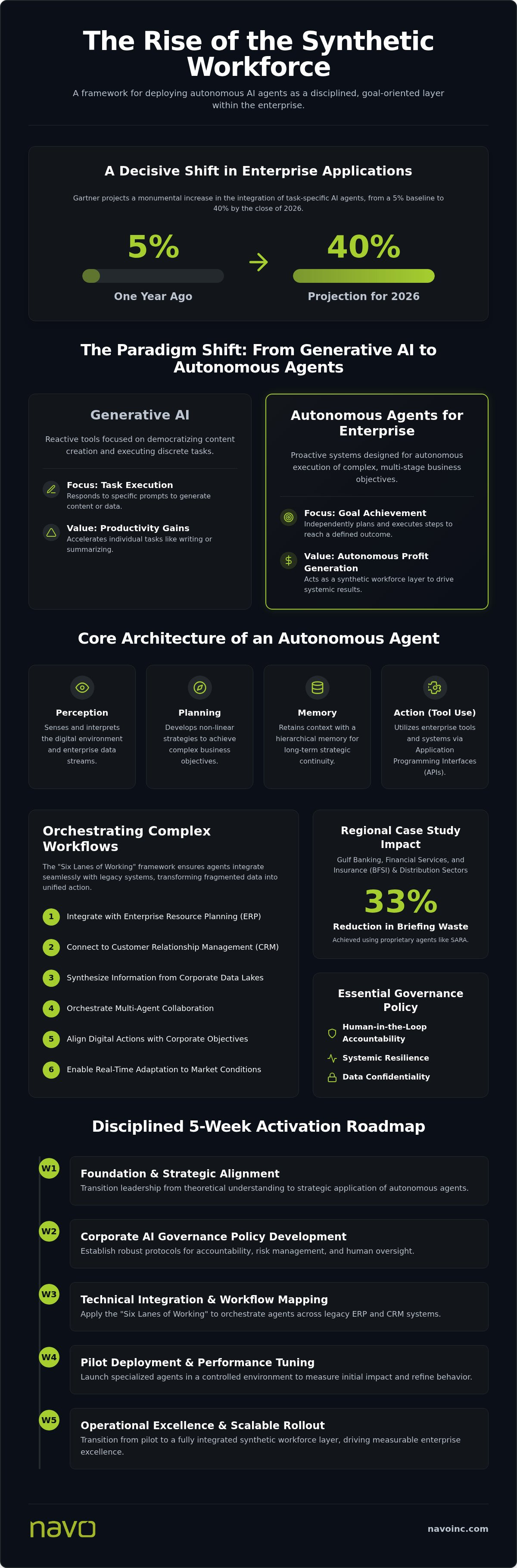
By the close of 2026, Gartner projects that 40% of enterprise applications will integrate task-specific AI agents, marking a decisive shift from the 5% baseline recorded just one year ago. This rapid proliferation of autonomous agents for enterprise signifies a transition from reactive digital assistants toward a sophisticated synthetic workforce layer capable of independent goal execution. Many executive teams across Dubai and the Gulf region currently find themselves at a strategic impasse, navigating the tension between the necessity of innovation and the paralysis caused by data confidentiality risks or the absence of clear ROI.
We recognize that the transition from experimental AI pilots to a scalable, profit-driving architecture requires more than just technical integration. This article outlines a rigorous framework for deploying a synthetic workforce that acts as a disciplined co-thinking partner. You will gain a comprehensive understanding of how to implement robust governance policies and human-in-the-loop protocols that transform fragmented tools into a unified engine for measurable enterprise excellence.
Key Takeaways
- Identify the critical evolution from task-based generative AI to goal-oriented autonomous agents for enterprise, establishing a permanent synthetic workforce layer within your organization.
- Apply the "Six Lanes of Working" framework to orchestrate complex workflows across legacy ERP and CRM systems, ensuring seamless technological and operational integration.
- Evaluate regional case studies from the Gulf’s BFSI and distribution sectors to learn how proprietary agents like SARA can reduce briefing waste by 33%.
- Develop a comprehensive Corporate AI Governance Policy that prioritizes human-in-the-loop accountability and systemic resilience in the face of autonomous decision-making.
- Implement a disciplined 5-week activation roadmap to transition your leadership team from theoretical understanding to operational excellence via CPD UK-accredited masterclasses.
The Paradigm Shift: From Generative AI to Autonomous Agents for Enterprise
The year 2026 represents a definitive inflection point in the maturation of corporate intelligence. The era of isolated artificial intelligence pilots has concluded, yielding to a structural reality where autonomous agents for enterprise function as a permanent, synthetic workforce layer. While the initial wave of generative AI focused on the democratization of content creation, agentic AI prioritizes the autonomous execution of complex, multi-stage business objectives. This transition moves the organizational focus from mere productivity gains toward systemic, autonomous profit generation. Enterprises in Dubai and across the Gulf states are now moving beyond the novelty of chatbots, seeking instead a disciplined architecture that can navigate high-stakes operational environments without constant human intervention.
Defining the Autonomous Agent Ecosystem
To understand the current shift, one must first clarify what are autonomous agents in a professional context. Unlike traditional Robotic Process Automation, which relies on rigid, linear "if-this-then-that" logic, autonomous agents utilize a non-linear cognitive loop. This ecosystem is built upon four foundational pillars: perception of the environment, strategic planning, long-term memory, and the proactive use of enterprise tools through Application Programming Interfaces. In a multi-agent environment, Large Model Orchestration serves as the conductor, ensuring that specialized agents collaborate rather than conflict. This sophistication allows agents to adapt to shifting market conditions in real-time, a feat impossible for legacy automation systems that lack the capacity for contextual reasoning.
The Strategic Need for an AI Co-Thinking Partner
The evolution of these systems has birthed a new organizational entity: the AI co-thinking partner. This is not a passive tool but a collaborative intelligence that supports the C-suite in navigating high-stakes decision-making. By synthesizing vast datasets across fragmented tool ecosystems, these agents identify structural risks and opportunities that remain invisible to human observation alone. The evolution of the AI co-thinking partner suggests that the future of leadership lies in the successful management of this synthetic workforce. For organizations in the Middle East, where rapid economic diversification demands agility, the deployment of autonomous agents for enterprise provides the necessary cognitive leverage to maintain a competitive advantage. It's a move from asking AI for answers to assigning AI the responsibility for outcomes.
Architectural Foundations: How Agentic AI Orchestrates Complex Enterprise Workflows
The architecture of autonomous agents for enterprise is not a mere extension of existing software but a fundamental redesign of organizational logic. To move beyond simple automation, we employ the "Six Lanes of Working" framework. This methodology categorizes agentic responsibilities into distinct operational streams, ensuring that each synthetic worker operates within a clear mandate. This structural clarity is essential when integrating agents with legacy environments such as Enterprise Resource Planning (ERP) systems, Customer Relationship Management (CRM) platforms, and vast Data Lakes. Without this framework, agents risk becoming isolated silos rather than integrated contributors. It's a disciplined approach that ensures every digital action aligns with a broader corporate objective.
Effective orchestration requires sophisticated memory management. Agents must retain context across long-term business cycles to ensure continuity in decision-making. This involves a hierarchical memory structure where agents distinguish between transient task data and permanent organizational knowledge. When specialized agents like SARA, focused on high-fidelity briefing, and NOVA, dedicated to complex orchestration, collaborate, they create a multi-agent system that is greater than the sum of its parts. If your organization is ready to move from fragmented tools to a unified synthetic layer, you might consult with our strategic architects regarding your specific infrastructure requirements.
Orchestration and Goal Decomposition
Success in the agentic era depends on the "Art of Problem Finding." Agents don't just solve problems; they must be directed to identify the right ones. High-level executive directives are decomposed into actionable sub-tasks through a process of recursive planning. This prevents "looping" or hallucinations during execution, as each sub-goal is validated against real-world data before the next phase begins. By defining objectives with precision, the orchestration layer ensures that agents remain aligned with the firm's strategic intent, maintaining a steady course through complex workflows.
Tool-Use and API Integration
Granting agents "hands" to interact with software environments is the cornerstone of the agentic enterprise. This requires robust Application Programming Interface (API) integrations that allow agents to initiate transactions or modify data securely. We prioritize a tool-agnostic architecture to prevent vendor lock-in, ensuring that the synthetic workforce remains resilient as the technological landscape evolves. Security protocols are non-negotiable. Every agent-initiated action must adhere to strict permission sets to maintain institutional integrity and protect sensitive data assets.
Case Study: Achieving Operational Excellence through Strategic AI Agent Deployment
A prominent financial institution in Dubai recently addressed a systemic bottleneck in its high-net-worth client onboarding process. The primary obstacle was not a lack of data but rather a profound "briefing waste" where critical client requirements were lost during the transition from initial intake to portfolio construction. By implementing autonomous agents for enterprise, the firm established a synthetic workforce layer designed to bridge these cognitive gaps. Our proprietary agent, SARA, was deployed to manage high-fidelity briefing, resulting in a documented 33% reduction in briefing waste within the first quarter. This efficiency gain allowed senior advisors to reallocate time toward high-value strategic consulting rather than administrative clarification.
While SARA handled the precision of information capture, our orchestration agent, NOVA, managed the complex downstream workflows. NOVA coordinated between the firm’s internal risk assessment tools and external market data feeds, accelerating the time-to-market for bespoke investment products. This deployment proved that multi-agent systems are most effective when they function as a cohesive unit. A critical lesson from this engagement was the necessity of human-in-the-loop approval gates. These checkpoints ensured that while the agents performed the heavy lifting of data synthesis, final accountability remained with the human partners. This balance of autonomy and oversight is what transformed a promising pilot into a resilient operational reality.
The Challenge: Overcoming "Confidentiality Paralysis"
Initial resistance to the project stemmed from a phenomenon we define as confidentiality paralysis. The executive team was hesitant to expose sensitive client data to autonomous systems without a robust security guarantee. We addressed this through the "Clarify-Enable-Protect-Evolve" adoption architecture. By starting with a "Clarify" phase to define exact data boundaries and a "Protect" phase to implement local hosting, we secured executive buy-in. This structured pathway moved the organization from defensive hesitation to an offensive posture, enabling the autonomous agents for enterprise to operate within a secure, high-trust environment.
The Outcome: Measurable Profit and Efficiency Gains
The financial impact of this transformation was immediate and measurable. Beyond the reduction in operational friction, the institution observed a decision accuracy rate exceeding 95% in its preliminary risk modeling. This precision directly contributed to a net-profit increase by reducing the costs associated with manual error correction and rework. These results have provided a definitive foundation for the firm’s broader synthetic workforce development roadmap. By treating AI agents as disciplined team members rather than mere software, the organization has achieved a level of operational excellence that was previously unattainable through traditional automation alone.
Governance and Accountability: Navigating the Risks of Autonomous AI Systems
The structural integration of autonomous agents for enterprise requires a transition from passive digital oversight to a rigorous Corporate AI Governance Policy. Unlike traditional software, agentic systems possess the capacity for independent action, which demands a robust framework for human-ownership. Organizations must define exactly who is responsible when a synthetic worker executes a decision that results in an unintended outcome. This accountability cannot be delegated to the algorithm; it must remain anchored in a human partner who maintains the authority to intervene. By establishing clear lines of responsibility, firms in the Gulf region can mitigate the risks associated with scaled autonomous mistakes while fostering a culture of disciplined innovation.
Auditability serves as the foundational pillar of this governance model. Every decision path taken by an autonomous system must be recorded in a transparent, immutable trail. This allows for retrospective analysis to identify the root cause of any systemic deviation. We align these protocols with global standards such as the National Institute of Standards and Technology (NIST) AI Risk Management Framework, while ensuring strict compliance with local regulations like Dubai’s AI Ethical Principles. This dual-layer approach protects the institution’s data assets and ensures that the autonomous agents for enterprise operate within the legal and ethical boundaries of their specific geographic context.
Request a consultation on Corporate AI Governance
Approval Protocols and Risk-Based Decision Paths
We distinguish between "Machine-in-the-Loop" and "Human-in-the-Loop" thinking based on the risk profile of the task. Routine data processing may operate with machine-level oversight, but high-stakes financial or legal actions require a dual-acceptance lock. This protocol ensures that an autonomous agent cannot finalize a transaction exceeding a predetermined AED threshold without explicit human validation. Defining these "Permitted-Use Boundaries" prevents agents from overstepping their mandate, ensuring that the synthetic workforce remains a subordinate partner to human leadership.
Ethical AI and Regional Compliance
Deploying autonomous systems across the Middle East and Southeast Asia requires a deep sensitivity to local cultural and legal norms. We address the "Black Box" problem by prioritizing explainable agentic logic, ensuring that the reasoning behind every autonomous action is accessible to human auditors. This transparency is vital for maintaining Environmental, Social, and Governance (ESG) standards as organizations scale their synthetic layers. By bridging the gap between traditional management theory and cutting-edge digital concepts, we ensure that your strategy is both technologically advanced and ethically resilient.
The Synthetic Workforce Roadmap: Implementing Autonomous Agents with Navo Inc.
The establishment of a synthetic workforce layer is not an exercise in software installation; it's a fundamental structural transformation. Navo Inc. facilitates this transition through a disciplined 5-week journey designed to move organizations from confidentiality paralysis toward tangible, governed value. Our methodology incorporates Continuing Professional Development (CPD) UK-accredited masterclasses to ensure that executive leadership possesses the cognitive tools required to manage these systems effectively. By tailoring our proprietary agents, SARA and NOVA, to the specific nuances of your industrial context, we ensure that autonomous agents for enterprise function as strategic assets rather than isolated technical novelties. This roadmap provides the steady, expert guidance necessary to navigate the complexities of organizational shifts in the agentic era.
Phase 1: Diagnostic and Readiness Survey
The diagnostic phase prioritizes the identification of high-impact use cases where agentic intelligence can catalyze measurable profit increases. We utilize rigorous Return on Investment (ROI) calculators to distinguish between vanity metrics and genuine operational leverage within the unique market conditions of Dubai and the wider Gulf region. This initial survey assesses your firm's readiness for a synthetic workforce layer by evaluating data accessibility, legacy system compatibility, and current governance maturity. Consulting with a generative AI partner at this stage is critical to ensure your long-term roadmap aligns with your immediate commercial objectives. It's a methodical approach that replaces speculative experimentation with a structured pathway for resolution.
Phase 2: Deployment and Performance Benchmarking
Following the establishment of a strategic foundation, the process transitions to active deployment. This is not a broad-brush approach but an iterative scaling process that values depth over brevity. We begin with a pilot agent deployment and establish strict Key Performance Indicators (KPIs) to monitor performance in real-time. These benchmarks include decision accuracy, knowledge-base hit rates, and the time-to-acceptance for autonomous actions. By measuring these outputs against established baselines, we provide a transparent view of the efficiency gains generated by autonomous agents for enterprise. This methodical progression ensures that the orchestration layer expands only after each component has proven its reliability and systemic health, maintaining human-in-the-loop accountability throughout the activation cycle.
Securing Strategic Leadership in the Agentic Era
The transition toward a permanent synthetic workforce is no longer a speculative future but a present operational requirement. By moving beyond task-based automation into goal-oriented autonomous agents for enterprise, organizations can achieve a level of cognitive leverage that traditional software cannot provide. This transformation requires a disciplined focus on architectural integrity, rigorous governance, and the "Art of Problem Finding" to ensure that every agentic action aligns with the firm's long-term profit objectives. Successfully navigating this shift ensures that your organization remains resilient in an increasingly complex global market.
Navo Inc. provides the structural excellence needed to manage this evolution, utilizing proprietary synthetic worker frameworks and CPD UK-accredited training to upskill leadership teams. Our commitment to guaranteed efficiency outcomes ensures that your deployment is measured by tangible net-profit increases rather than experimental milestones. We help you move from the paralysis of data confidentiality concerns to the activation of a governed, high-performing synthetic layer.
The complexity of the 2026 landscape demands a steady, expert hand to guide your organizational evolution. With the right framework in place, your enterprise can lead the charge into a future defined by resilient, autonomous excellence.
Frequently Asked Questions
What is the primary difference between an AI chatbot and an autonomous agent for enterprise?
An AI chatbot functions as a reactive interface that requires constant prompting to generate text or code based on specific queries. In contrast, autonomous agents for enterprise are goal-oriented systems that decompose high-level directives into actionable sub-tasks. These agents plan their own workflows and execute them across multiple tool environments without requiring continuous human intervention to move between steps.
How do autonomous agents handle sensitive enterprise data without compromising security?
We mitigate the risks of data exposure through our "Protect" phase, which prioritizes local data residency and tool-agnostic architectures. By implementing strict permission sets and aligning with regional regulations like Dubai’s AI Ethical Principles, agents interact with sensitive data within a secure, controlled environment. This ensures that institutional integrity is maintained while the synthetic workforce operates on proprietary datasets.
Can autonomous agents replace human employees in the workplace?
These systems are designed to function as a synthetic workforce layer that augments human capability rather than replacing it. They act as co-thinking partners that handle high-volume, low-context tasks, which effectively removes administrative friction. This allows human professionals to reallocate their cognitive resources toward strategic leadership and high-stakes problem-solving that requires nuanced human judgment.
What is "Human-in-the-Loop" and why is it critical for agentic AI governance?
"Human-in-the-Loop" refers to a mandatory governance protocol where a human partner maintains the authority to validate or veto an agent's decision path. This mechanism is critical for high-stakes financial or legal actions, ensuring that an agent cannot finalize a transaction exceeding a predetermined AED threshold without human approval. It anchors accountability in human leadership while leveraging the speed of autonomous execution.
How long does it typically take to deploy an autonomous agentic system in a large organization?
Our transformation roadmap typically spans a 5-week period from initial diagnostic to activation. This structured journey begins with a readiness survey and the identification of high-impact use cases. It concludes with a disciplined performance benchmarking phase to ensure the system is stable, secure, and ready to deliver measurable outcomes within the existing enterprise infrastructure.
What are the most common use cases for autonomous agents in the Middle East and SE Asia markets?
In the Gulf region and Southeast Asia, the most frequent applications include high-fidelity client intake in the banking sector and complex supply chain orchestration in distribution. These markets often utilize autonomous agents for enterprise to eliminate "briefing waste" and accelerate time-to-market for bespoke products. Such deployments are essential for organizations seeking to maintain agility in rapidly diversifying economies.
How do we measure the ROI of a synthetic workforce layer?
Return on Investment is measured through tangible net-profit increases and the reduction of operational friction. We focus on specific benchmarks such as decision accuracy rates exceeding 95% and documented reductions in manual error correction costs. For example, our frameworks have demonstrated a 33% reduction in briefing waste, which directly translates into recovered billable hours and improved project margins.
Does Navo Inc. provide training for executives on managing autonomous agents?
Yes, Navo Inc. provides CPD UK-certified masterclasses specifically designed to upskill leadership teams in the management of agentic systems. These sessions provide executive-level decision-makers with the strategic frameworks required to lead a hybrid workforce. The training ensures that leaders can move from a position of confidentiality paralysis to one of governed, high-value AI activation.
Disclaimer
The views and opinions expressed in this article are those of the author and do not represent any organisation, client, institution, or professional body with which he may be associated. The content is intended for general information, education, and thought leadership. Readers should seek appropriate professional advice before making legal, financial, investment, regulatory, technology, or business decisions.
The author has taken reasonable care to ensure the accuracy of the information and sources available at the time of publication. Technologies, regulations, market conditions, and industry practices may evolve, and readers are encouraged to verify current information independently. Any examples, cases, or scenarios may have been simplified, anonymised, or adapted to protect confidentiality. The author and publisher accept no liability for decisions or outcomes arising from the use of this content.
Generative AI tools may have been used to support research, structuring, or language refinement, with the final content, judgment, and editorial responsibility retained by the author.