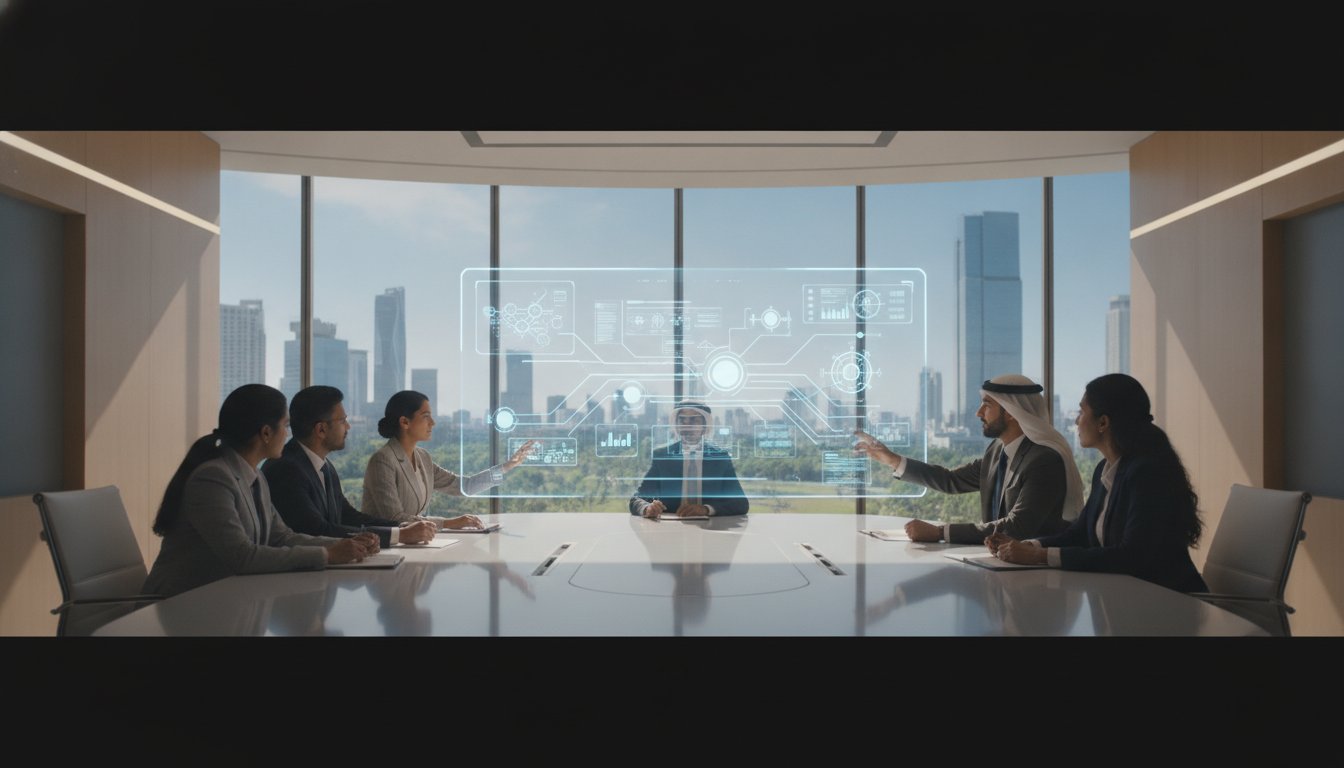

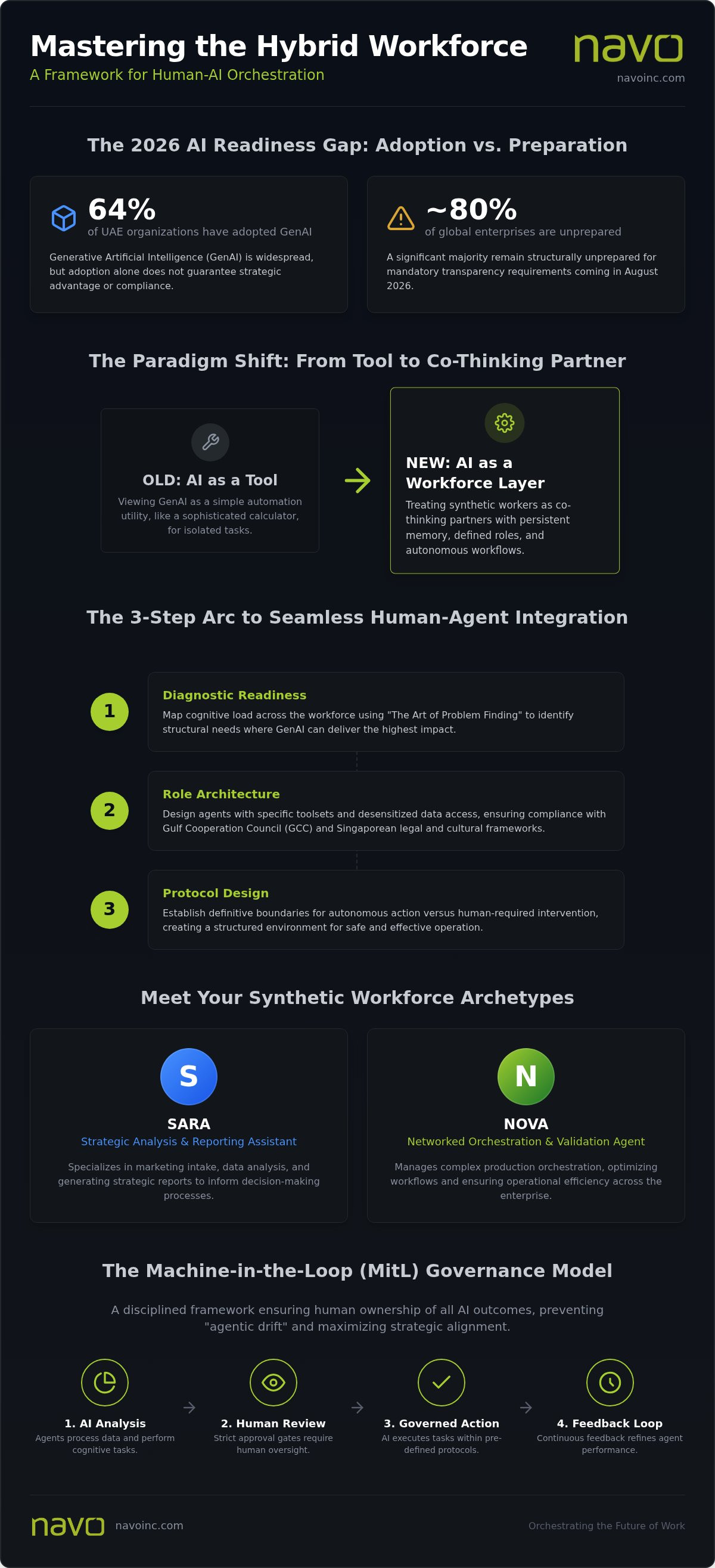
While 64% of organizations in the United Arab Emirates (UAE) have embraced generative artificial intelligence (GenAI), nearly 80% of global enterprises remain structurally unprepared for the mandatory transparency requirements enforced this August 2026. You've likely realized that integrating synthetic workers with human teams is no longer a simple technical deployment. It's a profound organizational shift that often surfaces fears of cultural resistance and uncertainty regarding measurable return on investment (ROI). You need a steady hand to navigate these complex transitions without compromising systemic health.
This guide provides a sophisticated framework to master the orchestration of hybrid human-AI teams. By anchoring your strategy in The Art of Problem Finding, you'll move from chaotic adoption to a disciplined Machine-in-the-Loop (MitL) governance model. We'll explore how to deploy agents like SARA and NOVA to achieve a seamless workforce that satisfies the latest National Institute of Standards and Technology (NIST) standards while securing a future-proofed talent strategy.
Key Takeaways
- Redefine Generative Artificial Intelligence (GenAI) as a functional workforce layer rather than a simple tool, establishing synthetic workers as co-thinking partners with defined memory and operational roles.
- Master the sophisticated orchestration of integrating synthetic workers with human teams by applying the Machine-in-the-Loop (MITL) framework to ensure human ownership of all agentic outcomes.
- Apply "The Art of Problem Finding" to identify high-stakes orchestration opportunities for agents like SARA and NOVA, ensuring they're structurally aligned with your business objectives before technical deployment.
- Secure a measurable Return on Investment (ROI) by implementing a Corporate AI Governance Policy that respects the specific regulatory frameworks of the Gulf Cooperation Council (GCC) and Singapore.
Beyond Automation: The Paradigm of Synthetic Workers as Co-Thinking Partners
In 2026, the global AI market has surpassed $514.5 billion, signaling a definitive transition beyond simple task automation. Many enterprises falter because they treat Generative Artificial Intelligence (GenAI) as a sophisticated calculator. We must redefine the synthetic worker as a functional workforce layer characterized by persistent memory, distinct organizational roles, and autonomous workflows. A co-thinking partner is a machine-intelligent agent that participates in the cognitive heavy lifting of strategy and execution.
Successfully integrating synthetic workers with human teams requires a diagnostic approach that prioritizes systemic health. We anchor this transition in "The Art of Problem Finding," ensuring that agents address deep-seated structural bottlenecks rather than superficial symptoms. This disciplined method of integrating synthetic workers with human teams relies on a Machine-in-the-Loop Framework to maintain human accountability while capitalizing on the efficiency of machine-driven analysis.
The Evolution of the Workforce Layer in 2026
The traditional binary of human versus machine is now obsolete within the high-stakes corporate environments of the Gulf Cooperation Council (GCC). Leading firms utilize specialized archetypes like SARA (Strategic Analysis and Reporting Assistant) for marketing intake and NOVA for complex production orchestration. These agents represent a permanent shift in labor dynamics. For a comprehensive analysis of these structures, review our Synthetic Workforce Development: The 2026 Executive Guide to Agentic AI. This model allows human professionals in Singapore and Dubai to focus on ethical governance while machines accelerate execution.
Orchestrating the Hybrid Team: Applying the Machine-in-the-Loop Framework
Effective orchestration requires more than just connectivity; it demands a rigorous Machine-in-the-Loop (MITL) architecture. This framework ensures human ownership of all machine-generated outputs while leveraging research on AI enhancing team innovation to drive creative breakthroughs. Without strict approval gates and continuous feedback loops, organizations risk "agentic drift," a phenomenon where autonomous systems gradually deviate from the original business intent due to iterative processing errors. We utilize the "Six Lanes of Working" to delineate where synthetic workers like NOVA accelerate operational speed and where humans retain the creative lead. Successfully integrating synthetic workers with human teams is not a matter of replacing labor but of optimizing cognitive distribution across the enterprise.
Five Steps to Seamless Human-Agent Integration
Our Continuing Professional Development (CPD) United Kingdom (UK) certified masterclasses follow a specific five-step activation arc to ensure organizational readiness and systemic health. Integrating synthetic workers with human teams through this arc allows for a disciplined transition from traditional workflows to agentic collaboration.
- Step 1: Diagnostic Readiness. We utilize comprehensive surveys to map current cognitive load across the workforce, identifying critical gaps using "The Art of Problem Finding" framework to ensure GenAI (Generative Artificial Intelligence) addresses structural needs.
- Step 2: Role Architecture. This involves designing agents with specific toolsets and desensitized data access, ensuring compliance with the legal and cultural sensitivities of the Gulf Cooperation Council (GCC) and Singapore.
- Step 3: Protocol Design. We establish definitive boundaries for autonomous action versus human-required intervention, creating a structured environment where agents like SARA can function without constant supervision.
This diagnostic approach ensures that every deployment is purposeful and governed. To see how these protocols apply to your specific industry, you can consult with our senior strategists for a tailored workforce assessment.
Strategic Governance and ROI: Ensuring Ethical Alignment and Measurable Impact
In the Agentic Era, robust governance is the primary enabler of organizational speed rather than a bureaucratic hurdle. Successfully integrating synthetic workers with human teams requires a Corporate Artificial Intelligence (AI) Governance Policy that aligns with the specific data sovereignty laws of the Gulf Cooperation Council (GCC) and Singapore. We implement a rigorous Classification Framework to ensure safe machine consumption of data, categorizing information into four distinct tiers: Public, Internal-Low, Confidential-Transformable, and Restricted. It's this structural clarity that prevents intellectual property leakage while allowing agents to operate at peak efficiency.
Calculating the Synthetic Workforce Return on Investment (ROI) moves beyond vague productivity metrics to focus on audited net-profit increases. By applying "The Art of Problem Finding" to conduct detailed efficiency audits, we establish a baseline for human-agent collaboration that guarantees measurable commercial impact. This disciplined approach ensures that your talent strategy remains future-proofed against the rapid evolution of autonomous systems and shifting regional regulations.
Safeguarding the Enterprise with the Desensitisation Toolkit
We deploy a proprietary Desensitisation Toolkit featuring twelve repeatable techniques, such as tokenisation and aggregation, to protect sensitive organizational assets. This ensures that agent-led decision-making remains transparent and fully auditable, providing the necessary assurance for board-level oversight. For executives looking to benchmark their internal talent against these sophisticated standards, our Continuing Professional Development (CPD) Certified AI Course: The Executive Standard for Synthetic Workforce Leadership provides the requisite framework for mastery in 2026. This toolkit allows for the safe processing of confidential data within the cultural and legal sensitivities of the Middle East and Southeast Asia.
Architecting the Agentic Enterprise of 2026
The transition toward a hybrid workforce is no longer a speculative venture but a structural necessity for maintaining systemic health. By applying "The Art of Problem Finding," you move beyond the limitations of simple automation to establish synthetic workers as co-thinking partners. Successful orchestration depends on a rigorous Machine-in-the-Loop (MITL) architecture. This structure ensures human accountability while driving measurable net-profit increases. Mastering the complexities of integrating synthetic workers with human teams requires both a disciplined governance model and a desensitized data strategy to protect intellectual property within the Gulf states and Singapore. This balanced approach secures your competitive advantage in an increasingly autonomous global market.
Authored by Amazon best-selling author Vasudevan Kidambi, our frameworks provide the steady hand needed to navigate these high-stakes organizational shifts and ensure your leadership remains visionary.
Frequently Asked Questions
What is the primary difference between a traditional AI bot and a synthetic worker?
A traditional Artificial Intelligence (AI) bot is typically a reactive, task-specific tool designed for simple queries or isolated tasks. In contrast, a synthetic worker is a machine-intelligent agent with defined roles, persistent memory, and autonomous workflows. By integrating synthetic workers with human teams, organizations gain co-thinking partners that participate in the cognitive heavy lifting of strategy and execution rather than just executing commands.
How does Navo Inc. guarantee a net-profit increase through GenAI consulting?
Navo Inc. achieves a guaranteed net-profit increase by embedding Generative Artificial Intelligence (GenAI) into core strategy and operations. We use "The Art of Problem Finding" to identify hidden inefficiencies before technical deployment. Our outcome-guaranteed consulting model relies on rigorous efficiency audits and the Five-Week Activation Arc to ensure that every agentic deployment delivers measurable commercial impact and structural excellence.
Can synthetic workers be integrated into highly regulated industries like BFSI in the Middle East?
Yes, synthetic workers are safely deployable in the Banking, Financial Services, and Insurance (BFSI) sector by utilizing our proprietary Classification Framework. This model categorizes data into four classes to ensure compliance with Gulf Cooperation Council (GCC) and Singaporean regulations. Our Desensitisation Toolkit employs twelve repeatable techniques like tokenisation, allowing for the secure use of sensitive data while maintaining full board-level auditability.
What are SARA and NOVA, and how do they function within a human team?
SARA (Strategic Analysis and Reporting Assistant) and NOVA are specialized synthetic workers designed for high-stakes enterprise functions. SARA focuses on marketing intake and brief validation to reduce budget waste, while NOVA handles complex production orchestration and project workflows. Integrating synthetic workers with human teams using these archetypes allows for a disciplined distribution of labor where machines handle data-heavy tasks and humans focus on oversight.
Disclaimer
The views and opinions expressed in this article are those of the author and do not represent any organisation, client, institution, or professional body with which he may be associated. The content is intended for general information, education, and thought leadership. Readers should seek appropriate professional advice before making legal, financial, investment, regulatory, technology, or business decisions.
The author has taken reasonable care to ensure the accuracy of the information and sources available at the time of publication. Technologies, regulations, market conditions, and industry practices may evolve, and readers are encouraged to verify current information independently. Any examples, cases, or scenarios may have been simplified, anonymised, or adapted to protect confidentiality. The author and publisher accept no liability for decisions or outcomes arising from the use of this content.
Generative AI tools may have been used to support research, structuring, or language refinement, with the final content, judgment, and editorial responsibility retained by the author.