

While the Gulf region accelerates toward a synthetic future, a 2025 report from the Massachusetts Institute of Technology (MIT) reveals a sobering reality; only 5% of Generative Artificial Intelligence (GenAI) projects delivered a measurable return on investment. Traditional productivity metrics, once anchored in human hours and manual outputs, have been rendered meaningless by the sheer velocity of agentic systems. You've likely observed how the speed of Generative Artificial Intelligence can mask a lack of strategic direction, creating a high-performance facade that fails to impact the bottom line. Effectively measuring Artificial Intelligence (AI) workforce performance requires a departure from legacy thinking toward a more intellectually rigorous model.
This article introduces an outcome-based framework for the 2026 synthetic era, ensuring your hybrid workforce of humans and Artificial Intelligence agents aligns with Continuing Professional Development (CPD) United Kingdom-certified standards. We'll examine how Navo Inc.’s proprietary "The Art of Problem Finding" methodology transitions organizations from technical precision toward genuine structural excellence.
Key Takeaways
- Recognize how legacy productivity metrics fail in the synthetic era where Generative Artificial Intelligence (GenAI) can automate high-volume outputs in seconds.
- Implement a sophisticated triple-layer framework for measuring AI workforce performance that audits human judgment and the Key Impact Points (KIPs) of synthetic workers like SARA and NOVA.
- Transition from measuring output volume to evaluating strategic consequence by anchoring your operations in "The Art of Problem Finding" methodology.
- Establish a certifiable Corporate AI Governance Policy that utilizes Continuing Professional Development (CPD) United Kingdom-certified benchmarks to ensure workforce readiness and guaranteed efficiency.
The Obsolescence of Traditional Productivity Metrics in the Agentic Era
The collapse of traditional productivity metrics is a structural inevitability in the age of Agentic AI. When Generative Artificial Intelligence (GenAI) can generate twelve months of technical documentation in minutes, "hours logged" becomes an indicator of systemic inefficiency rather than dedication. Organizations often fall into the "Efficiency Trap," where employees use synthetic tools to automate low-value administrative tasks without increasing the strategic consequence of their output. True leadership in 2026 requires a decisive shift from activity-based monitoring to value-based performance frameworks. Effectively measuring AI workforce performance demands we stop counting keystrokes and start auditing the depth of human judgment applied to machine-generated drafts.
The Art of Problem Finding as a Performance Benchmark
The ultimate Key Performance Indicator (KPI) for the modern executive isn't prompt engineering; it's the rigorous diagnostic work of "The Art of Problem Finding." Leaders must reward the discovery of "Unknown Knowns" (existing insights that are underutilized) and "Unknown Unknowns" (unseen systemic risks). While prompt engineering focuses on technical execution, problem finding ensures that synthetic workers like SARA (marketing brief validation) or NOVA (production orchestration) are deployed against high-stakes organizational friction.
By prioritizing diagnostic rigor over output volume, firms can guarantee that measuring AI workforce performance reflects actual net-profit impact rather than mere digital busywork. This methodology forces a "Machine-in-the-Loop" thinking model where the human partner identifies the right problem before the AI agent executes the solution. Rewarding this intellectual heavy lifting prevents the dilution of strategic quality in an era of infinite content.
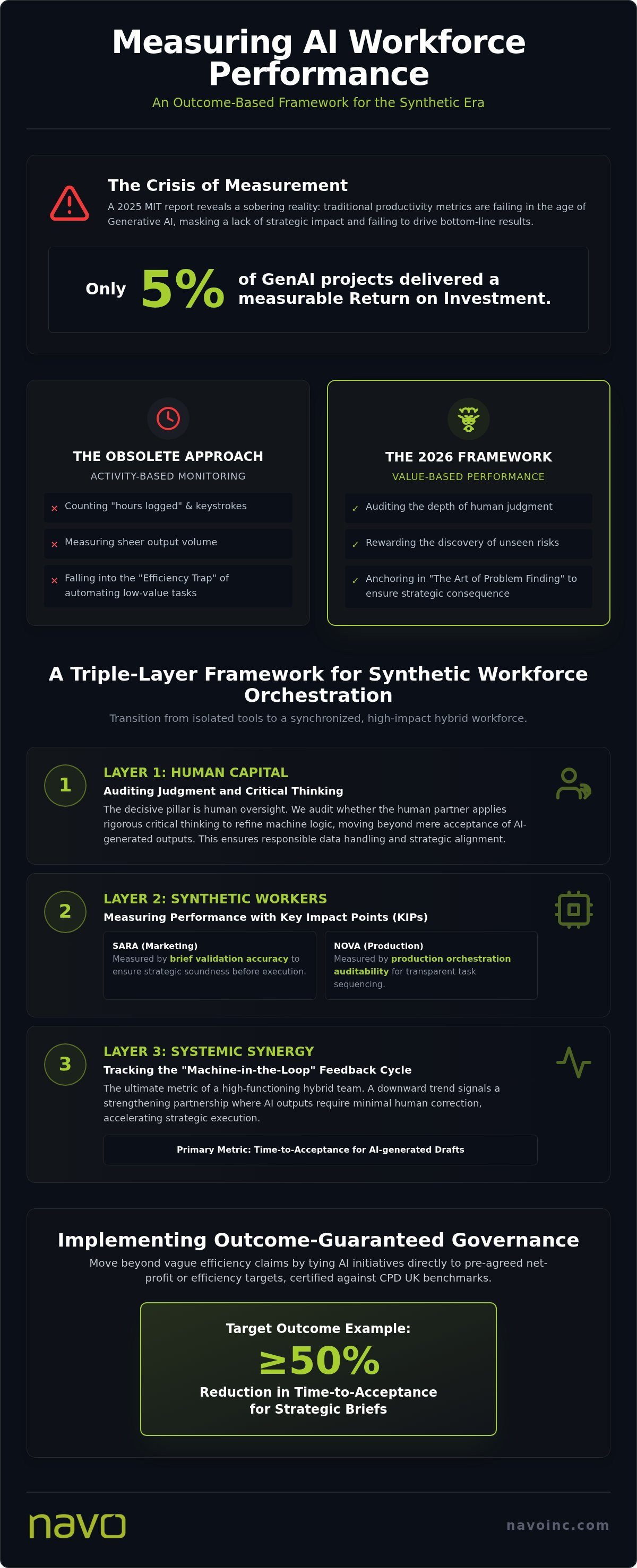
A Triple-Layer Framework for Synthetic Workforce Orchestration
Effective orchestration requires a multi-dimensional approach to measuring AI workforce performance. Layer 1 centers on human capital, specifically the desensitization of data and the exercise of responsible judgment. As noted in the framework for assessing AI competitiveness from the U.S. Government Accountability Office (GAO), human capital remains the decisive pillar in technological superiority. We audit whether the human partner is merely accepting outputs or if they're applying rigorous critical thinking to refine machine logic.
Layer 2 introduces Key Impact Points (KIPs) for synthetic workers. SARA's performance is audited by her brief validation accuracy, ensuring that marketing inputs are strategically sound before execution. NOVA is measured by production orchestration auditability, providing a transparent trail of how complex tasks were sequenced. Layer 3 evaluates systemic synergy through the "Machine-in-the-Loop" feedback loop. We track the "time-to-acceptance" for Artificial Intelligence (AI) generated drafts; a downward trend here signals a high-functioning partnership where machine outputs require minimal correction.
Evaluating Agentic ROI via Proprietary Diagnostic Tools
Moving beyond the superficial metric of "time saved," we employ Return on Investment (ROI) calculators that translate efficiency into net-profit increases. By deploying agents like SARA, organizations target a ≥50% reduction in time-to-acceptance for strategic briefs, directly minimizing budget waste. Achieving this level of orchestration depth ensures that your synthetic workforce functions as a synchronized unit rather than isolated tools. If your current metrics fail to capture this complexity, reach out to our consultants to design a custom governance framework.
Implementing Outcome-Guaranteed Performance Governance
Structural resilience in the synthetic era requires more than just technical oversight; it demands a Corporate AI Governance Policy that codifies the relationship between output, ethical boundaries, and permitted-use rules. When measuring AI workforce performance, executives must move beyond vague efficiency claims toward "Outcome-Guaranteed" models. These models tie consulting interventions directly to pre-agreed net-profit or efficiency targets. By utilizing Continuing Professional Development (CPD) United Kingdom-certified benchmarks, organizations can objectively quantify workforce readiness. This ensures that every human-in-the-loop possesses the requisite diagnostic skills to manage Artificial Intelligence (AI) agentic systems safely and effectively.
Navigating Regional Sensitivities in the GCC and ASEAN Markets
In the Gulf Cooperation Council (GCC) and Association of Southeast Asian Nations (ASEAN) regions, performance monitoring must align with local cultural norms regarding workplace transparency and data sovereignty. For instance, the Saudi Cabinet designated 2026 as the "Year of Artificial Intelligence," signaling a high-stakes push for structural transformation. Integrating a specific Corporate AI Governance Policy ensures that human-ownership mechanisms remain intact, preventing the "black box" effect often associated with autonomous agents.
Benchmarking talent through a CPD Certified AI Course provides a standardized metric for leadership across Dubai, Singapore, and Malaysia. This academic rigor is essential where only 23% of employees in Singapore currently trust their employers to act in their best interest during AI introduction. Navo’s framework bridges this trust gap by establishing auditable performance standards that respect regional sensitivities while driving radical progress. We ensure that measuring AI workforce performance remains a collaborative effort that honors the human-centric values of the Middle East and Southeast Asia.
Architecting the Future of Synthetic Leadership
The transition from legacy activity-based monitoring to a value-centric architecture is a structural necessity for regional leaders. By prioritizing "The Art of Problem Finding" over mere output volume, organizations ensure that human judgment remains the primary driver of strategic consequence. Effectively measuring AI workforce performance requires this sophisticated integration of human critical thinking and the auditable impact of agents like SARA and NOVA. Navo’s approach, anchored in CPD UK-certified (Continuing Professional Development United Kingdom) masterclasses and a net-profit increase guarantee, provides the steady hand needed to navigate these complex shifts. Adopting a Corporate AI Governance Policy ensures that your enterprise remains resilient, ethical, and demonstrably efficient in a competitive global landscape.
The path toward structural excellence begins with a disciplined commitment to outcome-based metrics, ensuring your organization doesn't just survive the synthetic era but leads it.
Frequently Asked Questions
How do we distinguish between human contribution and AI output in performance reviews?
Distinguishing human contribution requires auditing the "Machine-in-the-Loop" thinking model. We measure the human's ability to apply responsible judgment and critical thinking to Artificial Intelligence (AI) generated drafts. Performance reviews focus on the diagnostic rigor applied before and after agent interaction. This ensures human partners are rewarded for strategic oversight rather than just the volume of content produced by synthetic systems.
What are the specific KPIs for synthetic workers like SARA and NOVA?
Specific Key Performance Indicators (KPIs) for synthetic workers include measurable impact points. For SARA (brief validation), we target a ≥95% classification accuracy and a ≥50% reduction in time-to-acceptance for marketing briefs. NOVA (production orchestration) is evaluated based on orchestration auditability and the seamless sequencing of complex workflows. These metrics ensure that measuring AI workforce performance remains grounded in objective, technical evidence.
How does the 'Art of Problem Finding' framework improve workforce ROI?
"The Art of Problem Finding" framework improves Return on Investment (ROI) by identifying "Unknown Knowns" and "Unknown Unknowns" before resource deployment. This diagnostic phase prevents organizations from wasting AI resources on low-value tasks. By focusing on strategic friction points, the workforce ensures that agentic deployments result in the net-profit increases guaranteed by Navo’s consulting models.
Is measuring AI workforce performance compliant with Dubai and GCC labor regulations?
Compliance with Dubai and Gulf Cooperation Council (GCC) regulations is maintained through a robust Corporate AI Governance Policy. This framework integrates human-ownership mechanisms and data desensitization protocols that respect local privacy norms. Aligning with the UAE (United Arab Emirates) National AI Strategy 2031 ensures that measuring AI workforce performance remains transparent and auditable. We prioritize human-centric oversight to meet regional legal standards.
Disclaimer
The views and opinions expressed in this article are those of the author and do not represent any organisation, client, institution, or professional body with which he may be associated. The content is intended for general information, education, and thought leadership. Readers should seek appropriate professional advice before making legal, financial, investment, regulatory, technology, or business decisions.
The author has taken reasonable care to ensure the accuracy of the information and sources available at the time of publication. Technologies, regulations, market conditions, and industry practices may evolve, and readers are encouraged to verify current information independently. Any examples, cases, or scenarios may have been simplified, anonymised, or adapted to protect confidentiality. The author and publisher accept no liability for decisions or outcomes arising from the use of this content.
Generative AI tools may have been used to support research, structuring, or language refinement, with the final content, judgment, and editorial responsibility retained by the author.