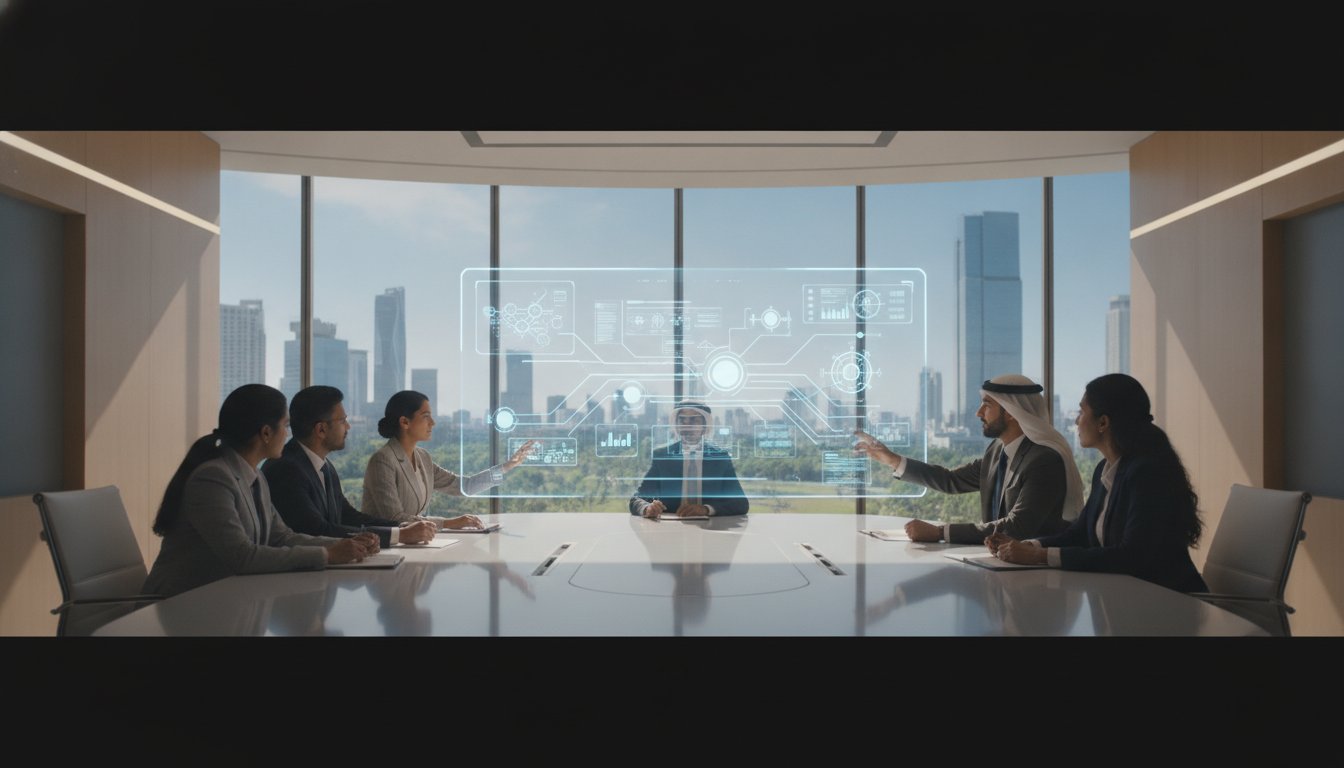

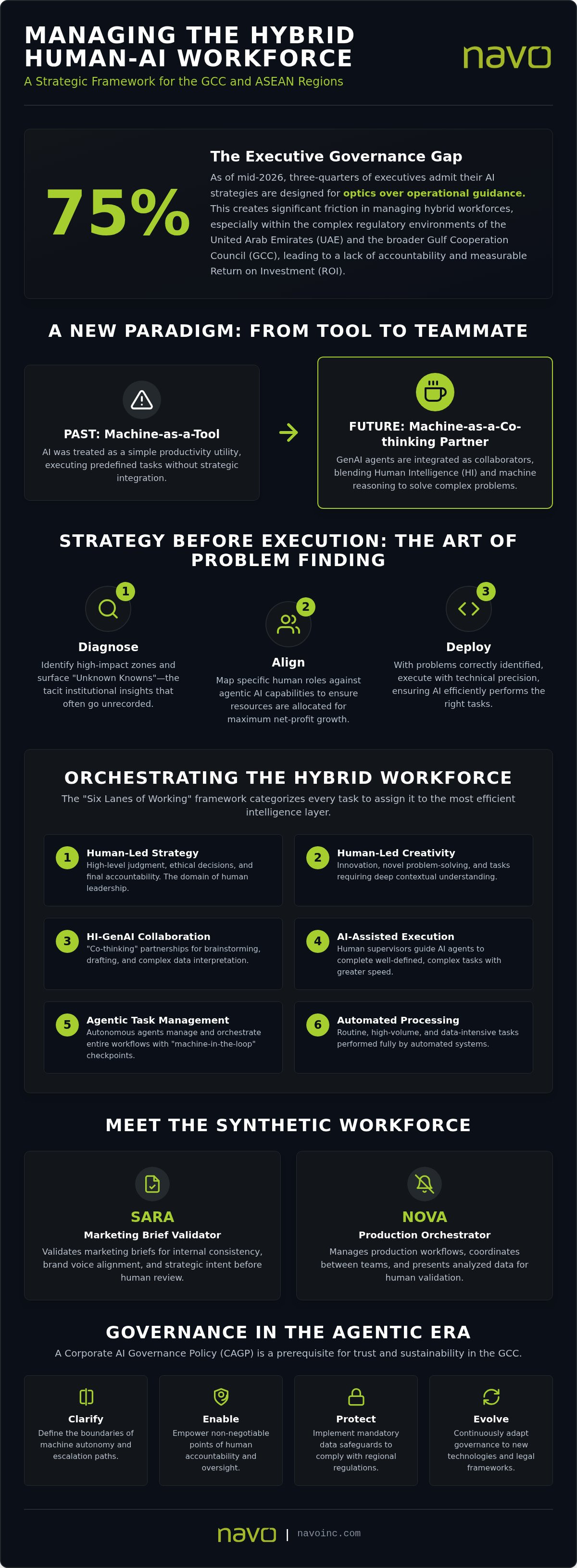
As of mid-2026, 75% of executives admit their current AI strategies are designed for optics rather than operational guidance. This lack of strategic depth creates significant friction when managing a hybrid human-AI workforce, particularly within the complex regulatory environments of the United Arab Emirates (UAE) and the broader Gulf Cooperation Council (GCC). You likely feel the weight of this governance gap as autonomous agents enter your workflows without a clear roadmap for accountability or measurable Return on Investment (ROI). This article offers a sophisticated framework to bridge that divide, moving from fragmented tool adoption to disciplined orchestration. We'll preview how The Art of Problem Finding allows for the precise deployment of synthetic workers like SARA and NOVA. You'll gain a structured roadmap to define roles for synthetic talent and ensure your human-AI collaboration yields the systemic efficiency required for regional leadership.
Key Takeaways
- Understand the systemic shift from "Machine-as-a-Tool" to "Machine-as-a-Co-thinking-Partner" to integrate Human Intelligence (HI) with Generative Artificial Intelligence (GenAI) agents.
- Implement the "Six Lanes of Working" framework for managing a hybrid human-AI workforce, ensuring every task is assigned to the most efficient intelligence layer.
- Navigate the complex regulatory landscapes of the Gulf Cooperation Council (GCC) by developing a Corporate AI Governance Policy (CAGP) that prioritizes data safeguards and ethical accountability.
- Utilize "The Art of Problem Finding" to identify high-impact opportunities for synthetic workers like SARA and NOVA, driving measurable net-profit growth.
The Evolution from Hybrid Workplace to Hybrid Workforce
By 2026, the strategic focus for Dubai and Riyadh-based enterprises has shifted fundamentally from the "hybrid workplace" to the "hybrid workforce." This evolution represents a systemic integration of Human Intelligence (HI) and Generative Artificial Intelligence (GenAI) agents. Unlike the previous decade's emphasis on physical location, this intelligence-based model positions Artificial Intelligence as a "Co-thinking Partner" rather than a simple productivity tool within the organizational hierarchy.
Managing a hybrid human-AI workforce effectively requires leaders to surface "Unknown Knowns," which are the tacit institutional insights that often go unrecorded. Failing to identify these realities leads to the misallocation of synthetic resources and significant organizational friction. It's no longer about where people work, but how different forms of intelligence collaborate to solve complex problems.
The Art of Problem Finding: Diagnosing Your Workforce Needs
The "Art of Problem Finding" framework provides the necessary diagnostic rigor to ensure strategic alignment. This methodology identifies high-impact zones for synthetic workers, such as SARA and NOVA, by mapping specific human roles against agentic AI capabilities. It's a critical step for maintaining structural excellence in the competitive Gulf and ASEAN (Association of Southeast Asian Nations) markets.
Strategic identification must always precede technical execution. If prompt engineering begins before problem identification is complete, the organization risks efficiently performing the wrong tasks. This diagnostic approach ensures that AI orchestration drives measurable net-profit growth rather than superficial automation. By treating AI as a structural solution, firms can achieve the guaranteed outcomes required in high-stakes environments.
Orchestrating the Synthetic Workforce Layer
The "Synthetic Workforce" serves as a distinct operational layer positioned between core organizational strategy and tactical execution. It's not merely a collection of software tools; it's a managed tier of autonomous agents capable of independent reasoning. Success in managing a hybrid human-AI workforce requires the introduction of an AI Agent Orchestrator. This new middle-management function coordinates specialized agents, ensuring they remain aligned with high-level enterprise objectives. Leaders must transition from monitoring micro-tasks to governing systemic outcomes.
Our proprietary "Six Lanes of Working" framework provides the necessary structure for this orchestration. It categorizes every task based on the required balance of human judgment and machine processing speed. This methodical categorization is a cornerstone of Preparing the Workforce for AI, ensuring that human talent is prioritized for high-value reasoning and creative problem-solving. By segregating routine execution from strategic thought, organizations can eliminate the friction often associated with rapid technological shifts.
Deploying Agentic AI: Lessons from SARA and NOVA
Proprietary agents like SARA and NOVA illustrate the efficacy of specialized roles. SARA validates marketing briefs for consistency and strategic intent, while NOVA manages production orchestration. These agents utilize "Machine-in-the-Loop" thinking, where they present analyzed data to human supervisors for final validation. This relationship preserves human accountability while leveraging agentic speed.
Integrating a synthetic worker follows a disciplined protocol:
- Orientation: Defining the agent's functional boundaries and access to secure data.
- Training: Refining agent logic through iterative feedback loops to match brand voice.
- Integration: Establishing seamless hand-off points between synthetic agents and human teams.
This structured deployment ensures that AI remains a profit-driving asset rather than a source of friction. For leaders seeking a structured pathway to agentic deployment, these frameworks provide the necessary stability to scale operations across the Gulf region.
Governance and Ethics in the Agentic Era
Sustainable success in managing a hybrid human-AI workforce depends on a robust Corporate AI Governance Policy (CAGP). This document serves as a strategic mandate, defining the boundaries of machine autonomy and the non-negotiable points of human accountability. Within the high-stakes environments of Dubai and Riyadh, governance isn't a bureaucratic hurdle but a prerequisite for organizational trust. By 2026, UAE regulatory updates have made clear data safeguards mandatory for any enterprise deploying agentic systems.
Leaders must navigate the unique cultural sensitivities and legal frameworks of the GCC and Singapore. A disciplined approach follows the 'Clarify-Enable-Protect-Evolve' framework. This methodical cycle ensures that as synthetic workers scale, human ownership remains intact. It addresses the primary executive fear of losing control by embedding transparency into the orchestration layer. Effectively Managing AI Workplace Risks requires this level of Board-level oversight to prevent systemic failures.
Implementing a Classification Framework for Data Safety
Protecting enterprise Intellectual Property (IP) requires a four-class information model, ranging from Public to Restricted. A desensitization toolkit, utilizing tokenization and data aggregation, ensures that agents like SARA and NOVA operate without accessing sensitive identifiers. To achieve Board-level assurance, leaders should follow this auditability checklist:
- Decision Auditing: Maintain a timestamped log of all autonomous agent reasoning paths.
- IP Safeguards: Verify that restricted data never leaves the secure enterprise environment during GenAI training.
- Regulatory Alignment: Ensure all agentic workflows comply with the UAE Personal Data Protection Law and regional sovereignty requirements.
Architecting the Future of Integrated Intelligence
The transition toward 2026 demands more than tactical automation; it requires a complete architectural redesign of the enterprise. Successfully managing a hybrid human-AI workforce necessitates the deployment of rigorous frameworks like the "Art of Problem Finding" to ensure synthetic agents serve strategic outcomes rather than creating operational noise. By establishing a clear Corporate AI Governance Policy, leaders in the UAE and Singapore can protect intellectual property while scaling agentic layers like SARA and NOVA. Navo Inc. brings proven expertise across global markets, offering CPD UK-certified masterclasses and outcome-guaranteed strategies to navigate these high-stakes transitions.
The era of the co-thinking partner has arrived. Those who architect their workforce with precision will define the next decade of regional innovation. Your organization's resilience depends on a steady, expert hand to guide this evolution.
Frequently Asked Questions
What is the difference between an AI tool and a synthetic worker?
A synthetic worker is an autonomous agent capable of independent reasoning and task execution, whereas a traditional Artificial Intelligence tool is a passive instrument requiring constant human prompting. Synthetic workers like SARA function as co-thinking partners within the organizational hierarchy. They take ownership of specific outcomes rather than just providing fragmented data outputs or simple automation.
How does the Art of Problem Finding improve AI workforce ROI?
The "Art of Problem Finding" framework improves Return on Investment (ROI) by identifying high-impact structural gaps before any technical deployment begins. By diagnosing "Unknown Knowns," this methodology ensures that synthetic resources solve systemic bottlenecks rather than just automating inefficient processes. This diagnostic rigor prevents the misallocation of capital and ensures that every agentic deployment contributes to measurable net-profit growth.
Is a hybrid human-AI workforce legal under UAE and Singaporean labor laws?
Yes, such workforces are legal provided they comply with regional data residency and privacy regulations, such as the UAE Personal Data Protection Law. Organizations must establish a Corporate AI Governance Policy (CAGP) to manage accountability. This policy ensures that human supervisors remain legally responsible for the actions and outputs of autonomous agents within the enterprise environment.
What are the first steps for a CHRO to prepare for agentic AI?
A Chief Human Resources Officer (CHRO) should prioritize the development of a Corporate AI Governance Policy and the "Six Lanes of Working" framework. These tools provide the necessary structure for managing a hybrid human-AI workforce by redefining roles based on intelligence layers. This transition requires moving beyond simple headcounts to focus on the orchestration of human and synthetic talent.
How do SARA and NOVA ensure production orchestration without human error?
SARA and NOVA utilize "Machine-in-the-Loop" thinking to validate strategic briefs and coordinate production schedules with mathematical precision. They eliminate routine computational errors by processing vast datasets against predefined governance rules. However, they operate under human supervision to ensure final outputs align with the specific cultural sensitivities and brand standards required in the Gulf and ASEAN (Association of Southeast Asian Nations) markets.
Can a hybrid workforce guarantee net-profit increases for my enterprise?
Strategic orchestration of a hybrid workforce is designed to drive measurable net-profit growth by optimizing intelligence-based resource allocation. When integrated through a rigorous diagnostic framework, synthetic workers reduce operational friction and systemic waste. This allows your human talent to focus on high-value, revenue-generating activities that require creative judgment and high-stakes decision-making, which are essential for regional leadership.
Disclaimer
The views and opinions expressed in this article are those of the author and do not represent any organisation, client, institution, or professional body with which he may be associated. The content is intended for general information, education, and thought leadership. Readers should seek appropriate professional advice before making legal, financial, investment, regulatory, technology, or business decisions.
The author has taken reasonable care to ensure the accuracy of the information and sources available at the time of publication. Technologies, regulations, market conditions, and industry practices may evolve, and readers are encouraged to verify current information independently. Any examples, cases, or scenarios may have been simplified, anonymised, or adapted to protect confidentiality. The author and publisher accept no liability for decisions or outcomes arising from the use of this content.
Generative AI tools may have been used to support research, structuring, or language refinement, with the final content, judgment, and editorial responsibility retained by the author.