

In the current corporate environment, the ability to solve problems has become a commodity; the true executive advantage lies in the ability to find them. Most leaders in the United Arab Emirates (UAE) are witnessing a troubling trend where Generative Artificial Intelligence (GenAI) initiatives fail to scale despite significant capital allocation. You likely feel the pressure of investing millions of UAE Dirhams (AED) into digital transformations that address symptoms rather than underlying systemic issues. Research indicates that fewer than 20% of enterprises managed to scale their GenAI efforts by late 2025.
This article provides the Art of Problem Finding methodology explained as a rigorous framework to secure your strategic investments. By shifting focus toward "Unknown Knowns" and "Unknown Unknowns," you can validate business challenges before committing resources. We'll examine how this structured method reduces waste in digital budgets and positions GenAI as a sophisticated co-thinking partner for organizational strategy.
Key Takeaways
- Transition from reactive problem-solving to the intellectual discipline of identifying the correct strategic challenges to eliminate the primary cause of corporate waste in digital transformation.
- Gain a deep understanding of the Art of Problem Finding methodology explained to uncover "Unknown Knowns" and "Unknown Unknowns" that currently reside in organizational silos or external blind spots.
- Protect your capital by validating business premises before allocating UAE Dirham (AED) toward Generative Artificial Intelligence (GenAI) pilots that may lack a sound strategic foundation.
- Discover how a diagnostic-first approach ensures that synthetic workers like SARA and NOVA are deployed against high-value opportunities rather than superficial operational symptoms.
Defining the Art of Problem Finding Methodology
Problem finding is the intellectual discipline of identifying the correct challenge before initiating any solution architecture. Within the Art of Problem Finding methodology explained by Vasudevan Kidambi in his 2024 work, the emphasis is placed on diagnostic precision rather than reactive execution. Traditional problem-solving frameworks typically assume the underlying premise is valid; yet, solving the wrong problem with technical perfection remains the primary driver of organizational waste. This methodology, detailed in Kidambi's Amazon #1 Best Seller, provides a rigorous structure to ensure that high-stakes transformation efforts target the actual strategic levers of a business rather than addressing superficial symptoms. The framework serves as the anchor for Continuing Professional Development (CPD) United Kingdom (UK)-certified Masterclasses, bridging the gap between traditional management theory and modern digital realities.
Why Problem Finding is the Critical Precursor to GenAI Success
Generative Artificial Intelligence (GenAI) drastically accelerates task execution, which makes the cost of pursuing a flawed objective higher than ever before. In the Gulf Cooperation Council (GCC) and Middle East and North Africa (MENA) business landscapes, leaders often rely on executive intuition to navigate complexity. While intuition is a seasoned asset, it often lacks the structured rigor required to manage the "Unknown Unknowns" that disrupt digital shifts. This methodology positions GenAI as a "co-thinking partner" for strategy. High-quality problem framing is essential because AI simply reflects the clarity or confusion of its initial instructions. By using a diagnostic framework, organizations avoid the common trap of deploying expensive technology for the wrong business problems. This disciplined approach ensures that every UAE Dirham (د.إ) invested in transformation is mapped to a validated strategic need, reducing the high failure rate of AI pilots that fail to scale.
The Strategic Framework: Navigating Unknown Knowns and Unknown Unknowns
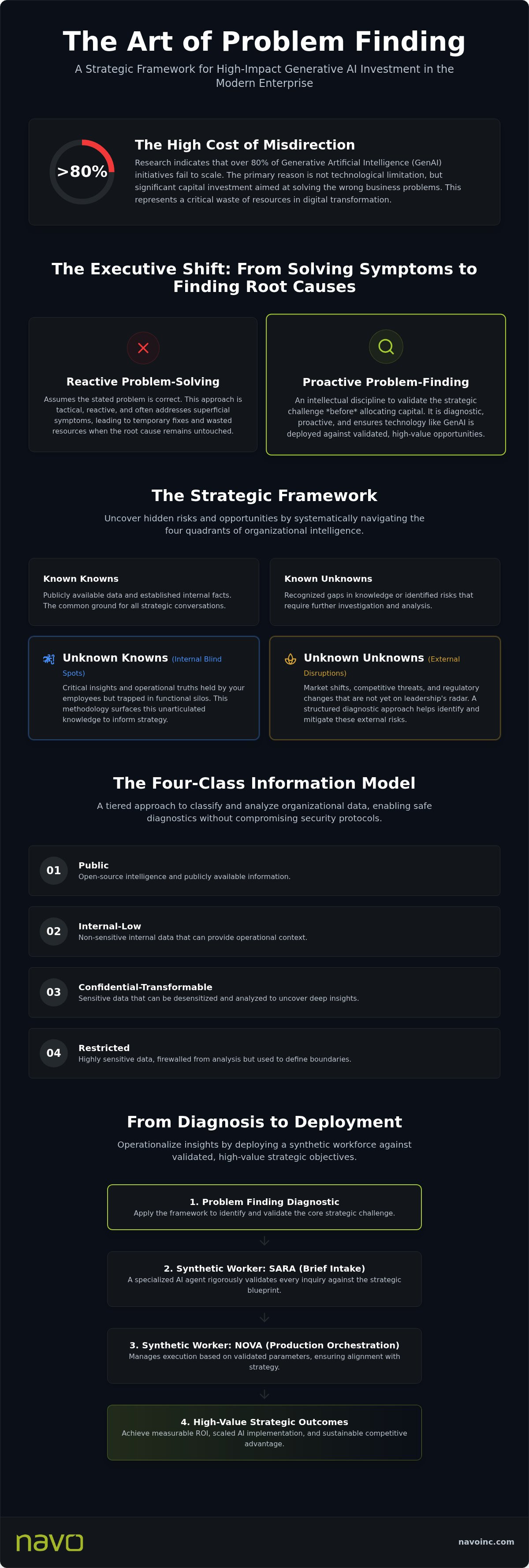
The Art of Problem Finding methodology explained involves a rigorous deconstruction of organizational intelligence to secure strategic foundations. Within this framework, "Unknown Knowns" represent the vast reservoir of insights that exist within your workforce but remain unarticulated or trapped in functional silos. These are the operational truths your employees know but leadership hasn't captured. Conversely, "Unknown Unknowns" are the external disruptions or internal blind spots that senior leadership has yet to perceive, often posing the greatest risk to digital transformation. Navo Inc. utilizes a disciplined diagnostic phase to surface these critical data points, ensuring that strategic foundations are secure before any technology deployment begins.
The Four-Class Information Model for Organizational Clarity
Effective problem discovery requires classifying information into four distinct tiers: Public, Internal-Low, Confidential-Transformable, and Restricted. This model allows for a precise understanding of data accessibility and strategic value. By employing a desensitisation toolkit, Navo Inc. safely analyzes internal data to identify hidden operational bottlenecks without compromising security or regulatory protocols in the Gulf. This level of clarity is a prerequisite for a robust synthetic workforce development strategy. It ensures that your AI initiatives address structural needs rather than superficial symptoms. If you require a diagnostic assessment of your current landscape, you can consult with our strategic advisors to identify your organization's hidden levers.
Implementing Problem Finding in the Era of Agentic AI
Operationalizing diagnostic insights requires a precise orchestration of technology and human oversight. The Art of Problem Finding methodology explained serves as the blueprint for designing agentic systems that deliver measurable value. By applying this framework, Navo Inc. builds specialized synthetic workers like SARA for Brief Intake, ensuring every inquiry is rigorously validated before processing. NOVA then manages Production Orchestration based on these validated parameters. This ensures agentic AI services are anchored to high-value strategic outcomes rather than isolated tasks. Within the Middle East and Association of Southeast Asian Nations (ASEAN) markets, maintaining human-in-the-loop thinking is critical for accountability, ensuring ethical standards and local regulatory sensitivities are upheld during the transition to autonomous operations.
Scaling the Methodology through CPD Certified AI Training
Leaders can master these advanced diagnostic disciplines through a CPD certified AI course. This five-week transformation journey includes a pre-prep phase, an intensive masterclass, and an activation arc designed for immediate corporate application. This curriculum empowers executives to apply the methodology directly to their unique business challenges, securing an immediate Return on Investment (ROI). Navo Inc. provides an outcome-guaranteed model because our consulting is built on this rigorous foundation. By validating the business premise first, we eliminate the systemic risks that cause digital transformation budgets to exceed their initial projections in UAE Dirham (د.إ), providing a disciplined path to structural excellence.
Securing the Strategic Foundation for Autonomous Intelligence
The Art of Problem Finding methodology explained serves as the ultimate safeguard against the systemic failure of Artificial Intelligence (AI) initiatives. By moving beyond symptomatic treatment toward a deep diagnostic of organizational blind spots, leaders ensure their digital transformation budget isn't squandered on perfectly solving the wrong problems. This framework, authored by Vasudevan Kidambi, a Top 20 Influential AI Leader, has already enabled systems like SARA to reclaim 33% of marketing budget waste. Navo Inc. offers a guaranteed net-profit increase for enterprise consulting clients who anchor their strategy in this rigorous discipline. Transitioning your organization toward structural excellence requires this fundamental shift from reactive solving to proactive finding. It's the most reliable way to navigate the complexities of the Generative AI (GenAI) era with professional composure and strategic certainty.
Schedule a Strategic Problem Finding Diagnostic with Navo Inc.
Your path toward a resilient, AI-augmented future begins with the discipline to validate every initial premise before execution.
Frequently Asked Questions
What is the main difference between problem finding and problem solving?
Problem solving focuses on providing technical solutions to predefined issues, while problem finding is the intellectual discipline of ensuring the issue itself is the correct strategic priority. In the Art of Problem Finding methodology explained by Vasudevan Kidambi, the focus shifts to diagnostic precision. This prevents the common corporate error of executing technically perfect solutions for irrelevant or misunderstood business challenges.
How does the Art of Problem Finding improve ROI for AI projects?
This methodology improves Return on Investment (ROI) by eliminating the high costs associated with failed Artificial Intelligence (AI) pilots that address the wrong goals. By identifying the right strategic levers during the diagnostic phase, organizations avoid wasting UAE Dirham (د.إ) on technology that doesn't scale. It ensures every deployment, including synthetic workers like SARA, targets high-value outcomes from the outset.
Can this methodology be applied to small and medium enterprises in the UAE?
Yes, the framework is highly effective for Small and Medium Enterprises (SMEs) in the United Arab Emirates (UAE) seeking to optimize limited digital transformation budgets. SMEs often face higher risks when technology investments fail to deliver immediate value. Applying this methodology allows smaller firms to compete with larger enterprises by ensuring their Generative Artificial Intelligence (GenAI) initiatives are lean, targeted, and structurally sound.
What are 'Unknown Unknowns' in a business strategy context?
'Unknown Unknowns' refer to external disruptions or internal blind spots that senior leadership has not yet perceived or identified as risks. These factors often derail digital transformation efforts because they aren't accounted for in traditional planning. The methodology uses a structured diagnostic process to surface these hidden threats, allowing for a more resilient and proactive organizational strategy that anticipates systemic shifts.
Disclaimer
The views and opinions expressed in this article are those of the author and do not represent any organisation, client, institution, or professional body with which he may be associated. The content is intended for general information, education, and thought leadership. Readers should seek appropriate professional advice before making legal, financial, investment, regulatory, technology, or business decisions.
The author has taken reasonable care to ensure the accuracy of the information and sources available at the time of publication. Technologies, regulations, market conditions, and industry practices may evolve, and readers are encouraged to verify current information independently. Any examples, cases, or scenarios may have been simplified, anonymised, or adapted to protect confidentiality. The author and publisher accept no liability for decisions or outcomes arising from the use of this content.
Generative AI tools may have been used to support research, structuring, or language refinement, with the final content, judgment, and editorial responsibility retained by the author.