

By the end of 2026, Gartner predicts that 40% of enterprise applications will feature task-specific Artificial Intelligence (AI) agents, a staggering leap from less than 5% just a year ago. You've likely observed that the integration of these autonomous tools often precipitates friction with legacy human workflows, threatening the expected Return on Investment (ROI). Successfully deploying AI agents in a hybrid workforce represents a sophisticated structural evolution of the organizational layer rather than a simple software implementation. This guide establishes an authoritative framework for orchestrating a co-thinking partnership between human intuition and machine execution to achieve systemic excellence. We'll apply "The Art of Problem Finding" to resolve governance risks in the United Arab Emirates (UAE) and Singapore, ensuring your transition to a synthetic workforce remains resilient, compliant, and strategically sound.
Key Takeaways
- Transition from viewing AI as a disparate toolset to managing a cohesive "Synthetic Workforce" through Machine-in-the-Loop Thinking, ensuring human intuition remains the primary orchestrator of agentic execution.
- Execute a disciplined 5-step framework for deploying AI agents in a hybrid workforce, beginning with specialized readiness audits to identify high-impact roles for autonomous integration.
- Establish a comprehensive Corporate AI Governance Policy that addresses the specific data residency and privacy mandates of the UAE, KSA, and Singapore to mitigate systemic and regulatory risks.
- Utilize "The Art of Problem Finding" to move beyond superficial automation, constructing a resilient agentic architecture that prioritizes structural excellence and measurable operational returns.
The Architecture of a Hybrid Workforce: Beyond Simple Automation
In 2026, the organizational paradigm has shifted from viewing Generative Artificial Intelligence (GenAI) as a mere productivity utility to integrating Agentic AI as a structured workforce participant. This evolution necessitates the creation of a "Synthetic Workforce," a distinct operational layer where autonomous agents function with specific mandates rather than as disparate tools. Successfully deploying AI agents in a hybrid workforce requires a move beyond simple automation toward a systemic architecture that prioritizes role-based integration. Navo Inc. advocates for a "Machine-in-the-Loop Thinking" approach, where the traditional hybrid work model evolves into a co-thinking partnership. This model ensures that agents don't just execute tasks but contribute to the strategic consequence of the enterprise by operating within a governed, collaborative ecosystem. The transition from passive software to active agentic participants represents a fundamental change in how labor is perceived and managed in high-stakes environments like Dubai.
Applying the Art of Problem Finding to Agent Deployment
We utilize the "Art of Problem Finding" framework to identify "Unknown Knowns," those embedded process inefficiencies that organizations often overlook or accept as inevitable. By diagnosing these friction points, leaders can accurately determine where the creative intuition and ethical judgment of human professionals remain indispensable and where the high-velocity orchestration of agents like SARA or NOVA provides superior structural health. A Synthetic Worker is a role-based entity equipped with specific memory, tool access, and feedback loops designed to achieve autonomous operational outcomes within a defined business function. This disciplined approach ensures that deploying AI agents in a hybrid workforce delivers a measurable Return on Investment (ROI) while respecting the unique cultural and regulatory landscape of the United Arab Emirates (UAE) and the wider Gulf region.
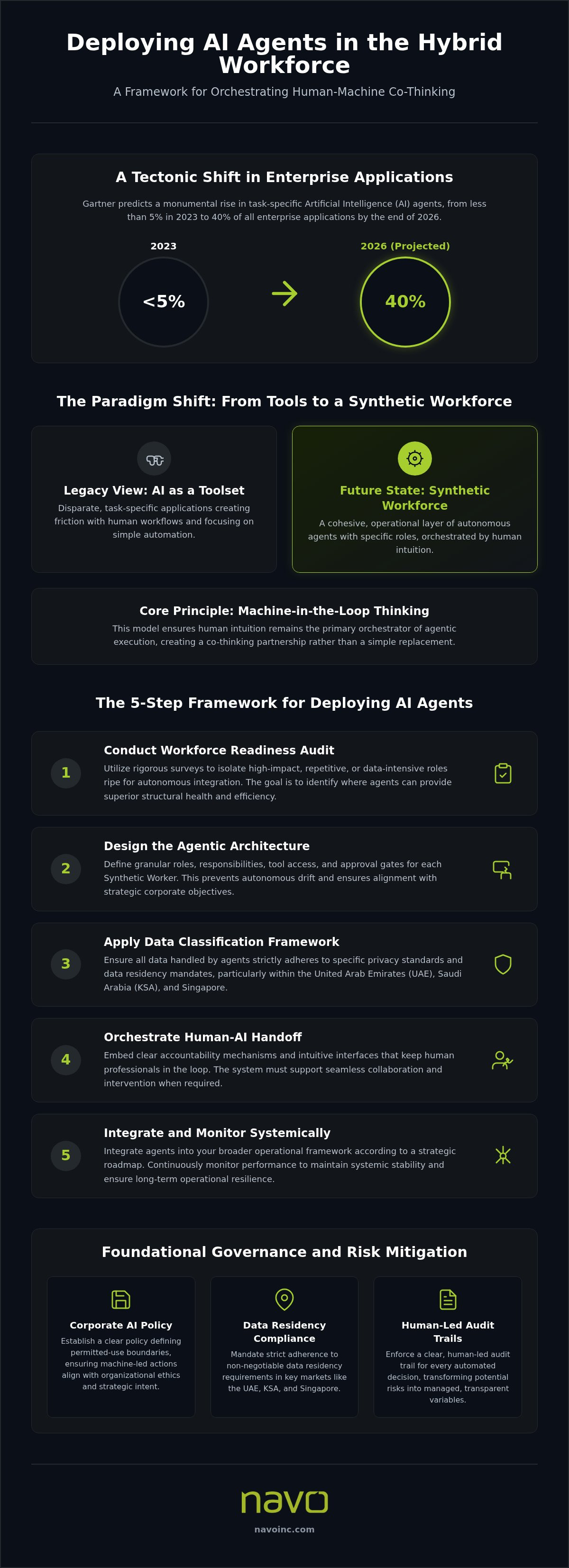
5 Steps for Deploying AI Agents in a Hybrid Workforce
Successfully deploying AI agents in a hybrid workforce demands a methodical transition from experimentation to enterprise-grade orchestration. First, conduct a rigorous workforce audit using Navo Inc.'s proprietary readiness surveys to isolate high-impact agentic roles. Second, design the agentic architecture where each Synth Worker possesses a granularly defined role and established approval gates; this prevents autonomous drift and ensures alignment with corporate objectives. Third, apply our Classification Framework to ensure all data handled by agents strictly adheres to the specific privacy standards and residency mandates of the United Arab Emirates (UAE) and the wider Gulf region. Fourth, orchestrate the human-AI handoff by embedding clear accountability mechanisms that keep human professionals in the loop. Finally, integrate these agents into your broader framework by consulting your agentic roadmap to maintain systemic stability and ensure long-term operational resilience.
Case Study: SARA and NOVA in Production Orchestration
The practical application of these steps is visible in the deployment of SARA and NOVA within high-stakes production environments. SARA manages Brief Intake and Validation, effectively reclaiming significant marketing spend by meticulously validating briefs before human execution begins. Meanwhile, NOVA focuses on production orchestration, providing the high-level auditability and operational efficiency required for complex global supply chains. For a deeper analysis of these sophisticated orchestration frameworks, consult our executive reference on Mastering Agentic AI Services. These agents don't merely perform tasks; they serve as a disciplined, tireless extension of your leadership's strategic intent across the Middle East and Association of Southeast Asian Nations (ASEAN) markets.
Governance and Risk Mitigation in the Agentic Era
Establishing a Corporate AI Governance Policy is the structural bedrock for deploying AI agents in a hybrid workforce. This policy must define permitted-use boundaries for autonomous agents, ensuring that machine-led actions align with organizational ethics and strategic intent. In markets like the United Arab Emirates (UAE), the Kingdom of Saudi Arabia (KSA), and Singapore, data residency requirements are non-negotiable. Agentic AI Governance mandates a clear, human-led audit trail for every automated decision, transforming potential risks into managed, transparent variables. We position governance as a "desensitisation" discipline; the objective isn't to restrict innovation but to sanitize workflows for safe, high-velocity execution. This ensures that every agentic interaction is anchored in a framework of accountability that satisfies both internal stakeholders and regional regulators.
Securing the Hybrid Future: The Navo Desensitisation Toolkit
Navo's toolkit utilizes a four-class information model, ranging from Public to Restricted data, to govern safe interactions with Generative Artificial Intelligence (GenAI). This model is supported by 12 repeatable techniques designed to protect confidential enterprise data. Key methods include:
- Tokenisation: Replacing sensitive identifiers with non-sensitive equivalents to maintain data utility without exposure.
- Aggregation: Summarizing granular data to prevent individual identification while preserving analytical value.
- Differential Privacy: Adding noise to datasets to ensure that agentic learning doesn't compromise underlying records.
Leaders across the Gulf Cooperation Council (GCC) and the Association of Southeast Asian Nations (ASEAN) should view this governance depth as a competitive advantage. It builds the trust necessary for large-scale adoption, allowing firms to navigate the complex regulatory landscapes of Dubai and Singapore while maintaining a leadership position in the agentic era. By prioritizing structural excellence, your organization can scale its synthetic workforce with confidence.
Orchestrating the Next Era of Organizational Excellence
The transition to a synthetic workforce requires more than technical proficiency; it demands a fundamental restructuring of how human intuition and machine execution interact. By deploying AI agents in a hybrid workforce through a role-based architecture, leaders can eliminate operational friction while adhering to the strict data residency mandates of the United Arab Emirates and Singapore. Utilizing frameworks like "The Art of Problem Finding" ensures that every agentic deployment is anchored in structural health and measurable performance. Authored by Vasudevan Kidambi, Navo Inc.’s approach includes Continuing Professional Development (CPD) UK-certified coaching and a guaranteed net-profit increase for enterprise clients.
The path toward agentic maturity is complex, but with a steady, analytical hand, your organization can lead this transformation with confidence and resilience.
Strategic Intelligence: Frequently Asked Questions
What is the difference between an AI tool and a Synthetic Worker?
An Artificial Intelligence (AI) tool is a passive utility designed for specific, prompt-based tasks, whereas a Synthetic Worker is a role-based autonomous entity. Unlike static software, Synthetic Workers possess memory, access to specialized tools, and feedback loops. They function as active participants within a "Machine-in-the-Loop" framework, executing complex workflows while maintaining alignment with broader organizational goals.
How do we ensure data privacy when deploying AI agents in the UAE and GCC?
Structural privacy is achieved by aligning deployment with regional data residency laws and implementing a rigorous desensitisation toolkit. When deploying AI agents in a hybrid workforce, organizations must use tokenisation and data aggregation to sanitize information before processing. This ensures compliance with the regulatory mandates of the United Arab Emirates (UAE) and the Gulf Cooperation Council (GCC) while protecting enterprise intellectual property.
What are the common pitfalls in hybrid workforce orchestration?
The primary pitfall is viewing agentic integration as a technical migration rather than a systemic workforce evolution. Organizations often fail to establish clear accountability gates, leading to "autonomous drift" where agents operate outside their intended strategic mandate. Successful orchestration requires "The Art of Problem Finding" to identify these friction points before they disrupt the Return on Investment (ROI).
Can AI agents operate without human supervision in a corporate environment?
Agents can operate with significant autonomy, but they shouldn't function without a defined human-led audit trail. High-stakes corporate environments require a co-thinking partnership where agents manage high-velocity data execution and human professionals oversee ethical judgment and creative strategy. This disciplined balance maintains structural excellence and ensures that autonomous decisions remain transparent and strategically sound.
Disclaimer
The views and opinions expressed in this article are those of the author and do not represent any organisation, client, institution, or professional body with which he may be associated. The content is intended for general information, education, and thought leadership. Readers should seek appropriate professional advice before making legal, financial, investment, regulatory, technology, or business decisions.
The author has taken reasonable care to ensure the accuracy of the information and sources available at the time of publication. Technologies, regulations, market conditions, and industry practices may evolve, and readers are encouraged to verify current information independently. Any examples, cases, or scenarios may have been simplified, anonymised, or adapted to protect confidentiality. The author and publisher accept no liability for decisions or outcomes arising from the use of this content.
Generative AI tools may have been used to support research, structuring, or language refinement, with the final content, judgment, and editorial responsibility retained by the author.