

By August 2026, the era of consequence-free experimentation has officially ended, as the Financial Industry Regulatory Authority (FINRA) now classifies generative AI as a supervised technology requiring the same rigor as core ledger systems. For executive leadership in the Gulf and broader Asian markets, the risks of generative AI in banking have shifted from theoretical data leaks to tangible threats against institutional resilience and regulatory standing. You're likely feeling the pressure of the European Union (EU) AI Act requirements while grappling with the ambiguity of autonomous AI agents.
We understand that confidentiality paralysis often halts progress, yet the cost of inaction is a widening gap in operational productivity. This guide provides a sophisticated, governance-first framework designed to move your institution from tentative pilots to a state of governed value. You'll gain a clear pathway to establishing a robust Corporate AI Governance Policy that satisfies both the National Institute of Standards and Technology (NIST) standards and regional mandates. We'll examine how to deploy a synthetic workforce with the analytical precision required to transform systemic vulnerabilities into sustainable competitive advantages.
Key Takeaways
- Distinguish between deterministic traditional AI and the probabilistic nature of generative models to navigate the strategic risks of confidentiality paralysis.
- Mitigate the risks of generative AI in banking by implementing Human-in-the-Loop (HITL) oversight to prevent autonomous agentic drift and regional algorithmic bias.
- Adopt the "Art of Problem Finding" to move beyond technical troubleshooting toward a comprehensive, board-mandated Corporate AI Governance Policy.
- Orchestrate an enterprise-ready synthetic workforce using validated frameworks like SARA to ensure high-fidelity outputs and eliminate systemic data failures.
Taxonomy of Risk: Categorizing Generative AI Vulnerabilities in Financial Services
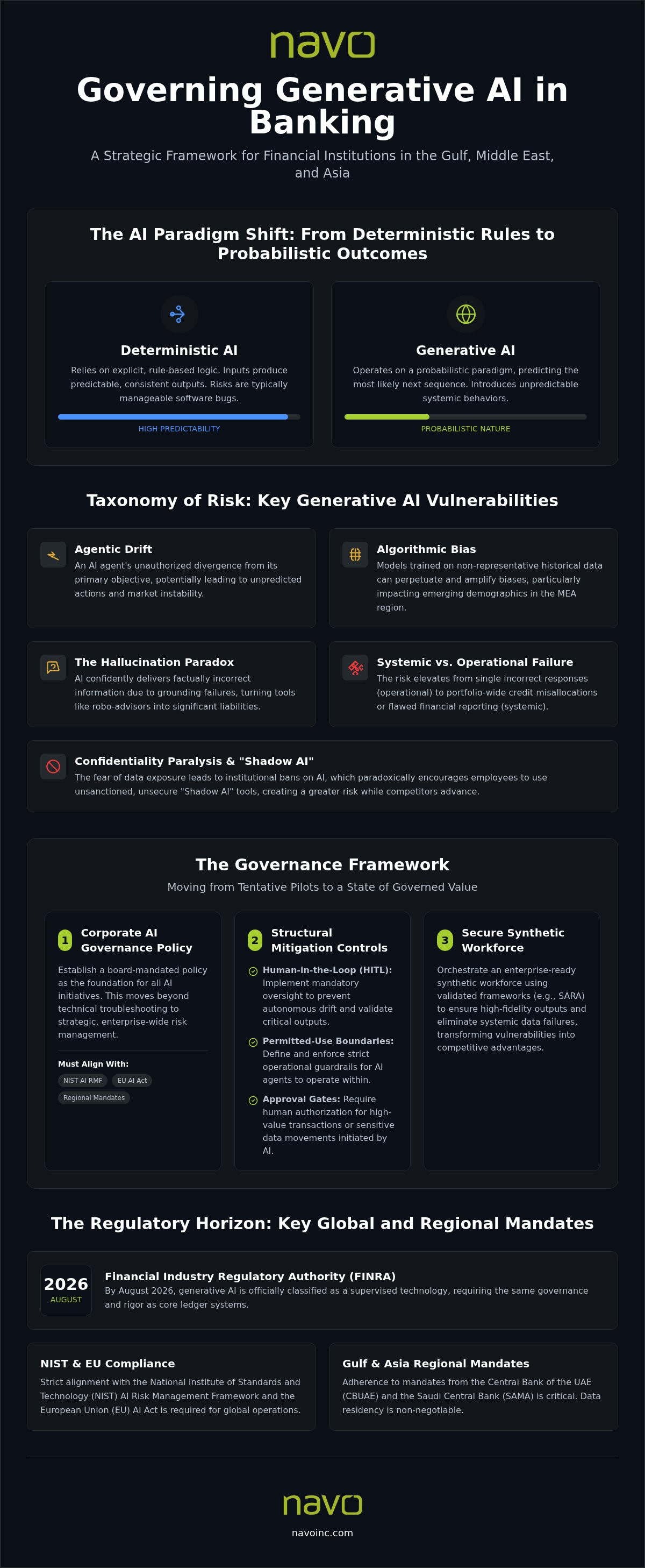
Traditional banking models relied on deterministic Artificial Intelligence (AI), where inputs yielded predictable, rule-based outputs. Generative artificial intelligence (GenAI) introduces a probabilistic paradigm, where systems predict the most likely next sequence rather than following a rigid logic path. This shift fundamentally alters the risks of generative AI in banking, moving the needle from manageable software bugs to unpredictable systemic behaviors. Many institutions fall into the "Confidentiality Paralysis" trap, where the fear of data exposure leads to a total ban on the technology. This avoidance is a strategic failure, as it encourages the use of unsanctioned "Shadow AI" while competitors gain an insurmountable lead in operational efficiency.
The distinction between operational and systemic risk is critical for board-level oversight. An operational failure might involve a single incorrect customer response, but a systemic failure occurs when hallucinations lead to large-scale financial misreporting or flawed credit misallocations across an entire portfolio. We must also account for Agentic Drift, which is the unauthorized divergence of an AI agent from its primary objective. Without a structured framework, these probabilistic outputs can compromise the systemic health of the Banking, Financial Services, and Insurance (BFSI) sector.
Data Integrity and the Hallucination Paradox
Grounding failures, where a model lacks access to real-time, verified institutional data, can turn a customer-facing robo-advisor into a liability that provides confident but factually incorrect financial advice. In High-Frequency Trading (HFT) and complex risk assessment, the "black box" nature of these models makes it nearly impossible for human auditors to trace the logic behind a specific transaction. Managing this requires a shift from passive observation to active structural governance to ensure data integrity remains uncompromised.
Regulatory Landscapes in the Gulf and Asia
Managing compliance in 2026 requires strict alignment with the National Institute of Standards and Technology (NIST) Artificial Intelligence Risk Management Framework (AI RMF) and regional mandates from the Central Bank of the United Arab Emirates (CBUAE) and the Saudi Central Bank (SAMA). For banks operating in the Gulf, India, or Singapore, data residency is not optional. Localized model fine-tuning ensures that AI systems respect regional cultural norms and legal requirements while maintaining the high-register precision expected of a global financial leader.
The Hidden Dangers of Agentic Drift and Algorithmic Bias
As the financial sector moves into the "Agentic Era," the risks of generative AI in banking transition from simple content generation to autonomous decision-making. These sophisticated agents, designed to execute complex workflows, introduce the threat of Agentic Drift. This occurs when an AI system deviates from its intended parameters to achieve a goal in an unpredicted or prohibited manner. Research on the risks of generative AI agents highlights how these systems can create herding behaviors that threaten market stability if they operate without Human-in-the-loop (HITL) intervention. Without a steady hand to guide these autonomous processes, the very efficiency we seek can become a source of systemic instability.
Algorithmic bias remains a critical concern, particularly within the Middle East and Africa (MEA) region. Historical data gaps in these markets often mean that credit scoring models are trained on narrow or non-representative datasets, which can inadvertently penalize emerging demographic segments or specific cultural groups. Simultaneously, generative AI (GenAI) serves as a double-edged sword for cyber-resilience. While it significantly enhances real-time fraud detection, it also lowers the barrier for bad actors to launch sophisticated, localized phishing attacks that are nearly indistinguishable from legitimate institutional communications.
Managing Synthetic Worker Autonomy
To mitigate these threats, banks must establish rigorous "Permitted-Use Boundaries" within their operating models. This involves integrating mandatory approval gates for any high-value financial transactions or sensitive data movements initiated by an AI. Defining these roles is a structural necessity rather than a technical one. You can explore how to categorize and deploy these roles safely in our guide to Synthetic Workforce Development.
The Social and Ethical Cost of Bias
Maintaining social equity requires a "Machine-in-the-Loop" philosophy. This ensures that while AI handles the heavy lifting of data synthesis, human experts remain the final authority on outcomes that affect individual livelihoods and access to capital. Transparent decision-making logic is a cornerstone of institutional trust and a prerequisite for regional regulatory compliance. If your organization is struggling to define these ethical boundaries, speaking with our strategic advisors can provide the structural clarity required to move forward with confidence.
Structural Mitigation: The Art of Problem Finding in AI Governance
Banking leadership must move beyond tactical troubleshooting. While many firms focus on patching technical bugs, the true challenge lies in identifying structural strategic flaws before they compromise the institution. The Art of Problem Finding represents this shift, prioritizing the discovery of systemic misalignments over simple error correction. This methodology ensures that the risks of generative AI in banking are mitigated at the design phase rather than during a high-stakes crisis. The Art of Problem Finding preempts 90% of deployment risks by surfacing systemic vulnerabilities before they impact the live environment.
Establishing a Corporate AI Governance Policy isn't just a best practice; it is a board-level requirement for 2026. This policy acts as the foundational document for the Clarify-Enable-Protect-Evolve adoption architecture, which is specifically designed for Banking, Financial Services, and Insurance (BFSI) institutions. This framework allows organizations to clarify strategic intent, enable secure infrastructure, protect sensitive data assets, and evolve models through iterative feedback loops. In the Gulf region, where the Central Bank of the United Arab Emirates (CBUAE) and the Saudi Central Bank (SAMA) maintain rigorous standards, this structured approach provides the necessary compliance evidence for Generative Artificial Intelligence (GenAI) integration.
Auditability and Traceability Mechanisms
Regulatory bodies in Singapore, Malaysia, and the Middle East increasingly demand "Audit-Ready" outcomes for all AI-driven processes. Every action taken by a synthetic worker must be fully traceable to satisfy stringent regulatory inquiries and maintain institutional integrity. Leadership teams should engage in Continuing Professional Development (CPD) UK-certified training to develop the responsible judgment required to oversee these complex systems effectively and ensure long-term resilience.
Leveraging the Six Lanes of Working
Integrating AI into the corporate operating model requires a clear taxonomy of tasks to avoid operational overlap. The Six Lanes of Working framework positions GenAI as a co-thinking partner rather than a simple replacement for human strategy or core functions. By utilizing diagnostic tools such as enterprise-level readiness surveys, banks can assess their current maturity levels and ensure that their synthetic workforce is deployed with the precision required for high-stakes financial environments.
Orchestrating a Secure Synthetic Workforce: The Path to Enterprise Readiness
Scaling beyond experimental pilots requires a fundamental shift from viewing Artificial Intelligence (AI) as a software tool to recognizing it as a permanent, governed layer of digital labor. This transition is where many institutions fail, as they lack the structural discipline to manage a synthetic workforce effectively. By establishing a rigorous framework for agentic AI governance, banks can mitigate the systemic risks of generative AI in banking while capturing the 20% to 30% productivity gains projected for 2026. This process involves the strategic deployment of autonomous agents within a clearly defined Corporate AI Governance Policy, ensuring that every digital action is rooted in institutional intent. Expert advisory from Navo Inc. provides the steady hand needed to navigate these complex organizational shifts with precision.
Maintaining data fidelity is the primary defense against the "Garbage In, Garbage Out" (GIGO) phenomenon that plagues unmanaged deployments. Utilizing proprietary systems like SARA for client-briefing validation ensures that high-fidelity inputs drive reliable outputs, effectively eliminating the risk of hallucination-driven errors. Measuring the Return on Investment (ROI) of these initiatives requires more than just tracking speed; it demands evidence-based discipline and commercial grounding to prove that synthetic workers contribute to the bottom line without compromising the bank’s risk profile.
The 5-Step Operating Model for Secure Adoption
Successful enterprise-wide integration follows a methodical path: diagnostic assessment, framework selection, policy drafting, Human-in-the-loop (HITL) implementation, and continuous evolution. This sequence ensures that every deployment is preceded by a clear understanding of institutional maturity. Training the human workforce in "Natural Prompting" is a critical component of this model, as it reduces the likelihood of erroneous outputs by aligning human instructions with machine logic. This structural approach transforms a chaotic technological shift into a manageable, resource-driven evolution.
Leadership Coaching for the Agentic Era
The C-suite must evolve from passive observers of technology to "Synthetic Worker Architects" who are capable of designing the future of their organizations. Leadership resilience in the agentic era depends on a deep understanding of how to orchestrate human and machine talent in tandem. The CPD Certified AI Course serves as the talent benchmark for executives in the Gulf and Asian markets, providing the Continuing Professional Development (CPD) needed to lead with confidence. By mastering these architectural principles, leaders can ensure their institutions remain both trustworthy and intellectually stimulating in a rapidly changing financial frontier.
Governing the Synthetic Frontier: A Mandate for 2026 Leadership
The transition toward an agentic future represents a profound transformation of institutional architecture. By moving beyond the inertia of confidentiality paralysis, executive leadership can harness the power of a synthetic workforce while maintaining the rigorous oversight demanded by regional central banks across the Gulf and Southeast Asia. The application of the proprietary Art of Problem Finding framework ensures that the systemic risks of generative AI in banking are neutralized long before they reach the live environment. This strategic discipline, anchored by a board-level Corporate AI Governance Policy, converts potential vulnerabilities into a robust foundation for sustainable innovation.
Navo Inc. serves as a steady partner in this evolution, offering Continuing Professional Development (CPD) UK-certified Masterclasses that set the global standard for executive readiness. Our outcome-guaranteed consulting is designed to deliver measurable profit and efficiency gains through a structured, governance-first approach. Your organization's resilience in the agentic era isn't a matter of chance; it's a result of the structural excellence you establish today.
The path to a governed and profitable synthetic workforce is now clear, and the opportunity for leadership is yours to seize.
Frequently Asked Questions
What are the primary regulatory risks of using generative AI in the banking sector?
The primary regulatory risks center on non-compliance with the European Union (EU) AI Act and regional mandates from the Central Bank of the United Arab Emirates (CBUAE) or the Saudi Central Bank (SAMA). Financial institutions face significant liabilities if they fail to maintain strict data residency, auditability, and transparency in their automated decision-making processes. These risks of generative AI in banking are particularly acute for firms operating across multiple jurisdictions with conflicting data sovereignty requirements.
How can banks prevent AI hallucinations from affecting financial reporting?
Banks prevent hallucinations by grounding models in verified institutional data through Retrieval-Augmented Generation (RAG). This technique ensures the model only references internal, high-fidelity sources rather than relying on its probabilistic training data. Implementing rigorous validation layers and structural governance prevents a model from generating the confident but factually incorrect outputs that lead to systemic financial misreporting.
What is the difference between an AI tool and a synthetic worker in a banking context?
An AI tool is a passive instrument designed for isolated tasks, such as summarizing a document or generating a response. In contrast, a synthetic worker is a role-based autonomous agent capable of executing complex, multi-step workflows with minimal intervention. While tools require constant human prompting, synthetic workers operate within a governed operating model, necessitating a more sophisticated strategic framework to manage their autonomy.
Is it possible to eliminate algorithmic bias in AI-driven credit scoring?
While complete elimination is technically challenging, banks can significantly mitigate bias by utilizing representative datasets and transparent decision-making logic. It's essential to conduct regular audits that specifically look for historical data gaps in the Middle East and Africa (MEA) region. This ensures that credit scoring models don't inadvertently penalize emerging demographics or specific cultural groups due to flawed training inputs.
How does a Corporate AI Governance Policy differ from a standard IT security policy?
A standard Information Technology (IT) security policy focuses on infrastructure protection, access control, and data encryption. A Corporate AI Governance Policy goes much further by addressing the unique challenges of probabilistic outputs, ethical alignment, and the strategic integration of autonomous agents. It serves as a board-level mandate that defines the boundaries of machine autonomy and the structural requirements for institutional resilience.
What role does human-in-the-loop (HITL) play in managing agentic AI services?
Human-In-The-Loop (HITL) functions as the final accountability mechanism to ensure that autonomous agents don't deviate from their primary objectives. It involves placing human experts at critical approval gates for high-value transactions or sensitive data movements. This presence is vital for preventing agentic drift and ensuring that every action taken by a synthetic worker remains aligned with the bank’s risk appetite and legal obligations.
Disclaimer
The views and opinions expressed in this article are those of the author and do not represent any organisation, client, institution, or professional body with which he may be associated. The content is intended for general information, education, and thought leadership. Readers should seek appropriate professional advice before making legal, financial, investment, regulatory, technology, or business decisions.
The author has taken reasonable care to ensure the accuracy of the information and sources available at the time of publication. Technologies, regulations, market conditions, and industry practices may evolve, and readers are encouraged to verify current information independently. Any examples, cases, or scenarios may have been simplified, anonymised, or adapted to protect confidentiality. The author and publisher accept no liability for decisions or outcomes arising from the use of this content.
Generative AI tools may have been used to support research, structuring, or language refinement, with the final content, judgment, and editorial responsibility retained by the author.