

If your organization views the cost of building a custom AI (Artificial Intelligence) agent as a static IT (Information Technology) expense rather than a dynamic capital allocation, you're likely part of the 60% of enterprises currently exceeding their budgets. You recognize that synthetic workers represent the next frontier of operational resilience; however, the lack of pricing transparency and the complexity of regional data sovereignty often stall momentum. This guide delivers a sophisticated breakdown of the strategic and technical investments required to deploy high performing agents within the UAE (United Arab Emirates) regulatory landscape.
We provide a clear framework for budgeting that distinguishes between initial development and long term operational value, including the necessary governance costs of machine in the loop oversight. You'll discover how to navigate API (Application Programming Interface) costs, such as the د.إ 110.10 per million tokens for premium output, while ensuring your deployment remains a functional asset rather than expensive shelfware. We conclude with a diagnostic approach to selecting partners who guarantee outcome based results; ensuring your transition to an agentic enterprise is both fiscally disciplined and strategically sound.
Key Takeaways
- You'll learn why transitioning from basic chatbots to sophisticated synthetic workers requires a shift in capital allocation from traditional IT expenses to strategic operational investments.
- You'll identify the primary structural drivers, such as LLM (Large Language Model) selection and RAG (Retrieval-Augmented Generation) infrastructure, that dictate the total cost of building a custom AI agent in 2026.
- You'll understand the mandatory role of Corporate AI Governance and performance monitoring in mitigating risks while ensuring compliance with UAE data sovereignty and regional regulatory standards.
- You'll discover a diagnostic framework for moving beyond "Confidentiality Paralysis" to achieve measurable ROI (Return on Investment) by converting agentic automation into synthetic profit.
- You'll see how applying "The Art of Problem Finding" prevents budget bloat by ensuring your AI deployment solves specific organizational challenges rather than creating technical debt.
The Economics of Agentic AI: Beyond Simple Development Costs
The transition from legacy chatbots to autonomous systems represents a fundamental shift in corporate architecture. Unlike basic conversational interfaces, an Intelligent Agent operates with a degree of agency, executing complex workflows across disparate software environments without constant human intervention. This evolution fundamentally alters the cost of building a custom AI agent, shifting the focus from simple interface development to complex cognitive architecture. While a chatbot is often a peripheral tool, a "Synth Worker" (AI Agent) functions as a scalable, synthetic employee. This requires a financial model closer to capital expenditure than traditional Software as a Service (SaaS) subscriptions, as the organization is investing in a proprietary asset that appreciates in value through continuous data refinement.
Most "Big 4" or "MBB" (McKinsey, Boston Consulting Group, Bain) firms approach AI through a billable-hour lens, often leading to protracted discovery phases that prioritize process over performance. Navo Inc. disrupts this paradigm by offering outcome-guaranteed strategic partnerships. Our methodology focuses on building high-stakes operational resilience rather than merely shipping code. We ensure that the investment remains a driver of systemic health rather than a drain on the balance sheet. By treating the cost of building a custom AI agent as an investment in a synthetic workforce, Dubai-based enterprises can achieve structural stability while pursuing radical progress.
The Art of Problem Finding: Reducing Wasteful AI Spending
The most significant drain on enterprise technology budgets isn't the technology itself, but the lack of strategic clarity. According to the BetterBriefs Global Report, poor brief quality leads to a 33% waste in marketing and technology budgets. Navo Inc. addresses this through a proprietary strategic audit designed to identify high Return on Investment (ROI) use cases before a single line of code is written. We practice "intellectual honesty," which occasionally means advising a client that an agent isn't necessary for their specific challenge. By prioritizing the "Art of Problem Finding," we prevent the deployment of expensive "shelfware" and ensure that every dirham (د.إ) spent contributes directly to the organization’s structural excellence.
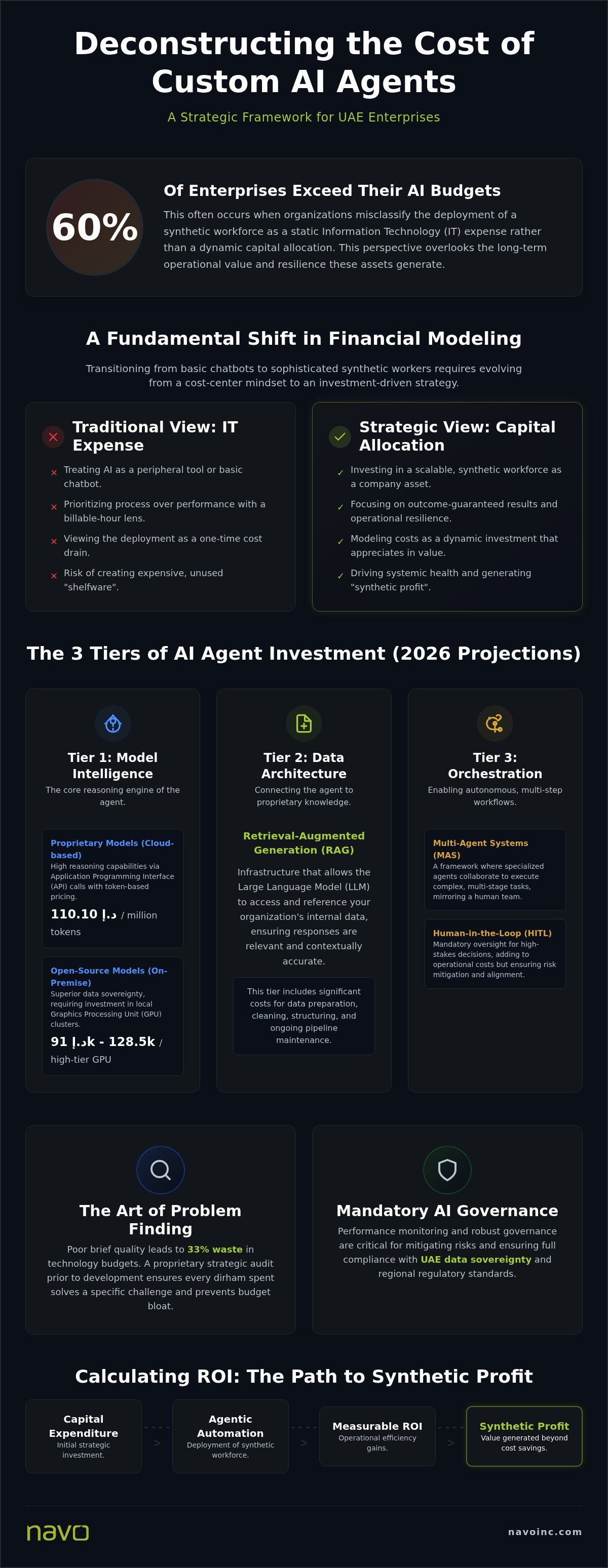
Structural Cost Drivers for Custom AI Agents in 2026
Determining the cost of building a custom AI agent requires a granular analysis of three primary structural tiers: model intelligence, data retrieval architecture, and agentic orchestration. In the current fiscal landscape, the market has matured beyond simple API (Application Programming Interface) calls. As highlighted in the 2026 AI Index Report, the economic viability of these systems depends heavily on inference volume and regional compliance requirements within the GCC (Gulf Cooperation Council). Proprietary models offer high reasoning capabilities with token based pricing; however, open source alternatives provide superior data sovereignty. The latter necessitates investment in on premise GPU (Graphics Processing Unit) clusters, where a single high tier processor can cost between د.إ 91,000 and د.إ 128,500.
Beyond the model itself, the complexity of Agentic Orchestration introduces a sophisticated layer of expenditure. High performing systems utilize a Multi Agent System (MAS) architecture. In this framework, NOVA-style project managers coordinate task specific agents to execute multi stage workflows. This orchestration ensures that synthetic workers don't just process information but manage outcomes with professional precision. For high stakes decision making, Human-in-the-Loop (HITL) integration is mandatory. This oversight layer adds to the operational budget but remains essential for mitigating risk and ensuring alignment with UAE (United Arab Emirates) regulatory standards. Organizations looking to optimize these structural drivers should consult with our strategic architects to ensure fiscal efficiency.
Model Selection and Data Pipeline Architecture
Enterprises must weigh the immediate convenience of cloud based token pricing against the long term security of local hosting. Data preparation remains a significant hurdle; cleaning and structuring proprietary datasets typically accounts for 25% to 35% of the total project budget. Retrieval-Augmented Generation (RAG) is a mechanism for grounding AI agents in real-time, verified enterprise data. This architectural choice prevents hallucinations and ensures that the agent's knowledge base remains current without the extreme expense of frequent model retraining.
Deployment, Governance, and the Operational Budget
Deployment represents a pivot from development to operational endurance. The total cost of building a custom AI agent remains incomplete without a dedicated allocation for Corporate AI Governance. This is not a secondary consideration; it's a structural necessity for ensuring auditability and mitigating algorithmic bias. Organizations often underestimate the "hidden" operational expenses associated with continuous performance monitoring. These systems require constant feedback loop optimization to prevent model drift and maintain peak efficiency.
Investment in the human element is equally critical. A synthetic workforce is only as effective as the leaders managing it. We recommend completing a CPD (Continuing Professional Development) certified AI course as a prerequisite for any enterprise scale deployment. This ensures that your team possesses the executive standard for synthetic workforce leadership, transforming AI from a technical experiment into a resilient organizational asset.
Regional Compliance and Data Sovereignty in the Middle East and Asia
Navigating the regulatory landscape of the GCC (Gulf Cooperation Council) and Southeast Asia introduces specific financial variables. Complying with the UAE (United Arab Emirates) Personal Data Protection Law (PDPL) and Saudi Arabia’s data protection frameworks requires localized data residency. Hosting AI workloads within regional hubs like Dubai or Singapore is a strategic imperative for maintaining data sovereignty. These choices impact infrastructure costs but provide the necessary legal resilience for modern enterprises.
Navo’s "Protect" phase in our adoption architecture is designed to manage these regulatory complexities with clinical precision. We ensure that your agentic systems are built on a foundation of systemic health, avoiding the catastrophic costs of non compliance. By addressing data sovereignty early, we convert a potential liability into a competitive advantage for regional leadership.
Calculating ROI: From Capital Expenditure to Synthetic Profit
Measuring the Return on Investment (ROI) for agentic systems requires moving beyond traditional cost saving metrics toward the generation of synthetic profit. Many executives suffer from "Confidentiality Paralysis," a hesitation to deploy agents due to concerns over data sovereignty or intellectual property. However, once an organization accepts the initial cost of building a custom AI agent as a strategic capital allocation, the focus shifts to reclaiming operational bandwidth. Our synthetic worker, SARA, demonstrates this by automating the client briefing process, which directly mitigates the 33% budget waste typical in poorly defined projects. By reclaiming these lost productivity hours, the agent pays for its own development within the first few quarters of activation.
Navo Management Consultants differentiates itself from traditional firms by offering outcome based consulting models that guarantee net profit increases. We don't just provide technical specifications; we architect systemic health. This approach ensures that every dirham (د.إ) invested contributes to a measurable uptick in organizational efficiency and revenue. To navigate this complex transition, we encourage leaders to initiate a Strategic AI Roadmap. This foundational document serves as the executive standard for navigating the 2026 technological landscape, ensuring your synthetic workforce is both fiscally disciplined and strategically aligned.
Building Your Strategic AI Roadmap with Navo
The transition to an agentic enterprise is a 5-week transformation journey that moves from rigorous preparation to full operational activation. We prioritize human ownership mechanisms, ensuring that your team remains the primary architect of change even as agents handle high volume cognitive tasks. This co-thinking model is essential for maintaining professional density and clarity in the "Agentic Era." It's about building a legacy of resilience and innovation that withstands the volatility of modern markets. Schedule a consultation to calculate the custom cost for your synthetic workforce and begin your journey toward radical progress.
Architecting the Agentic Future
Integrating synthetic workers into your organizational fabric demands a departure from legacy procurement mindsets. We've analyzed how the cost of building a custom AI agent involves balancing model intelligence with the complexities of regional data sovereignty and multi-agent orchestration. Prioritizing structural excellence through "The Art of Problem Finding" ensures your enterprise avoids the pitfalls of budget bloat and technical debt. By treating these deployments as capital allocations rather than peripheral expenses, you secure a foundation for long-term operational resilience.
Navo Management Consultants provides the expert hand needed to navigate these high-stakes shifts. Our proprietary SARA and NOVA architectures, combined with CPD (Continuing Professional Development) UK-certified leadership coaching, ensure your transition is both disciplined and visionary. We stand behind our strategic frameworks with outcome-guaranteed profit increases; transforming your AI investment into a resilient engine for synthetic profit.
The era of agentic automation is not a distant frontier. It's a present reality for leaders prepared to architect change and lead their industries with professional composure.
Frequently Asked Questions
Is it cheaper to build a custom AI agent or buy a pre-configured solution in 2026?
Custom builds are more sustainable for enterprises requiring deep integration with proprietary systems and unique regional workflows. While pre-configured solutions offer lower initial costs, they often lack the flexibility to handle complex GCC (Gulf Cooperation Council) regulatory requirements. Investing in a custom build creates a long-term asset that appreciates through data refinement. This strategic approach ensures the cost of building a custom AI agent translates into a durable competitive advantage rather than a temporary fix.
How does the "Art of Problem Finding" framework reduce the overall cost of AI development?
The "Art of Problem Finding" framework reduces total development costs by identifying high-yield use cases before a single line of code is written. Budget bloat often stems from building solutions for poorly defined organizational challenges. By applying this diagnostic methodology, we eliminate approximately 33% of wasteful spending associated with poor briefing and redundant feature development. This ensures that technical resources are allocated only to initiatives that guarantee measurable net profit increases.
What are the ongoing maintenance and API costs for an enterprise-level AI agent?
Ongoing expenses for an enterprise-level agent include API (Application Programming Interface) token fees and continuous performance monitoring. For high-stakes operations, token costs for premium output models are approximately د.إ 110.10 per million tokens. You should also budget for regular feedback loop optimization to prevent model drift. These maintenance costs typically range from 15% to 20% of the initial development expenditure annually to ensure the agent maintains peak operational efficiency.
Can I build a custom AI agent that complies with Middle Eastern data sovereignty regulations?
Custom agents are specifically designed to meet the rigorous data sovereignty standards of the UAE (United Arab Emirates) and Saudi Arabia. Generic cloud-based solutions often store data in external jurisdictions, creating significant compliance risks. A custom architecture allows for hosting on regional cloud infrastructure or on-premise servers within Dubai. This localized approach ensures that all synthetic worker operations remain fully compliant with the UAE Personal Data Protection Law (PDPL).
What is the typical timeline to see a positive ROI from a synthetic worker deployment?
Most enterprises achieve a positive ROI (Return on Investment) within six to twelve months of full activation. Initial gains are often realized by automating high-volume cognitive tasks, such as client briefing or data structuring, which reclaim significant productivity hours. The speed of return is accelerated when leadership teams undergo CPD (Continuing Professional Development) certified training. This ensures the human workforce is prepared to co-think effectively with their new synthetic counterparts.
Disclaimer
The views and opinions expressed in this article are those of the author and do not represent any organisation, client, institution, or professional body with which he may be associated. The content is intended for general information, education, and thought leadership. Readers should seek appropriate professional advice before making legal, financial, investment, regulatory, technology, or business decisions.
The author has taken reasonable care to ensure the accuracy of the information and sources available at the time of publication. Technologies, regulations, market conditions, and industry practices may evolve, and readers are encouraged to verify current information independently. Any examples, cases, or scenarios may have been simplified, anonymised, or adapted to protect confidentiality. The author and publisher accept no liability for decisions or outcomes arising from the use of this content.
Generative AI tools may have been used to support research, structuring, or language refinement, with the final content, judgment, and editorial responsibility retained by the author.