
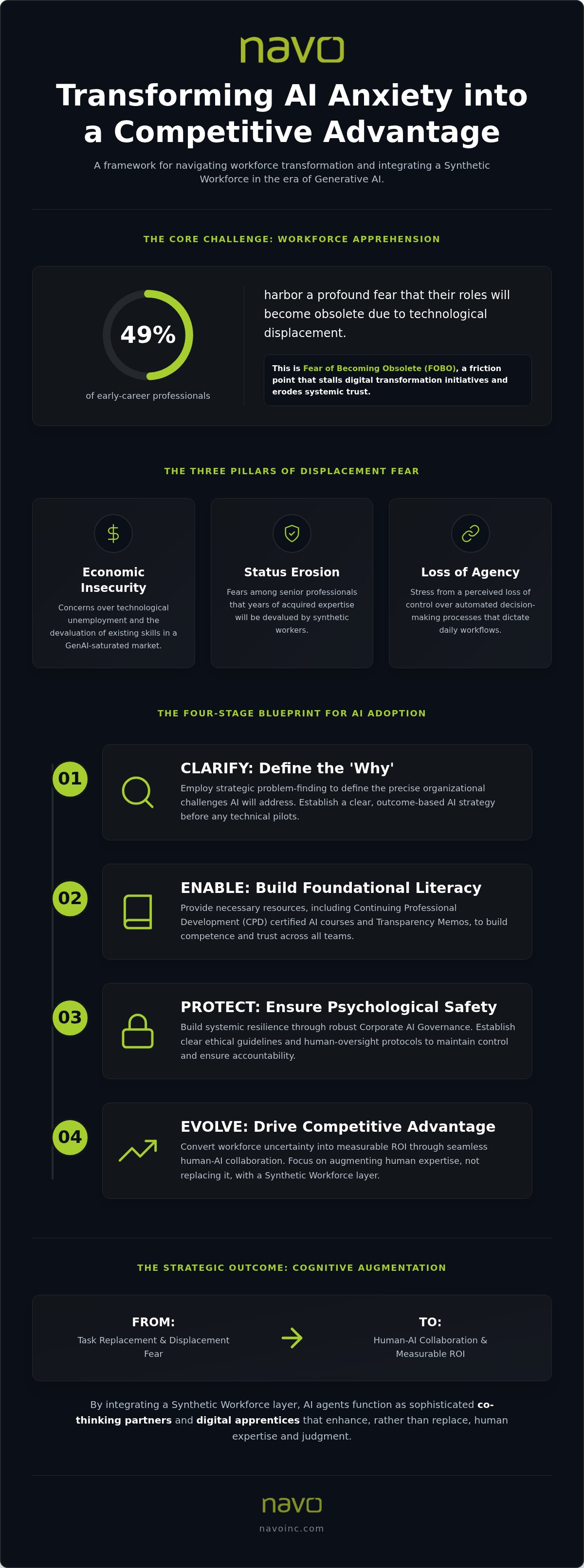
A July 2026 report reveals that 49 percent of early-career professionals harbor a profound fear that their roles will become obsolete due to technological displacement. You likely recognize that this friction, often defined as Fear of Becoming Obsolete (FOBO), is currently stalling your digital transformation initiatives and eroding systemic trust within your organization. Successfully managing employee anxiety about AI automation is no longer a peripheral human resources concern; it's a fundamental requirement for maintaining a high-performance culture in an era of rapid disruption.
This article delivers a sophisticated, framework-driven approach to transforming workforce apprehension into a strategic competitive advantage through transparent communication and the integration of a Synthetic Workforce layer. We'll explore how to deploy AI agents as sophisticated co-thinking partners while securing a measurable Return on Investment (ROI) from your Generative Artificial Intelligence (GenAI) adoption. By aligning your leadership strategy with the specific regulatory and cultural nuances of the United Arab Emirates (UAE) and the wider Gulf region, you can navigate this complex shift with professional composure and structural excellence.
Key Takeaways
- Analyze the psychological shift from task replacement to cognitive augmentation to address the root causes of resistance toward Artificial Intelligence (AI).
- Implement the Clarify-Enable-Protect-Evolve architecture to provide a structured roadmap for managing employee anxiety about AI automation across your organization.
- Integrate a Synthetic Workforce layer where AI agents, such as NOVA, function as digital apprentices that enhance, rather than replace, human expertise.
- Build systemic resilience and psychological security through robust Corporate AI Governance and Continuing Professional Development (CPD) UK-certified literacy programs.
- Convert workforce uncertainty into a competitive advantage by focusing on the measurable Return on Investment (ROI) generated through seamless human-AI collaboration.
Deciphering the Psychological Root of AI-Induced Workplace Anxiety
Automation anxiety represents a systemic response to perceived professional obsolescence, a phenomenon that transcends simple technical hesitation. For leaders in the United Arab Emirates (UAE), managing employee anxiety about Artificial Intelligence (AI) automation requires an understanding that the corporate world has moved beyond the era of simple task replacement. While legacy automation targeted manual labor, Generative Artificial Intelligence (GenAI) focuses on cognitive augmentation. This shift triggers deep-seated resistance because it challenges the fundamental value of human intellect and specialized judgment within the organizational hierarchy.
The "Identity Paradox" introduces a complex psychological barrier to evolution. The workforce often perceives AI as a direct competitor for professional identity, failing to recognize its potential as a sophisticated co-thinking partner. Distinguishing between healthy skepticism, which can drive rigorous quality control, and paralyzing fear is essential for executive leadership. The latter manifests as a complete rejection of innovation, necessitating immediate strategic intervention to restore organizational equilibrium and psychological safety.
The Three Pillars of Professional Displacement Fear
The psychological friction within modern workforces typically rests on three distinct pillars. Economic insecurity is the most visible, rooted in concerns over technological unemployment and long-term employability in a GenAI-saturated market. Status erosion follows, as senior professionals fear their years of acquired expertise will be devalued by synthetic workers. Finally, a loss of agency creates significant stress, as individuals feel they're losing control over automated decision-making processes that dictate their daily workflows.
Recognizing the Symptoms of Organizational Friction
Identifying these fears early is critical for maintaining high-performance cultures. You'll likely observe passive-aggressive resistance to new tool deployments, often masked as technical incompatibility or workflow misalignment. Another symptom is the "silo effect," where teams withhold critical data to protect their perceived individual value. Left unaddressed, this uncertainty severely impacts employee retention and mental well-being, particularly in high-stakes environments. Strategic intervention through frameworks developed by Navo Inc. can help stabilize these cultural shifts and convert fear into a collaborative advantage.
The Four-Stage Communication Blueprint for Generative AI (GenAI) Adoption
Managing employee anxiety about AI automation demands a disciplined architectural response rather than superficial reassurance. Navo Inc. utilizes the Clarify, Enable, Protect, Evolve adoption architecture as a primary diagnostic tool for leadership. This framework ensures that the impact of AI workplace anxiety on life satisfaction is mitigated through structural transparency. Peer-to-peer executive credibility remains the cornerstone of this approach. Leaders must articulate an Outcome-Based AI Strategy that prioritizes organizational health before initiating any technical pilot programs involving a Large Language Model (LLM) or Retrieval-Augmented Generation (RAG).
Inclusivity during this transition relies on linguistic clarity. Always expand technical terms like Large Language Model (LLM) or Retrieval-Augmented Generation (RAG) to prevent the alienation of non-technical stakeholders who may feel excluded by specialized jargon. This practice reinforces a culture of transparency and professional respect.
Phase 1 & 2: Clarification and Enablement
The Clarify phase employs the Art of Problem Finding to define the precise organizational challenges AI will address. Once the "why" is established, the Enable phase provides the necessary resources, such as a Continuing Professional Development (CPD) certified AI course, to build foundational literacy. For regional contexts like the Gulf Cooperation Council (GCC) and India, a Transparency Memo should be issued. This document must explicitly state that AI is a tool for augmentation, emphasizing collective stability and the preservation of professional dignity over mere cost-cutting measures.
Phase 3 & 4: Protection and Evolution
The Protect phase establishes rigorous Human-in-the-Loop (HITL) approval gates to maintain data security and ethical oversight. These gates ensure that human judgment remains the final arbiter of quality. Finally, the Evolve phase creates a feedback loop where employees participate in Machine-in-the-Loop iterations, refining the AI’s output through their unique expertise. This collaborative evolution transforms apprehension into a shared mission of excellence. If your organization requires a tailored roadmap, you can consult with our strategic advisors to begin your transformation.
Transitioning from Displacement Fears to Synthetic Workforce Collaboration
The transition from viewing Artificial Intelligence (AI) as a disruptive force to an integrated operational asset requires a fundamental redefinition of the workforce structure. Managing employee anxiety about AI automation is most effectively achieved by introducing the 'Synthetic Workforce' layer, where AI agents execute complex roles rather than isolated tasks. This evolution repositions orchestration agents like NOVA from perceived competitors to 'digital apprentices' that require human mentorship and oversight. By utilizing agentic AI services, organizations reclaim immense cognitive bandwidth for their employees. This allows the human workforce to pivot toward high-value strategic thinking and creative problem-finding. This 'Co-Thinking Partner' model replaces the anxiety of displacement with the security of collaborative intelligence, where human intuition guides machine precision.
The ROI of Human-Machine Synergy
Strategic synthetic workforce development enables the redefinition of traditional roles into more sophisticated versions of themselves. For instance, a standard Content Writer evolves into an AI Content Strategist and Editor, responsible for overseeing a fleet of generative agents. This structural pivot significantly reduces burnout by offloading repetitive cognitive labor, thereby stabilizing the emotional health of the organization and ensuring a measurable Return on Investment (ROI) on human capital. The focus shifts from primitive cost-cutting to aggressive profit-generation through enhanced output quality.
Implementing 'Machine-in-the-Loop' Thinking
Machine-in-the-Loop (MITL) thinking establishes a protocol where human judgment provides the essential strategic direction while AI provides the operational scale. Natural Prompting emerges as a core leadership skill, allowing managers to direct synthetic assets with linguistic precision. These workers are not temporary digital tools. They are permanent organizational assets that retain institutional memory and enhance team resilience during periods of rapid market fluctuation. This partnership ensures that the human element remains the definitive architect of value, maintaining control over the final output through rigorous approval gates.
Establishing Governance and CPD-Certified Literacy for Long-Term Resilience
Establishing a robust Corporate AI Governance Policy is the definitive step in managing employee anxiety about AI automation. Governance provides the structural guardrails necessary to create a safe harbor for innovation, effectively transitioning the workforce from a state of "confidentiality paralysis" to governed value creation. In the United Arab Emirates (UAE) and Singapore, where data sovereignty and regulatory compliance are paramount, governance frameworks must be tailored to regional sensitivities. A clear policy ensures that Generative Artificial Intelligence (GenAI) adoption is not a chaotic disruption but a disciplined evolution toward systemic health.
The Strategic Importance of AI Governance
Effective governance requires the implementation of human-ownership mechanisms and risk-based decision paths. Accountability rules are essential to protect employees from the repercussions of potential algorithmic errors, ensuring that the human remains the final arbiter of quality. By integrating Environmental, Social, and Governance (ESG) principles into the AI transformation strategy, leadership demonstrates a commitment to ethical progress. This structural transparency mitigates the fear of the unknown, providing a logical response to the complexities of the modern technological landscape.
Future-Proofing Through Continuous Education
The 2026 Talent Benchmark establishes "Synthetic Skills" as the new standard for executive and operational excellence. Continuing Professional Development (CPD) United Kingdom (UK) accredited training is essential for building trust and professionalizing AI competencies within the organization. Navo Inc. provides modular professional development pathways that allow all levels of management to evolve alongside the technology. This commitment to education ensures that the workforce remains resilient, capable, and intellectually stimulated by the potential of human-AI collaboration.
Architecting a Resilient Future Through Governed AI Integration
Successfully managing employee anxiety about AI automation requires shifting the narrative from displacement to augmentation through the Clarify-Enable-Protect-Evolve architecture. By establishing a Synthetic Workforce layer, you transform potential friction into a sustainable competitive advantage. This transition is anchored in rigorous Corporate AI Governance and the professionalization of skills through Continuing Professional Development (CPD) UK-certified masterclasses. It's about building a stable, high-performance culture that views technology as a co-thinking partner rather than a replacement for human intellect.
Navo Inc. brings specialized expertise in the Gulf Cooperation Council (GCC) and Asian markets, providing outcome-guaranteed consulting that respects regional cultural norms and regulatory standards. Our approach ensures that your leadership remains a steady, expert hand during complex organizational shifts. We focus on delivering a measurable Return on Investment (ROI) from Generative Artificial Intelligence (GenAI) adoption while maintaining the systemic health and psychological security of your workforce.
The era of human-AI collaboration isn't a threat to be managed; it's a frontier to be mastered. With the right strategic framework, your organization won't just survive the transition. It will lead the next generation of industrial excellence across the Middle East and beyond.
Frequently Asked Questions
What is the most common cause of employee resistance to AI automation in 2026?
The primary driver of resistance in 2026 is "Fear of Becoming Obsolete" (FOBO), specifically regarding the displacement of cognitive expertise. Employees often view Artificial Intelligence (AI) as a direct competitor rather than a co-thinking partner, leading to a defensive stance. This psychological friction is a natural systemic response when managing employee anxiety about AI automation, as individuals perceive a loss of professional identity and long-term economic security within the organization.
How can leaders expand technical abbreviations to improve AI literacy?
Leaders should prioritize linguistic inclusivity by explicitly defining complex terminology during all organizational communications. For instance, always expand Large Language Model (LLM) or Retrieval-Augmented Generation (RAG) upon their first mention. This practice removes the barrier of specialized jargon, ensuring that non-technical stakeholders feel integrated into the digital transformation process rather than alienated by it. Clear communication remains a fundamental pillar of structural transparency and workforce trust.
Is it better to hire new AI talent or upskill the existing workforce?
A strategic balance is required, but upskilling the existing workforce offers a higher Return on Investment (ROI) due to the preservation of institutional memory. Training current employees through Continuing Professional Development (CPD) United Kingdom (UK) certified programs ensures that those with deep domain expertise can direct synthetic assets effectively. While hiring new talent provides technical specialized skills, upskilling fosters a culture of loyalty and resilience during periods of rapid technological evolution.
What are the legal considerations for AI automation in the GCC region?
Organizations in the Gulf Cooperation Council (GCC) must navigate evolving data sovereignty regulations and regional labor laws that emphasize employee protection. By 2026, many jurisdictions have implemented stricter transparency requirements regarding the use of AI in employment decisions. Establishing a robust Corporate AI Governance Policy is essential to ensure compliance with local standards in the United Arab Emirates (UAE) and Saudi Arabia, protecting the firm from legal liabilities and algorithmic bias.
How does a 'Synthetic Workforce' differ from traditional software automation?
Traditional software automation is designed to execute repetitive, rule-based tasks within rigid parameters. In contrast, a Synthetic Workforce utilizes Agentic Artificial Intelligence (AI) to execute entire roles and manage complex, multi-step workflows. This layer operates with a degree of autonomous reasoning, serving as a digital apprentice that can adapt to changing contexts. It represents a shift from mechanical execution to collaborative cognitive augmentation, where AI agents function as sophisticated co-thinking partners.
Can Generative AI (GenAI) coaching really improve employee morale?
Generative Artificial Intelligence (GenAI) coaching significantly improves morale by replacing uncertainty with competence and a sense of agency. When employees understand how to orchestrate AI agents effectively, their anxiety regarding displacement diminishes. This professional development empowers the workforce to offload repetitive cognitive labor, allowing them to focus on high-value strategic initiatives. Managing employee anxiety about AI automation through expert coaching builds a high-performance culture rooted in psychological security and technological mastery.
Disclaimer
The views and opinions expressed in this article are those of the author and do not represent any organisation, client, institution, or professional body with which he may be associated. The content is intended for general information, education, and thought leadership. Readers should seek appropriate professional advice before making legal, financial, investment, regulatory, technology, or business decisions.
The author has taken reasonable care to ensure the accuracy of the information and sources available at the time of publication. Technologies, regulations, market conditions, and industry practices may evolve, and readers are encouraged to verify current information independently. Any examples, cases, or scenarios may have been simplified, anonymised, or adapted to protect confidentiality. The author and publisher accept no liability for decisions or outcomes arising from the use of this content.
Generative AI tools may have been used to support research, structuring, or language refinement, with the final content, judgment, and editorial responsibility retained by the author.