

The era of treating Artificial Intelligence (AI) as a mere collection of experimental chat interfaces has concluded; in its place, a disciplined era of the synthetic workforce has arrived. Many leaders across the Gulf Cooperation Council (GCC) and Southeast Asia find themselves paralyzed by an abundance of tools that offer novelty but lack structural utility. Identifying high-impact AI agent use cases is no longer a matter of technological curiosity but a core requirement for organizational resilience. You've likely realized that the initial wave of Generative Artificial Intelligence (GenAI) adoption often prioritized speed over systemic health, leaving your teams with fragmented workflows and unresolved questions about data sovereignty.
It's understandable to feel cautious when regional regulatory frameworks and the complexity of existing legacy systems seem to move at different speeds. This guide promises to move beyond the hype, providing a curated roadmap for transitioning from isolated tools to a sophisticated, governed synthetic workforce that drives measurable profit. We'll explore a framework for identifying the specific friction points where AI can excel, examine the nuances of managing a human-agent hybrid workforce, and provide a diagnostic pathway to ensure your technological evolution remains both secure and strategically sound.
Key Takeaways
- Distinguish between passive Generative Artificial Intelligence (GenAI) and active synthetic workers to move beyond simple chat interfaces toward autonomous, multi-step goal execution.
- Analyze high-impact AI agent use cases across marketing and supply chain functions to eliminate operational waste and navigate complex Middle East and North Africa (MENA) logistics.
- Apply "The Art of Problem Finding" to diagnose organizational friction points, ensuring technological investments address high-stakes business challenges rather than superficial needs.
- Integrate the "Six Lanes of Working" framework to position agents as strategic co-thinking partners while upholding rigorous Agentic Artificial Intelligence (AI) Governance.
- Scale your synthetic workforce using a structured architecture to maintain compliance with the evolving regulatory standards of the Gulf Cooperation Council (GCC) and broader Asian markets.
Defining the Agentic Era: From Generative Tools to Synthetic Workforces
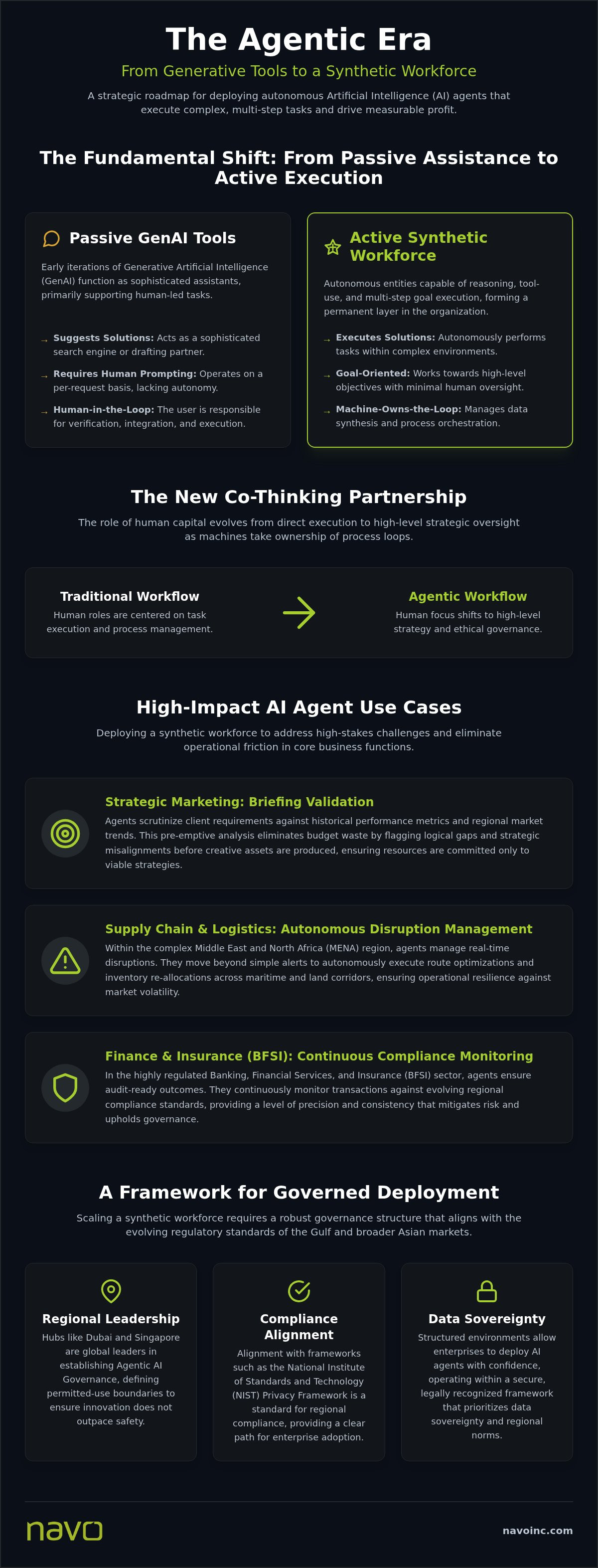
The transition from passive Generative Artificial Intelligence (GenAI) to active agentic systems represents a fundamental restructuring of the corporate architecture. While early iterations of GenAI functioned as sophisticated search engines or drafting assistants, the current environment demands autonomous entities capable of reasoning, tool-use, and multi-step goal execution. We've moved beyond the "chatbot" phase into a period defined by the synthetic worker. These agents don't just suggest solutions; they execute them within complex environments, often with minimal human oversight. In 2026, the most effective AI agent use cases treat these systems as a permanent Synthetic Workforce Layer that sits alongside traditional human teams on the organizational chart.
This shift introduces the "Co-Thinking Partner" model. In this framework, the machine isn't a subordinate tool but a strategic collaborator that manages the heavy lifting of data synthesis and process orchestration. This evolution requires a move away from "confidentiality paralysis" toward governed value, where enterprises deploy agents with clear boundaries and high-level objectives. The goal isn't just efficiency; it's the creation of an operational resilience that can withstand rapid market shifts through the deployment of autonomous, self-correcting workflows.
The Evolution of Machine-in-the-Loop Thinking
Traditional human-centric workflows are undergoing a radical transformation as machines take ownership of process execution. This change necessitates a high degree of "Intellectual Honesty" from executive leadership. Organizations must rigorously assess where human cognitive biases or fatigue degrade performance compared to an agent's tireless consistency. When machines move from being "in the loop" to "owning the loop," human roles pivot toward high-level strategy and ethical oversight, ensuring the synthetic workforce remains aligned with core corporate values.
Regional Regulatory Landscape: Gulf and Asia
Dubai and Singapore have emerged as global leaders in establishing Agentic Artificial Intelligence (AI) Governance. These regions define permitted-use boundaries, ensuring innovation doesn't outpace safety. Alignment with the National Institute of Standards and Technology (NIST) Privacy Framework is now a standard for regional compliance. This structured environment allows enterprises to deploy AI agent use cases with confidence, ensuring synthetic workforces operate within a secure, legally recognized framework that prioritizes data sovereignty and regional norms.
High-Impact AI Agent Use Cases Across Enterprise Functions
Deploying a synthetic workforce requires moving beyond generic productivity toward high-stakes functional excellence. In Strategic Marketing, one of the most effective AI agent use cases involves briefing validation. These agents scrutinize client requirements against historical performance metrics to eliminate budget waste before a single creative asset is produced. By the time a human strategist reviews the brief, the agent has already flagged logical gaps and misalignments with regional market trends, ensuring that resources are only committed to viable strategies.
Supply Chain and Logistics operations within the Middle East and North Africa (MENA) region benefit from autonomous agents that manage real-time disruption. These systems don't just alert managers to delays; they execute route optimization and inventory re-allocation across complex maritime and land corridors. Similarly, in the Banking, Financial Services, and Insurance (BFSI) sector, agents ensure audit-ready outcomes by continuously monitoring transactions against evolving regional compliance standards. This level of precision allows executives to consult with experts on scaling these capabilities without compromising governance or data integrity.
SARA and NOVA: Specialized Agent Archetypes
Specialized orchestration is best exemplified by proprietary agent archetypes designed for specific workflow friction points. SARA acts as a Synthetic Client-Briefing Specialist, drastically reducing time-to-acceptance by validating complex project scopes against organizational benchmarks. NOVA, a Project Orchestration agent, manages the intricate feedback loops and approval gates that often stall enterprise initiatives. These agents function as co-thinking partners, maintaining momentum in environments where human cognitive load often leads to bottlenecks.
Sector-Specific Applications in the Gulf States
The Real Estate and Energy sectors in the Gulf Cooperation Council (GCC) utilize agents for sophisticated Environmental, Social, and Governance (ESG) reporting and predictive modeling. These agents synthesize vast datasets to ensure alignment with national sustainability mandates and regional energy transitions. Additionally, government entities are integrating these systems into citizen-centric digital transformation initiatives, using agents to handle multi-step administrative processes that previously required extensive manual intervention, thereby enhancing the speed and accuracy of public service delivery.
The Strategic Framework: Transitioning from Chatbots to Agentic Orchestration
Many enterprises fail because they rush to implement AI agent use cases without a diagnostic foundation. It's easy to automate a process; it's difficult to ensure that process actually generates value. This is where "The Art of Problem Finding" becomes essential. This proprietary diagnostic approach requires leaders to look past surface symptoms of inefficiency to identify the structural friction points that truly hinder growth. The transition from speculative experimentation to structured deployment requires a lens that prioritizes systemic health over mere speed.
To scale effectively, we utilize the Clarify, Enable, Protect, and Evolve Adoption Architecture. This structured pathway moves an organization through four distinct phases. First, we clarify the specific business outcomes and agentic boundaries. Second, we enable the workforce by equipping them with the "Synthetic Skills" needed for collaboration. Third, we protect the organization by establishing rigorous Agentic Artificial Intelligence (AI) Governance. Finally, we evolve the system by refining the agentic layer based on real-world performance data. This methodical progression ensures that the synthetic workforce remains an asset rather than a liability.
Establishing Machine-in-the-Loop approval protocols ensures that while agents execute, humans retain ownership of the outcomes. This isn't just a safety measure; it's a requirement for maintaining the intellectual integrity of the organization. Calculating the Return on Investment (ROI) of a synthetic workforce must also move beyond vague metrics. We focus on measurable net-profit increases, examining how agentic orchestration reduces cycle times and eliminates error-related costs across the Gulf region's high-stakes sectors.
From Confidentiality Paralysis to Governed Value
Initial hesitation often stems from "confidentiality paralysis," where the fear of data leakage stalls progress. Overcoming this requires a robust Corporate AI Governance Policy that defines clear parameters for data handling. Building these internal capabilities is supported by Continuing Professional Development (CPD) UK-certified coaching. These masterclasses equip leadership teams with the technical and strategic literacy required to manage a hybrid workforce effectively and ethically.
Diagnostic Tools for Readiness
Before deployment, organizations should use readiness surveys and ROI calculators to benchmark their current maturity. These tools provide a baseline for the Navo's enterprise AI adoption framework, ensuring that the transition is data-driven rather than speculative. By assessing your current state, you can ensure that your investment in Generative Artificial Intelligence (GenAI) is strategically aligned with your long-term resilience goals.
Governance and the Human-Agent Co-Thinking Partnership
Sustaining a synthetic workforce requires a shift from operational oversight to a framework of Agentic Artificial Intelligence (AI) Governance. It's not enough to deploy technology; you must manage accountability and data safeguards with the same rigor applied to human capital. When exploring sophisticated AI agent use cases, the focus must remain on systemic health and the protection of intellectual property. A critical component of this transition is the "Six Lanes of Working" framework. This model positions Generative Artificial Intelligence (GenAI) as a strategic co-thinking partner, clearly defining where agents lead, where humans intervene, and where the two intersect. By categorizing tasks into these distinct lanes, organizations avoid the common pitfall of treating AI as a mere replacement tool, instead leveraging it as a force multiplier for complex decision-making.
Trust remains the primary currency of any organizational shift. Leaders must implement a "Post-Conflict Playbook" to address the psychological and structural friction that arises during the transition to a hybrid workforce. This involves transparent communication and a commitment to future-proofing talent through CPD (Continuing Professional Development) certified AI courses. These programs ensure that your team's skills evolve alongside the technology, maintaining a competitive edge while fostering a culture of innovation and professional composure.
Ethics, Anonymisation, and Auditability
Data handling in the Middle East and wider Gulf region requires strict adherence to regional norms and international standards. Implementing Information Commissioner’s Office (ICO) aligned anonymisation guidance ensures that sensitive corporate and personal data remain protected. Every action taken within your AI agent use cases must be captured in an audit-ready format. This level of transparency is vital for regulatory oversight and internal quality control, providing a clear trail of machine reasoning and execution that satisfies both legal mandates and executive scrutiny.
Next Steps for the C-Suite
The window for speculative pilot programs is closing. Executives must now move toward full-scale synthetic workforce deployment to capture market share and ensure long-term resilience. Engaging with a generative AI consulting service provides the strategic depth needed to guarantee profit outcomes and operational stability. It's time to move beyond the experimental and establish a permanent, governed layer of synthetic workers that drive measurable value and structural excellence.
Architecting Your Synthetic Workforce Strategy
The integration of a synthetic workforce layer represents the definitive boundary between organizations that merely react to technological shifts and those that architect them. Success in 2026 depends on moving beyond fragmented experimentation toward a governed, co-thinking partnership. By prioritizing "The Art of Problem Finding," leadership teams can identify the specific friction points where agentic orchestration delivers the highest structural value. Whether navigating the regulatory landscapes of the Gulf or optimizing complex global supply chains, the focus remains on measurable profit and operational resilience through sophisticated AI agent use cases.
Our approach combines intellectually rigorous strategy with practical execution. Through Continuing Professional Development (CPD) UK-certified Masterclasses and outcome-guaranteed strategy consulting, we provide the steady hand needed to navigate these complex organizational shifts. The era of the passive tool has ended; the era of the strategic synthetic partner has begun. It's time to lead your organization into a more resilient, Generative Artificial Intelligence (GenAI) driven future.
Strategic Insights: Frequently Asked Questions
What is the difference between an AI chatbot and an AI agent?
An Artificial Intelligence (AI) chatbot is fundamentally reactive, providing information only when prompted, whereas an AI agent is autonomous and goal-oriented. Agents possess the capability to reason, use external tools, and execute multi-step processes without constant human intervention. They represent a shift from passive interfaces to active synthetic workers that can manage entire workflows independently within a corporate environment.
How do AI agents handle data privacy in highly regulated regions like the UAE or Singapore?
Handling data privacy in the United Arab Emirates (UAE) or Singapore requires a rigorous approach to Agentic Artificial Intelligence (AI) Governance. Agents must operate within local data residency laws and utilize Information Commissioner’s Office (ICO) aligned anonymisation techniques to protect sensitive information. This ensures that AI agent use cases remain compliant with regional mandates while allowing for the synthesis of high-value corporate data.
Can AI agents really replace human workers in complex decision-making roles?
AI agents are designed to function as co-thinking partners rather than wholesale replacements for human expertise in complex decision-making. We utilize the "Six Lanes of Working" framework to delineate where machines lead and where humans provide critical ethical and strategic oversight. Human workers remain the final authority on high-stakes outcomes, while agents manage the cognitive load of data processing and execution.
What are the common risks associated with deploying autonomous agents in an enterprise environment?
The primary risks include "confidentiality paralysis," where fear of data exposure halts innovation, and the potential for logic errors in autonomous execution. Without a structured Corporate AI Governance Policy, agents may operate outside of permitted-use boundaries. Ensuring every agentic action is captured in an audit-ready format is essential for mitigating these risks and maintaining organizational control over the synthetic workforce.
How do I measure the ROI of a synthetic workforce implementation?
Measuring the Return on Investment (ROI) of a synthetic workforce requires moving beyond vague efficiency metrics toward a focus on net-profit increase. Organizations should analyze specific AI agent use cases by tracking reductions in project cycle times and the elimination of costly manual errors. This diagnostic approach allows executives to quantify the value of agentic orchestration in direct financial terms, ensuring long-term operational resilience.
Disclaimer
The views and opinions expressed in this article are those of the author and do not represent any organisation, client, institution, or professional body with which he may be associated. The content is intended for general information, education, and thought leadership. Readers should seek appropriate professional advice before making legal, financial, investment, regulatory, technology, or business decisions.
The author has taken reasonable care to ensure the accuracy of the information and sources available at the time of publication. Technologies, regulations, market conditions, and industry practices may evolve, and readers are encouraged to verify current information independently. Any examples, cases, or scenarios may have been simplified, anonymised, or adapted to protect confidentiality. The author and publisher accept no liability for decisions or outcomes arising from the use of this content.
Generative AI tools may have been used to support research, structuring, or language refinement, with the final content, judgment, and editorial responsibility retained by the author.