

The era of treating Artificial Intelligence (AI) as a collection of isolated productivity tools is over, and enterprises that fail to transition toward a unified architectural strategy risk permanent structural obsolescence. Many leadership teams find themselves trapped in a state of confidentiality paralysis, where legitimate data security fears stifle the very innovation intended to drive growth. You've likely observed that fragmented agents often fail to communicate, leading to a visible lack of measurable Return on Investment (ROI) from your current technology spend. Our approach to ai integration consulting moves beyond simple software deployment to architecting a sophisticated synthetic workforce layer that functions as a strategic co-thinking partner.
We understand the frustration of seeing vast potential buried under layers of technical debt and regulatory uncertainty. This article provides a clear roadmap for enterprise-wide orchestration, promising a framework where profit and efficiency gains are not just hoped for but guaranteed through rigorous governance. We'll explore how to align these high-performance systems with the specific regional regulations of the Gulf states and broader Middle East, ensuring your transition to a 2026-ready organization is both secure and radically profitable.
Key Takeaways
- Transition from fragmented, tool-first deployments to a strategic orchestration of Generative Artificial Intelligence (GenAI) within core business operations.
- Explore how specialized synthetic workers like SARA and NOVA maintain a single source of truth and automate complex validation tasks across your enterprise.
- Discover how professional ai integration consulting resolves "Confidentiality Paralysis" by aligning systems with the National Institute of Standards and Technology (NIST) Privacy Framework.
- Secure the Agentic AI era in the Banking, Financial Services, and Insurance (BFSI) sector through rigorous data anonymization and regional regulatory compliance.
- Access a structured blueprint for moving from pilot to profit using the 5-week Navo Masterclass and data-driven Return on Investment (ROI) diagnostic tools.
The Strategic Imperative: Why Tool-First AI Integration Fails the Enterprise
Enterprise leadership often mistakes the procurement of Generative Artificial Intelligence (GenAI) licenses for a digital transformation strategy. True ai integration consulting is the strategic orchestration of these technologies into the foundational architecture of an organization. Many firms across the Gulf and Southeast Asia are currently trapped in "Confidentiality Paralysis," a state where valid concerns over data sovereignty and security halt progress at the pilot stage. This stagnation occurs when the focus remains on the tool rather than the systemic solution.
Unlike the generic, volume-based implementation strategies often favored by "Big 4" firms, a sophisticated approach begins with the "Art of Problem Finding." This diagnostic phase ensures we don't apply high-cost technology to low-value problems. It's about identifying the structural bottlenecks where a synthetic workforce can deliver the highest net-profit increase. High-level ai integration consulting requires this shift from being a passive tool-user to becoming a disciplined architect of change.
The Fallacy of Discrete AI Agents
Implementing uncoordinated agents leads to fragmented data silos and operational friction. When agents don't share a common logic or communication protocol, they become liabilities rather than assets. We advocate for a unified Synthetic Workforce Layer, a cohesive environment where agents collaborate under a centralized governance framework. This ensures systemic health and prevents the "agent sprawl" that currently plagues disconnected enterprise environments.
Framework-Led Adoption: The Clarify-Enable-Protect-Evolve Architecture
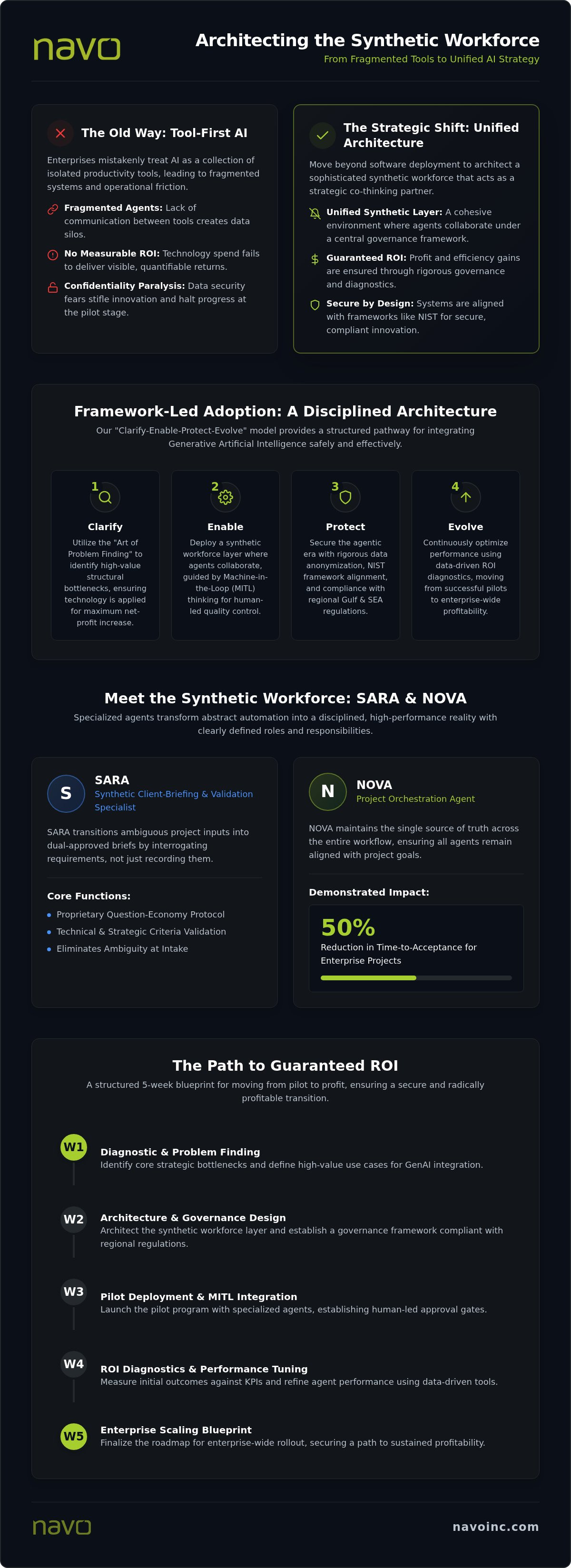
Scaling requires a disciplined architecture to avoid the chaotic sprawl of rapid adoption. Our "Clarify-Enable-Protect-Evolve" model provides a structured pathway for integrating GenAI safely. A critical component is Machine-in-the-Loop (MITL) thinking, which ensures human expertise remains the primary arbiter of quality while the synthetic layer handles the heavy cognitive lifting. This balance is essential for maintaining the high standards required by regulatory bodies in Dubai and Singapore.
Architecting a Synthetic Workforce: A Case Study in Agentic AI Orchestration
Scaling the utility of Generative Artificial Intelligence (GenAI) requires a shift from passive tools to active, role-defined workers. Effective ai integration consulting transforms the abstract promise of automation into a disciplined, agentic reality. We achieve this by deploying specialized entities like SARA, a Synthetic Client-Briefing & Validation Specialist. SARA doesn't merely record requirements; she interrogates them. By utilizing our proprietary Question-Economy Protocol, she transitions raw, often ambiguous project inputs into dual-approved briefs that meet both technical and strategic criteria.
While SARA manages the intake, NOVA, our Project Orchestration Agent, maintains the "source of truth" across the entire workflow. NOVA ensures that every uncoordinated agent within the ecosystem remains aligned with the overarching project goals. This orchestration has demonstrated a 50% reduction in time-to-acceptance for enterprise projects, as it eliminates the typical back-and-forth caused by misaligned expectations. Organizations that consult with our strategic architects find that this rigor replaces chaos with a predictable, high-performance output.
Role Definition for Synthetic Workers
Success in this era depends on precise role definition. Each synthetic worker must have clearly delineated responsibilities, memory retention parameters, and specific tool-usage permissions. We implement "Approval Gates" at every critical juncture. These gates ensure that human leaders maintain absolute ownership over AI-generated outcomes, preventing the "black box" effect that often leads to operational drift. It's a structured partnership where the machine handles the cognitive load and the human provides the final validation.
Scaling Operational Efficiency in Hubs like Dubai and Singapore
In high-velocity markets like Dubai and Singapore, where operational agility is a competitive mandate, the deployment of a synthetic layer is no longer optional. These regions demand a level of precision and speed that traditional human-only workflows struggle to maintain. By integrating these agentic systems, firms can scale their operations without a linear increase in headcount. For a deeper analysis of this transition, explore our guide on synthetic workforce development to understand how these roles fit into a modern organizational chart.
Corporate AI Governance: Securing the Agentic Era in the Gulf and Beyond
The transition to an agentic workforce necessitates a robust Corporate AI Governance policy that transcends basic compliance. Sophisticated ai integration consulting ensures that these systems align with the National Institute of Standards and Technology (NIST) Privacy Framework while respecting the unique sovereign data laws of the United Arab Emirates (UAE) and the Kingdom of Saudi Arabia (KSA). For organizations in the Banking, Financial Services, and Insurance (BFSI) and healthcare sectors, the stakes are exceptionally high. We implement rigorous data anonymization protocols that allow synthetic workers to process sensitive information without exposing the underlying private records.
Ethical implementation isn't a passive checkbox exercise. We advocate for the appointment of a Certified Independent Director to oversee the ethical trajectory of the synthetic workforce. This role provides the objective oversight necessary to prevent algorithmic bias and ensure that the "Protect" phase of our architecture remains uncompromised. This leadership layer bridges the gap between technological capability and corporate responsibility, grounding innovation in systemic health and regional cultural norms.
Human-Ownership Mechanisms
Accountability must be hard-coded into the integration lifecycle. We establish risk-based decision paths that trigger mandatory human intervention whenever an AI agent encounters a high-variance scenario. These rules prevent "black box" autonomous failures by ensuring that a human expert is always the final arbiter of significant corporate actions. It's about maintaining absolute control over the evolution of the system as it scales across your enterprise.
Governing the Synthetic Skills Gap
Maintaining high performance requires a commitment to continuous education. Integration success is inextricably linked to certified AI professional training, which ensures your leadership understands the mechanics of the workforce they oversee. We mandate a 24-month renewal requirement for synthetic skill standards to keep pace with the rapid technological frontiers expected by 2026. This ensures your team remains as resilient as the technology they manage.
Establish your governance framework today.
Path to Guaranteed ROI: From Pilot to Profit
The transition from a speculative pilot to a profit-generating enterprise layer requires more than just technical proficiency; it demands a radical alignment of technology with financial objectives. Our 5-week Navo Masterclass serves as the definitive blueprint for this evolution, moving organizations through a structured diagnostic process that ensures every deployment contributes to the bottom line. Unlike traditional models where fees are decoupled from results, our ai integration consulting utilizes an outcome-guaranteed framework. We tie our consulting fees directly to measurable net-profit increases or efficiency gains, ensuring our interests remain perfectly synchronized with yours.
Selecting the right artificial intelligence consulting firm is a high-stakes decision for any board. A rigorous selection process for ai integration consulting should prioritize partners that offer more than generic advice. Look for a collaborator that provides data-driven readiness surveys and proprietary Return on Investment (ROI) calculators to benchmark success before a single line of code is integrated. This diagnostic precision is what separates visionary strategy from expensive experimentation.
Measuring Impact on Net Profit
A disciplined approach to calculating the ROI of Generative AI is essential for maintaining stakeholder confidence. We've identified that traditional creative and marketing briefs often contain up to 33% waste due to ambiguity and misaligned requirements. By utilizing SARA (Synthetic Client-Briefing & Validation Specialist), enterprises can reclaim this lost value through automated, high-precision validation. This isn't just about saving time; it's about direct capital recovery that flows straight to the net profit line.
Securing High-Stakes Strategic Coaching
Technology alone cannot navigate the complexities of cultural and organizational shifts. Engaging a seasoned leadership coach like Vasudevan Kidambi provides the necessary catalyst for true enterprise transformation. With over 30 years of experience across the Middle East and Africa (MEA) and India, this level of strategic guidance ensures that your synthetic workforce architecture is built on a foundation of seasoned business wisdom. It's the difference between a temporary tech upgrade and a permanent competitive advantage.
Engage Navo Inc. for an outcome-guaranteed AI integration diagnostic
Architecting the 2026 Enterprise Frontier
The transition toward a fully orchestrated synthetic workforce requires a departure from the fragmented, tool-centric experiments of the past. Success in 2026 depends on a disciplined adherence to the "Art of Problem Finding," ensuring that every Artificial Intelligence (AI) deployment addresses a high-value structural bottleneck rather than a superficial symptom. By implementing a unified architecture that prioritizes governance and regional compliance, your organization can move beyond the limitations of uncoordinated agents to achieve a state of systemic excellence.
Our ai integration consulting methodology provides the rigorous framework necessary to bridge the gap between current technical debt and future profitability. Through Continuing Professional Development (CPD) UK-accredited coaching and a commitment to guaranteed net-profit increase benchmarks, we transform potential into measurable performance. This journey replaces operational friction with a predictable, high-performance output that remains resilient against shifting technological frontiers.
The path to enterprise-wide orchestration is clear; it's time to lead your organization into the agentic era with confidence and strategic precision.
Frequently Asked Questions
What is the primary difference between AI integration and simple automation?
AI integration is the strategic orchestration of cognitive capabilities into complex workflows, whereas simple automation follows static, rule-based logic. Simple automation handles repetitive, predictable tasks; integration involves agentic systems that reason and adapt to new data. Professional ai integration consulting focuses on creating a synthetic workforce that evolves with the business. This allows for higher-level problem solving and cognitive support across the entire organization.
How does Navo Inc. guarantee net-profit increases for its enterprise clients?
We guarantee outcomes by utilizing a rigorous diagnostic phase called the Art of Problem Finding to identify specific capital recovery opportunities. By benchmarking current inefficiencies with Return on Investment (ROI) calculators, we tie our consulting fees to the actual realization of profit or efficiency gains. This model ensures that every deployment is financially justified and directly contributes to the bottom line, providing a safety net for enterprise-level investments.
Are synthetic workers like SARA and NOVA compatible with our existing ERP and CRM systems?
Synthetic workers like SARA and NOVA are designed to be system-agnostic, interfacing with existing Enterprise Resource Planning (ERP) and Customer Relationship Management (CRM) platforms via secure Application Programming Interfaces (APIs). They function as an intelligent layer that sits atop your current technology stack, extracting and processing data without requiring a total system overhaul. This ensures that your current investments in platforms like SAP or Salesforce remain central to your digital architecture while gaining agentic capabilities.
How long does a typical enterprise-level AI integration consulting project take?
A typical enterprise engagement begins with a 5-week masterclass to establish the strategic blueprint and identify high-impact use cases. The subsequent implementation of a synthetic workforce layer usually spans three to six months, depending on the complexity of the organizational workflows and the depth of the required governance framework. This methodical pace ensures that the integration is resilient, governed, and fully aligned with regional regulatory requirements before moving to a full-scale rollout.
What regional AI regulations in the Gulf region must we consider before deployment?
Organizations must adhere to the specific data sovereignty and privacy laws of the United Arab Emirates (UAE) and the Kingdom of Saudi Arabia (KSA). These include the UAE's Personal Data Protection Law (PDPL) and the KSA's Personal Data Protection Law, which mandate strict controls over how data is processed. Effective ai integration consulting incorporates these legal requirements into the system architecture. We utilize data anonymization and local hosting strategies to ensure full compliance with regional mandates.
Disclaimer
The views and opinions expressed in this article are those of the author and do not represent any organisation, client, institution, or professional body with which he may be associated. The content is intended for general information, education, and thought leadership. Readers should seek appropriate professional advice before making legal, financial, investment, regulatory, technology, or business decisions.
The author has taken reasonable care to ensure the accuracy of the information and sources available at the time of publication. Technologies, regulations, market conditions, and industry practices may evolve, and readers are encouraged to verify current information independently. Any examples, cases, or scenarios may have been simplified, anonymised, or adapted to protect confidentiality. The author and publisher accept no liability for decisions or outcomes arising from the use of this content.
Generative AI tools may have been used to support research, structuring, or language refinement, with the final content, judgment, and editorial responsibility retained by the author.