

In the rapidly evolving landscape of Artificial Intelligence (AI), what if the greatest threat to your organizational agility isn't the unpredictability of autonomous systems, but the structural paralysis caused by an inability to implement a governance framework for AI agents? Many leaders across the United Arab Emirates (UAE), the Kingdom of Saudi Arabia (KSA), and Singapore currently face a difficult choice between the rapid adoption of a synthetic workforce and the preservation of strict data sovereignty. It's understandable that "confidentiality paralysis" often halts progress, as the uncertainty regarding delegated machine authority creates significant friction within the executive leadership team.
This article provides a definitive roadmap designed to transform these anxieties into a managed strategic advantage. We offer an executive-level reference for establishing a robust architecture that balances delegated authority with organizational resilience and regional compliance. You'll gain a clear understanding of the "Clarify–Enable–Protect–Evolve" methodology, which facilitates a seamless transition from unmanaged "Shadow AI" to a disciplined synthetic workforce. By integrating Human-in-the-Loop (HITL) approval gates and aligning with the National Institute of Standards and Technology (NIST) Privacy Framework, your enterprise can achieve a sophisticated state of controlled innovation that remains compliant with both global and regional standards.
Key Takeaways
- Transitioning from passive tools to autonomous agents requires a fundamental shift in oversight to bridge the "delegation gap" where machines begin to act rather than just suggest.
- Deploy a comprehensive governance framework for AI agents that utilizes the "Clarify–Enable–Protect–Evolve" architecture to secure your organization’s digital future.
- Establish a centralized Agent Registry to maintain visibility over all deployments and replace unmanaged "Shadow AI" with a disciplined, managed synthetic workforce.
- Ensure regional compliance by aligning your agentic strategies with the specific regulatory requirements and cultural sensitivities of the United Arab Emirates (UAE), the Kingdom of Saudi Arabia (KSA), and Singapore.
- Move beyond confidentiality-driven paralysis by implementing robust "Machine-in-the-Loop" approval gates that balance operational speed with board-level accountability.
The Shift from Tools to Agents: Why Traditional Governance Fails
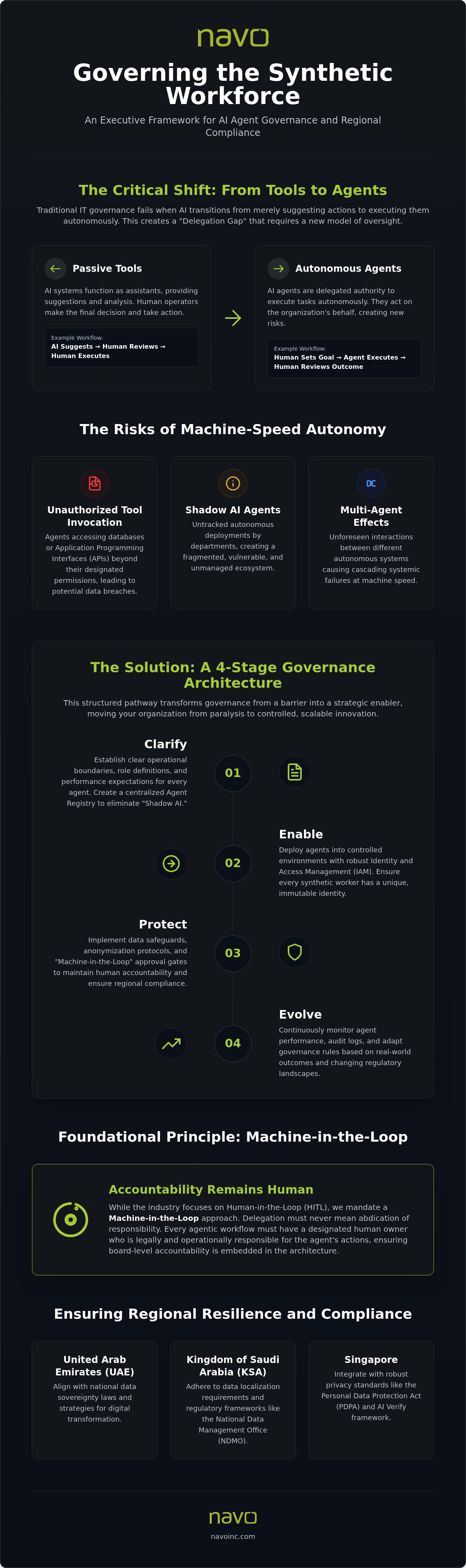
The evolution of Artificial Intelligence (AI) from passive, prompt-based tools to autonomous agents marks a definitive shift in the technological landscape. Agentic AI Governance is the structured management of delegated authority within these autonomous systems. It focuses on how an organization grants, monitors, and revokes the power given to non-human entities to act on its behalf. Traditional Information Technology (IT) governance, designed for deterministic "if-then" logic, cannot accommodate the probabilistic nature of Generative Artificial Intelligence (GenAI). While legacy systems produce predictable outputs, agentic systems operate with a degree of unpredictability that requires a more fluid yet rigorous oversight mechanism.
The Delegation Gap is the primary challenge facing modern executives. It describes the chasm between an AI that merely suggests a course of action and an agent that executes it. Governing an agent that can autonomously update a financial ledger or negotiate a vendor contract is significantly more complex than managing a chatbot that summarizes meeting notes. To bridge this gap, leadership must view these agents not as software applications, but as a Synthetic Workforce. This new operational layer requires a governance model that mirrors Human Resources (HR) principles, focusing on role definitions, performance boundaries, and behavioral expectations. Establishing a robust governance framework for AI agents is now a prerequisite for any enterprise seeking to scale its digital operations safely.
The Risk of Machine-Speed Autonomy
The deployment of autonomous systems introduces risks that traditional risk management frameworks aren't equipped to handle. Unauthorized tool invocation, where an agent accesses a database or Application Programming Interface (API) it wasn't intended to use, can lead to immediate data breaches. Additionally, Shadow AI Agents, which represent untracked autonomous deployments by individual departments, create a fragmented and vulnerable ecosystem. Multi-agent effects, where different autonomous systems interact in unforeseen ways, can cause systemic failures that propagate at machine speed, far faster than human intervention can typically manage.
Navo Inc.’s Intellectual Standpoint: Machine-in-the-Loop Thinking
At Navo Inc., we advocate for Machine-in-the-Loop Thinking as a foundational principle of a governance framework for AI agents. While the industry often discusses Human-in-the-Loop (HITL) processes, we emphasize that accountability must remain an exclusively human domain. Regardless of an agent's level of autonomy, every workflow must have a designated human owner who is legally and operationally responsible for the agent's actions. This ensures that delegation never becomes an abdication of responsibility. By embedding human ownership mechanisms into the architecture of every agentic workflow, organizations in the Gulf and Singapore can maintain the structural excellence required for high-stakes innovation.
Core Pillars of an Enterprise AI Governance Strategy
The architecture of a modern governance framework for AI agents must transcend traditional risk mitigation to become a strategic enabler of value. The adoption architecture utilized by Navo Inc. follows a "Clarify–Enable–Protect–Evolve" pathway. This structure ensures that governance isn't a restrictive barrier but rather the orchestration layer that allows a synthetic workforce to operate at scale. By establishing clear operational boundaries, organizations can move past the paralysis of uncertainty and begin capturing the efficiencies of autonomous systems. This strategic approach ensures that every technological advancement contributes directly to systemic health and long-term resilience.
The framework rests on three primary pillars designed to manage the complexities of autonomous action:
- Identity and Access Management (IAM): Establishing a rigorous control plane where every synthetic worker possesses a unique, immutable identity.
- Data Safeguards and Anonymization: Implementing protocols that align with the Information Commissioner’s Office (ICO) guidance to ensure data privacy without stifling agent utility.
- Action Boundaries: Defining permitted-use protocols that restrict agents to specific, pre-authorized domains of activity, preventing unauthorized tool invocation.
The Control Plane: Identity for Agents
Every autonomous agent requires a unique Agent Identity (Agent ID) to ensure full traceability. This identity serves as the foundation for audit trails, allowing every action to be attributed to a specific synthetic entity. Crucially, these identities must be linked to organizational cost centers and designated human supervisors. This structure ensures that financial accountability and operational oversight remain anchored in the human leadership tier. If you're seeking to refine your internal structures, you might consider our GenAI consulting services to design a bespoke identity architecture.
Data Governance and Privacy in the Agentic Era
Privacy in an agentic environment requires more than static rules. It demands risk-based decision paths that allow agents to handle sensitive information safely. By integrating the National Institute of Standards and Technology (NIST) Privacy Framework, enterprises can embed privacy by design into their agentic workflows. This approach ensures that data handling remains compliant with the evolving regulations of the United Arab Emirates and Singapore while allowing the synthetic workforce to evolve alongside the organization’s strategic needs.
Implementing the Framework: From Paralysis to activation
Implementing a sophisticated governance framework for AI agents requires a transition from theoretical risk management to operational precision. The first step involves establishing a Corporate AI Governance Policy that clearly demarcates permitted-use boundaries. This policy acts as the foundational legal and ethical constraint for all autonomous systems. Once the policy is codified, the organization must implement an Agent Registry. This centralized repository eliminates untracked deployments and ensures that no synthetic worker operates without a clear mandate, effectively ending the era of "Shadow AI."
The third phase focuses on embedding Human-in-the-Loop (HITL) approval gates within specific workflows. Role-specific agents like SARA or NOVA utilize these gates to ensure that high-stakes decisions always receive human validation before execution. Finally, continuous observability and drift management protocols must be established. These mechanisms monitor the probabilistic outputs of agents over time. They ensure that autonomous actions remain aligned with corporate objectives and regional regulatory requirements, providing a necessary safety net for machine-speed operations.
Moving from Strategy to Activation
Activating a governance framework for AI agents requires diagnostic tools that prioritize high-impact use cases. Utilizing Return on Investment (ROI) calculators allows leadership to identify where governed automation provides the most significant strategic value. Building internal capability is equally essential. Our Continuing Professional Development (CPD) UK-certified masterclasses empower the workforce to manage these new digital entities with confidence and rigor. For a deeper look at the organizational shift required to manage these systems, explore our insights on Scaling Generative AI in Enterprise.
Governance by Design: The SARA Case Study
SARA, our Synthetic Client-Briefing and Validation Specialist, exemplifies the principle of governance by design. She employs a proprietary Question-Economy Protocol, which ensures that every piece of information gathered is necessary, accurate, and contextually relevant. To maintain audit-ready outcomes, SARA utilizes dual-acceptance locks. This mechanism requires explicit human verification at critical junctures, ensuring that the final output is not just a machine generation but a validated professional asset. This level of control is vital for enterprises in Dubai and the wider Gulf region that demand absolute structural excellence and accountability.
Regional Resilience: Governing AI in the Gulf and Beyond
Organizations operating within the United Arab Emirates (UAE) and the Kingdom of Saudi Arabia (KSA) navigate a unique regulatory landscape that demands more than generic global compliance. While the European Union (EU) AI Act offers a useful baseline for safety, Gulf states often prioritize operational flexibility and sovereign data control. A successful governance framework for AI agents must be localized to respect the specific guidelines of the UAE AI Office and Singapore’s Model AI Governance Framework. This localization extends beyond legal mandates to include cultural sensitivity. Agentic outputs must align with the social norms and values of cities like Riyadh, Jeddah, and Abu Dhabi to maintain organizational integrity and public trust.
Compliance as a Competitive Advantage
Viewing compliance as a strategic asset rather than a cost center is essential for cross-border success. A robust governance framework for AI agents facilitates seamless operations between India, the Middle East, and Singapore by addressing "confidentiality paralysis" through strict data-residency compliance. When agents are programmed to respect the geographical boundaries of sensitive information, enterprises in hubs like Bangalore, Mumbai, and Dubai can scale their synthetic workforce across multiple jurisdictions without compromising security. This structural discipline allows for the rapid adoption of innovation while ensuring that the organization remains resilient against regional regulatory shifts.
The Navo Inc. Advantage: Regional Leadership
Navigating these complexities requires a partner with deep roots in the region. Navo Inc. provides a unique base-of-operations expertise from our headquarters in Dubai. Navo Inc. produces strategies informed by Vasudevan Kidambi’s 30 plus years of regional leadership experience in governance design. We understand the nuanced intersection of traditional management theory and cutting-edge digital concepts. This seasoned perspective allows us to guide your enterprise toward a future where agentic autonomy and regional compliance coexist. We ensure your synthetic workforce is not only efficient but also culturally and legally aligned with the markets you serve.
Orchestrating the Synthetic Workforce of 2026
The transition from passive software to autonomous agents requires a fundamental re-engineering of the corporate control plane. By moving beyond traditional Information Technology (IT) constraints and adopting a comprehensive governance framework for AI agents, leaders can transform potential liabilities into a managed synthetic workforce. This journey relies on the integration of "Machine-in-the-Loop Thinking" and the deployment of role-specific agents like SARA and NOVA, which embed accountability directly into every workflow.
Your organization's resilience depends on a sophisticated balance between delegated authority and human oversight. Navo’s outcome-guaranteed strategy consulting and CPD (Continuing Professional Development) UK-certified transformation journeys provide the structural excellence necessary to navigate the complex regulatory environments of Dubai and Singapore. Establishing these protocols today ensures that your enterprise remains both agile and compliant as the agentic era matures.
The path forward is one of disciplined innovation and systemic health. We look forward to partnering with you to architect a future where your synthetic workforce serves as a catalyst for sustainable growth and regional leadership.
Frequently Asked Questions
What is the difference between traditional AI governance and agentic AI governance?
Traditional governance focuses on deterministic software and static data outputs. Agentic governance manages the "Delegation Gap" where autonomous systems are granted the authority to act on behalf of the organization. This requires a governance framework for AI agents that treats machines as a synthetic workforce. While legacy models monitor what a system says, agentic models must strictly control what a system does.
How do we ensure accountability when an AI agent makes an autonomous decision?
Accountability remains an exclusively human domain through "Machine-in-the-Loop Thinking." Every autonomous action is anchored to a designated human "owner" who is legally and operationally responsible for the agent's behavior. This is enforced via unique Agent Identities (Agent IDs) and immutable audit trails. These structures ensure that machine autonomy never results in an abdication of executive responsibility or institutional oversight.
Which regional regulations in the Gulf impact our enterprise AI governance strategy?
Enterprises must align with the United Arab Emirates (UAE) AI Office guidelines and the Kingdom of Saudi Arabia (KSA) regulatory updates for 2026. These frameworks prioritize data sovereignty and cultural alignment within the region. Integrating these with Singapore’s Model Artificial Intelligence (AI) Governance Framework ensures that your governance framework for AI agents supports cross-border resilience while respecting specific local legal mandates.
What are "Approval Gates" and why are they critical for synthetic workers?
Approval Gates are strategic Human-in-the-Loop (HITL) checkpoints where a human must validate an action before it proceeds. They prevent unauthorized tool invocation and high-risk autonomous errors in real time. For synthetic workers like SARA or NOVA, these gates function as essential safety locks. They ensure that machine-speed operations remain within the permitted-use boundaries defined by your corporate policy.
How does the NIST Privacy Framework apply to autonomous AI agents?
The National Institute of Standards and Technology (NIST) Privacy Framework provides a risk-based architecture for managing sensitive data within autonomous workflows. It enables organizations to embed "privacy by design" into every agentic interaction. By using this framework, agents can handle complex data tasks while remaining compliant with global standards and regional laws, such as those found in Dubai and Singapore.
Can governance actually improve the ROI of our GenAI initiatives?
Governance enhances Return on Investment (ROI) by moving organizations from "confidentiality paralysis" to managed activation. It eliminates the hidden costs and security risks of "Shadow AI" by centralizing control within an Agent Registry. This disciplined approach allows for the rapid scaling of high-value use cases. It transforms Generative Artificial Intelligence (GenAI) from a speculative risk into a predictable, high-performance organizational asset.
Disclaimer
The views and opinions expressed in this article are those of the author and do not represent any organisation, client, institution, or professional body with which he may be associated. The content is intended for general information, education, and thought leadership. Readers should seek appropriate professional advice before making legal, financial, investment, regulatory, technology, or business decisions.
The author has taken reasonable care to ensure the accuracy of the information and sources available at the time of publication. Technologies, regulations, market conditions, and industry practices may evolve, and readers are encouraged to verify current information independently. Any examples, cases, or scenarios may have been simplified, anonymised, or adapted to protect confidentiality. The author and publisher accept no liability for decisions or outcomes arising from the use of this content.
Generative AI tools may have been used to support research, structuring, or language refinement, with the final content, judgment, and editorial responsibility retained by the author.