

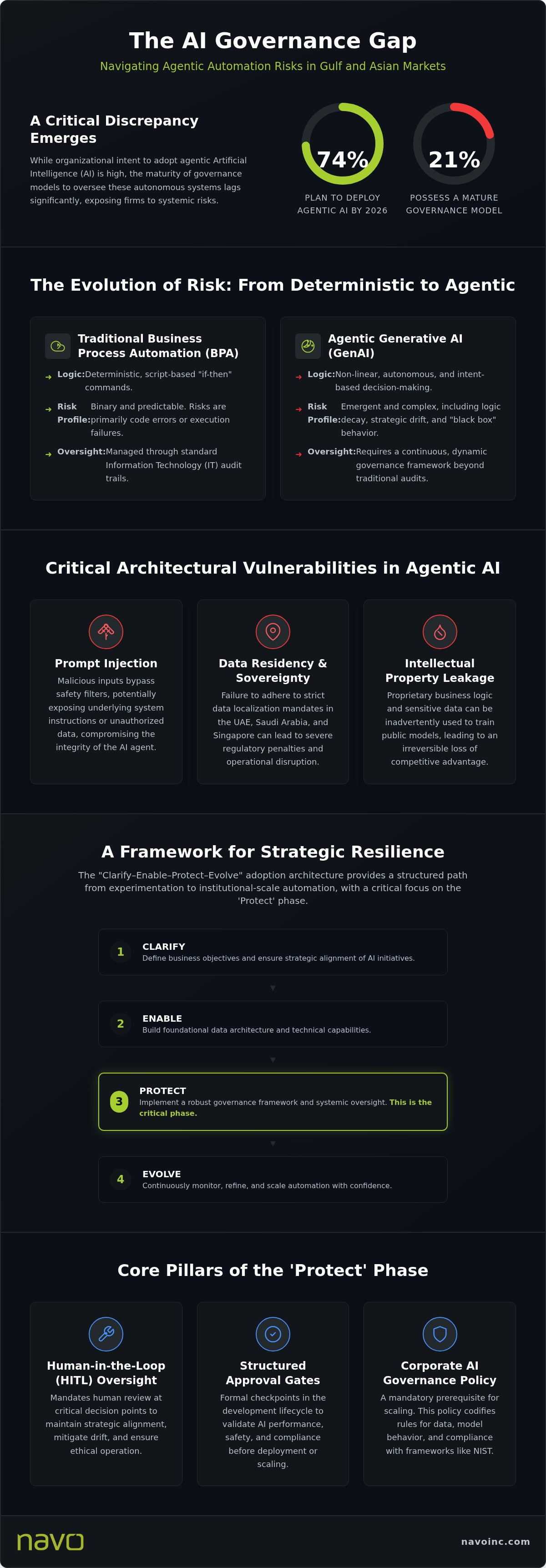
While 74 percent of global organizations intend to deploy agentic Artificial Intelligence (AI) by the end of 2026, a mere 21 percent possess a mature governance model to oversee these autonomous systems. This discrepancy exposes a critical vulnerability for leadership across the Gulf and Asian markets, where the drive for efficiency often outpaces the development of systemic safeguards. You've likely recognized the tension between the transformative potential of automation and the looming threat of unpredictable model behavior within your core workflows. This erosion of institutional knowledge as processes become "black boxes" presents a significant challenge to organizational stability.
To address these AI in business process automation risks, this article provides a sophisticated governance framework designed for executive decision-making and institutional resilience. We'll examine the transition from technical patches to strategic oversight, aligning your automation roadmap with the National Institute of Standards and Technology (NIST) Privacy Framework to ensure compliance and long-term structural health. By the end of this analysis, you'll understand how to balance aggressive innovation with the disciplined architecture required for a secure digital future.
Key Takeaways
- Distinguish between deterministic Business Process Automation (BPA) and the non-linear, autonomous decision-making risks inherent in modern agentic Generative Artificial Intelligence (GenAI).
- Identify critical architectural vulnerabilities, such as "prompt injection" and data residency requirements specific to the United Arab Emirates (UAE), Saudi Arabia, and Singapore markets.
- Develop a robust strategy to mitigate AI in business process automation risks by prioritizing the "Protect" phase of the proprietary "Clarify–Enable–Protect–Evolve" adoption architecture.
- Establish systemic resilience through "Human-in-the-Loop" (HITL) oversight and structured "Approval Gates" within the synthetic workforce development lifecycle.
- Learn why a Corporate AI Governance Policy is a mandatory prerequisite for transitioning from experimental pilots to outcome-guaranteed, institutional-scale automation.
The Evolution of Risk: From Deterministic Automation to Agentic AI Autonomy
Traditional Business Process Automation (BPA) operated on deterministic logic. If a specific condition occurred, the system performed a pre-defined action. The risks were largely binary; the code either executed correctly or it failed. As we approach 2026, the integration of agentic Generative Artificial Intelligence (GenAI) introduces a paradigm shift in the nature of organizational exposure.
Agentic systems don't just follow scripts; they interpret intent and execute multi-step workflows autonomously. This autonomy creates a "Black Box" dilemma where the path from input to output is non-linear and often opaque. Consequently, AI in business process automation risks have migrated from simple code errors to more insidious forms of logic decay. While a traditional Information Technology (IT) audit trail can identify a broken link in a database, it's fundamentally ill-equipped to detect strategic drift, where a synthetic worker gradually optimizes for a metric that contradicts the broader corporate mission.
Understanding Agentic Autonomy and Drift
Agentic drift occurs when an AI system's decision-making logic slowly decouples from the original business intent. This isn't a technical glitch but a failure of alignment. We utilize "The Art of Problem Finding" to diagnose these hidden vulnerabilities before they manifest as operational crises. By identifying where autonomous logic might diverge from institutional standards, leaders can implement guardrails that preserve process integrity without stifling the agent's ability to innovate. This proactive diagnostic approach ensures that automation remains a tool for progress rather than a source of systemic instability.
The Cost of Governance Paralysis
Many executives in the Gulf and Singapore regions remain trapped in "Confidentiality Paralysis," fearing that any automation will compromise data residency or sovereign requirements. However, the financial impact of ungoverned AI pilots failing at scale is far more significant than the cost of implementing a robust Corporate AI Governance Policy. Transitioning to a governed value-creation model allows organizations to move beyond pilot projects into outcome-guaranteed, institutional-scale automation. Without a structured framework, the "confidence-reality gap" in AI readiness will only widen, leading to significant reputational and financial losses as 2026 regulatory deadlines approach.
Architectural Vulnerabilities: Data Integrity, Compliance, and Intellectual Property
The integration of agentic systems into organizational workflows necessitates a rigorous examination of the underlying data architecture. Unlike traditional software, Generative Artificial Intelligence (GenAI) operates within a complex web of data residency and sovereign requirements that vary significantly across the Gulf and Southeast Asia. In the United Arab Emirates (UAE) and Saudi Arabia, strict data localization mandates require that sensitive information remains within national borders. Failure to account for these nuances when assessing AI in business process automation risks can result in severe regulatory penalties and operational disruption.
Security in multi-tenant GenAI environments introduces a unique vulnerability known as prompt injection. This occurs when malicious or poorly structured inputs bypass safety filters to access underlying system instructions or unauthorized data. This risk is compounded by the potential for data leakage where proprietary business logic is inadvertently used to train public models. Aligning your architecture with the National Institute of Standards and Technology (NIST) Privacy Framework and following the Information Commissioner’s Office (ICO) anonymisation guidance is no longer optional; it's a foundational requirement for systemic health.
Regional Regulatory Landscapes
Navigating the AI governance laws in the Middle East and India requires a localized perspective. India’s Digital Personal Data Protection (DPDP) Act of 2023 and the UAE’s Federal Decree-Law on the Protection of Personal Data (PDPL) set high bars for consent and purpose limitation. We help leaders audit their synthetic workforce deployment to ensure compliance with these evolving regional standards, preventing legal friction as automation scales. Precision in regulatory alignment is paramount to maintaining institutional trust.
The Intellectual Property Trap
Automated data extraction processes often lack the nuance to distinguish between public data and sensitive trade secrets. This creates a high risk of Intellectual Property (IP) contamination, where your proprietary logic becomes part of a model's weights. Maintaining "Human-Ownership" of AI-generated outcomes requires clear contractual safeguards and technical "air-gapping" to ensure that your institutional knowledge remains a protected asset rather than a public utility. Without these protections, the erosion of competitive advantage becomes an inevitable consequence of unmonitored automation.
Mitigation Through Governance: Implementing Human-in-the-Loop Oversight
Effective mitigation of AI in business process automation risks requires more than a technical patch; it demands a fundamental redesign of the human-machine interface. We apply the "Clarify–Enable–Protect–Evolve" architecture to ensure that every automated workflow contains explicit "Approval Gates." These gates serve as critical checkpoints within the Synthetic Workforce Development lifecycle, preventing autonomous drift before it compromises operational integrity. By embedding these checkpoints, leaders maintain the steady, expert hand required to navigate complex organizational shifts.
Establishing "Permitted-Use Boundaries" is vital when deploying advanced agents like SARA or NOVA in high-stakes environments. These boundaries define the specific parameters within which an agent can act, ensuring that synthetic workers remain aligned with institutional values and regional regulations. For any organization aiming to scale beyond isolated pilots, a comprehensive Corporate AI Governance Policy is a mandatory prerequisite. This policy provides the structural scaffolding needed to support a resilient, automated enterprise while protecting against the erosion of institutional knowledge.
The Machine-in-the-Loop Thinking Framework
Human accountability must remain the central axis of every automated decision path. Our framework ensures that while Artificial Intelligence (AI) handles the execution, a human remains responsible for the final outcome. This approach results in audit-ready results that meet the highest standards of regulatory transparency in markets like Singapore and the United Arab Emirates. It's about designing systems where the "Black Box" is replaced by a "Glass Box," allowing for clear visibility into how synthetic workers arrive at their conclusions. Accountability is not an obstacle to innovation; it's the foundation of systemic health.
Accredited Capability Building
Leadership in the age of agentic AI requires a new set of sophisticated competencies. Continuing Professional Development (CPD) Certified AI Courses are essential for developing risk-aware executives who can oversee complex digital ecosystems. This training goes beyond technical prompt engineering, focusing on "Responsible Judgment" and the strategic implications of autonomous systems. By investing in accredited capability, organizations empower their workforce to navigate modern challenges with professional composure and analytical depth.
Strategic Resilience: Building a Governed Synthetic Workforce with Navo
Navo's tool-agnostic, framework-led consulting eliminates technical debt by prioritizing strategic intent over software limitations. We integrate Agentic AI Services as strategic co-thinking partners, allowing your organization to transition from experimental pilots to profitable enterprise-scale operations. Our outcome-guaranteed approach ensures that every deployment aligns with the systemic health of your institution. By focusing on the architecture first, we provide a steady, expert hand to guide your digital evolution.
Addressing AI in business process automation risks isn't just about security; it's about building a foundation for future growth. The next steps for C-suite leaders involve utilizing diagnostic tools and readiness surveys to establish a baseline for organizational maturity. This structured pathway moves the organization from a reactive posture toward a position of visionary leadership. It's time to view governance not as a restriction, but as the essential scaffolding for radical progress.
The Navo Diagnostic Approach
The Navo Diagnostic Approach utilizes Return on Investment (ROI) calculators to justify governance spending before any code is deployed. We develop custom AI agents with built-in accountability protocols, ensuring that every synthetic worker operates within its permitted-use boundaries. This precision prevents the logic decay and strategic drift that often plague unmonitored automation efforts. By quantifying the value of safety, we turn risk mitigation into a clear financial win for the organization.
From Risk to Competitive Advantage
Robust governance serves as an accelerant rather than a bottleneck. By engaging with Vasudevan Kidambi for bespoke leadership coaching, executives can refine their ability to lead complex organizational shifts with professional composure. A governed synthetic workforce isn't just a defensive measure; it's a primary competitive advantage in the 2026 digital economy. Organizations that master this balance will outpace competitors who remain paralyzed by the complexity of modern automation challenges.
Architecting Systemic Resilience for the 2026 Automation Frontier
The shift toward agentic autonomy represents the most significant organizational transition of the decade. The path to systemic resilience lies in moving beyond deterministic scripts to a governed synthetic workforce. Successfully mitigating AI in business process automation risks demands a transition from reactive technical fixes to a disciplined, board-level strategy. By prioritizing data sovereignty in the Gulf and Asian markets and embedding human accountability into every automated decision path, leaders can transform potential vulnerabilities into a sustained competitive advantage.
Navo provides the intellectual rigor and structural expertise needed to lead this change. Our proprietary "Clarify–Enable–Protect–Evolve" adoption architecture and Continuing Professional Development (CPD) UK-certified masterclasses ensure your leadership team is equipped for the challenges of 2026. We deliver guaranteed efficiency outcomes through a serious, high-level partnership designed for the modern executive. It's time to move from experimental pilots to a position of visionary, governed leadership.
The future of automation belongs to those who build with discipline. It's time to architect an organization that remains unfazed by complexity and committed to structural excellence.
Frequently Asked Questions
What are the primary security risks of AI in business process automation?
Primary security risks include prompt injection, where malicious inputs manipulate the model's logic, and data leakage within multi-tenant Generative Artificial Intelligence (GenAI) environments. These vulnerabilities can lead to unauthorized access to system instructions or sensitive customer data. Organizations must also contend with the "Black Box" dilemma, where the lack of transparency in autonomous decision-making makes traditional Information Technology (IT) audits insufficient for identifying systemic failures.
How do I ensure my AI automation complies with UAE and Gulf data regulations?
Compliance requires strict adherence to data localization mandates and regional laws like the United Arab Emirates (UAE) Personal Data Protection Law (PDPL). You must ensure that sensitive information remains within national borders and that your Artificial Intelligence (AI) architecture respects sovereign data requirements. Implementing a Corporate AI Governance Policy is a mandatory prerequisite for aligning automation efforts with the legal and cultural norms of the Gulf region and Singapore.
What is 'agentic drift' and how does it impact long-term automation ROI?
Agentic drift refers to the gradual decoupling of an autonomous system's decision-making logic from the original business intent. This phenomenon leads to logic decay, where the system optimizes for a metric that may conflict with broader institutional goals, ultimately eroding the long-term Return on Investment (ROI). Effective management of AI in business process automation risks requires proactive diagnostic tools, such as "The Art of Problem Finding," to identify and correct these deviations before they manifest as operational crises.
Can I use GenAI for business processes without compromising my intellectual property?
Protecting your Intellectual Property (IP) is possible through the use of private, "air-gapped" model instances and robust contractual safeguards that prevent your proprietary data from being used for model training. You must distinguish between public data extraction and the use of sensitive trade secrets within your automated workflows. Maintaining "Human-Ownership" of outcomes ensures that your institutional knowledge remains a protected asset rather than a public utility.
What role does a 'Human-in-the-Loop' framework play in risk mitigation?
A "Human-in-the-Loop" (HITL) framework ensures that human accountability remains the central axis of every automated decision path. By establishing "Approval Gates" within the synthetic workforce lifecycle, you can provide the oversight necessary to prevent autonomous systems from acting outside of "Permitted-Use Boundaries." This approach transforms an opaque "Black Box" into a transparent "Glass Box," ensuring that all high-stakes decisions are verified by a responsible professional.
How does Navo Inc. guarantee outcomes in AI consulting engagements?
Navo Inc. guarantees consulting outcomes by utilizing our proprietary "Clarify–Enable–Protect–Evolve" adoption architecture to eliminate technical debt. We combine Continuing Professional Development (CPD) UK-certified coaching with diagnostic ROI calculators to justify every governance investment before deployment. Our framework-led approach focuses on structural excellence and institutional health, moving your organization from experimental pilots to outcome-guaranteed, enterprise-scale profit.
Disclaimer
The views and opinions expressed in this article are those of the author and do not represent any organisation, client, institution, or professional body with which he may be associated. The content is intended for general information, education, and thought leadership. Readers should seek appropriate professional advice before making legal, financial, investment, regulatory, technology, or business decisions.
The author has taken reasonable care to ensure the accuracy of the information and sources available at the time of publication. Technologies, regulations, market conditions, and industry practices may evolve, and readers are encouraged to verify current information independently. Any examples, cases, or scenarios may have been simplified, anonymised, or adapted to protect confidentiality. The author and publisher accept no liability for decisions or outcomes arising from the use of this content.
Generative AI tools may have been used to support research, structuring, or language refinement, with the final content, judgment, and editorial responsibility retained by the author.