

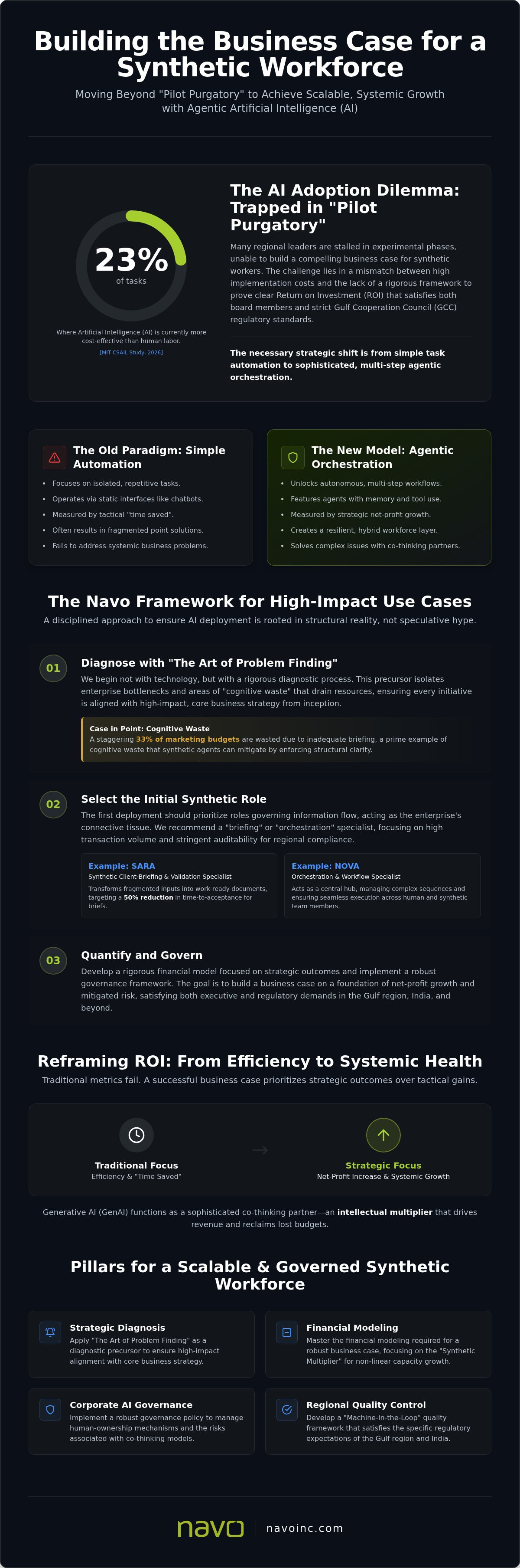
Did you know that a 2026 study from the Massachusetts Institute of Technology (MIT) Computer Science and Artificial Intelligence Laboratory (CSAIL) revealed that Artificial Intelligence (AI) is currently more cost-effective than human labor in only 23% of analyzed tasks? This stark reality often leaves regional leaders trapped in "pilot purgatory," unable to move beyond experimental phases because they lack a rigorous framework for building a business case for synthetic workers that satisfies both the Board of Directors and strict Gulf Cooperation Council (GCC) regulatory standards.
You're likely experiencing the frustration of high implementation costs clashing with the need for clear Return on Investment (ROI). This article provides the sophisticated financial and operational frameworks necessary to master executive buy-in for a scalable synthetic workforce. We'll move beyond simple automation to explore the quantification of "co-thinking" value, ensuring your Generative Artificial Intelligence (GenAI) strategy transitions from a technical experiment into a disciplined engine for systemic health and net-profit growth.
Key Takeaways
- Shift the organizational narrative from simple automation to agentic orchestration to unlock autonomous, multi-step synthetic workflows.
- Apply "The Art of Problem Finding" as a diagnostic precursor to ensure high-impact alignment with core business strategy.
- Master the financial modeling required for building a business case for synthetic workers, focusing on the "Synthetic Multiplier" for non-linear capacity growth.
- Implement a robust Corporate AI (Artificial Intelligence) Governance Policy to manage human-ownership mechanisms and co-thinking risks.
- Develop a "Machine-in-the-Loop" quality control framework that satisfies the specific regulatory expectations of the Gulf region and India.
Beyond the Pilot: The Strategic Necessity of a Synthetic Workforce Layer
Synthetic workers represent a paradigm shift in organizational architecture. Unlike the static interfaces of the early 2020s, these autonomous systems possess the capability for multi-step workflows, persistent memory retention, and the sophisticated use of enterprise-level tools. Building a business case for synthetic workers requires a fundamental transition in executive mindset. We must move away from viewing AI (Artificial Intelligence) as a series of isolated "chatbots" and toward a model of Agentic AI orchestration. This involves a workforce layer where agents act with intent, executing complex sequences that previously required human intervention.
The 2026 reality for enterprises in Dubai, Singapore, and Mumbai is unforgiving. A "wait and see" approach is no longer a viable strategy; it's a recipe for structural obsolescence. As we analyze the broader impact of artificial intelligence on workers, it's clear that the competitive advantage now lies in the speed of integration. For a deeper dive into this transition, consult our Synthetic Workforce Development: The 2026 Executive Guide to Agentic AI. Success today isn't about testing technology. It's about architecting a resilient, hybrid workforce.
The Cost of Cognitive Waste
Enterprise inefficiency often stems from poor communication and misaligned objectives. The BetterBriefs Global Report identified a staggering 33% waste in marketing budgets due to inadequate briefing. This cognitive waste isn't limited to marketing. It compounds across the entire organization when "problem finding" errors lead to misdirected energy. Synthetic workers mitigate this by enforcing rigorous, data-driven standards at the point of inception, ensuring that every project begins with structural clarity.
Reframing the ROI: Efficiency vs. Profit Growth
Traditional metrics often fail because they focus on tactical "time saved" rather than strategic outcomes. When building a business case for synthetic workers, we must prioritize net-profit increase over simple efficiency gains. GenAI (Generative Artificial Intelligence) functions best as a sophisticated co-thinking partner. It's an intellectual multiplier. By shifting the focus to how these agents drive revenue and reclaim lost budgets, leaders can justify the investment through a lens of systemic health and long-term financial evolution.
The Navo Framework for Identifying High-Impact Use Cases
Identification of high-impact use cases begins not with technology, but with diagnosis. We employ "The Art of Problem Finding" to isolate enterprise bottlenecks that drain cognitive resources. This diagnostic rigor ensures that building a business case for synthetic workers is rooted in structural reality rather than speculative hype. By utilizing our "Six Lanes of Working" model, leaders can map synthetic workers directly to core business strategy, ensuring every agent deployed serves a measurable objective.
Consider SARA, our Synthetic Client-Briefing & Validation Specialist. SARA targets a 50% reduction in time-to-acceptance for briefs by transforming fragmented, raw inputs into work-ready, validated documents. This eliminates the iterative friction that often stalls project momentum. Organizations often find that a consultative diagnostic is the most efficient way to identify these high-leverage entry points.
Selecting Your Initial Synthetic Role
The first deployment should prioritize roles that govern the flow of information. We recommend starting with a "briefing" or "orchestration" specialist, such as NOVA. These roles act as the connective tissue of the enterprise. Selection criteria should focus on high transaction volume, a high knowledge-base hit rate, and stringent auditability requirements to ensure compliance with regional data standards.
The Question-Economy Protocol
Efficiency in a synthetic workforce is measured by the quality of the exchange. Our proprietary Question-Economy Protocol serves as a mechanism for maximizing prompt efficiency and reducing iterative cycles between humans and AI (Artificial Intelligence). This protocol ensures that every interaction is architected to produce maximum clarity with minimum cognitive waste.
Quantifying the Business Case: Financial Modelling and Risk Mitigation
A rigorous financial model for building a business case for synthetic workers requires moving beyond anecdotal evidence toward empirical validation. The first phase involves establishing a definitive baseline for current process costs. This calculation must incorporate direct human labor and the hidden costs of oversight and error rates associated with cognitive fatigue. By identifying these variables, leaders can accurately measure the "Synthetic Multiplier." This metric represents the capacity increase achievable without linear headcount growth, a critical factor as the digital human market is projected to reach $26 billion by 2031 according to PricewaterhouseCoopers (PwC) in June 2026.
Strategic modeling also requires accounting for the human element within the synthetic loop. We integrate Continuing Professional Development (CPD) United Kingdom (UK)-certified training for human handlers to ensure the workforce evolves alongside the technology. This investment in human capital mitigates technical debt and ensures long-term systemic health. Finally, the framework must include risk-based decision paths and liability frameworks that align with regional governance standards in the Middle East and India.
The Financial Impact of Guaranteed Outcomes
Most AI (Artificial Intelligence) initiatives fail to secure Board approval because they lack performance guarantees. Navo’s commitment to a guaranteed net-profit increase fundamentally alters the risk profile of the business case. By targeting a reduction in Time-to-Acceptance (TTA) for mission-critical workflows, we transform the synthetic workforce from a cost center into a profit-driving asset. This shift in perspective is essential for securing high-level executive buy-in in competitive markets like Singapore and Mumbai.
Mitigating 'Confidentiality Paralysis'
Governance and regulatory anxiety often stall progress. Addressing "Confidentiality Paralysis" involves a structured approach to data handling that adheres to Information Commissioner’s Office (ICO) anonymisation guidance and the National Institute of Standards and Technology (NIST) Privacy Framework. For a comprehensive overview of these governance structures, refer to our guide on Mastering Agentic AI Services: An Executive Reference. These mechanisms ensure that synthetic deployments remain compliant while maintaining operational velocity.
Governing the Synthetic-Human Co-thinking Model
Governance isn't just about restriction; it's about structural excellence. Establishing a Corporate AI (Artificial Intelligence) Governance Policy provides the necessary accountability rules and human-ownership mechanisms to prevent operational drift. This framework ensures that building a business case for synthetic workers remains grounded in ethical and legal reality. We utilize "Machine-in-the-Loop Thinking" to maintain rigorous quality control, ensuring that human intuition remains the final arbiter of strategic output.
Our adoption architecture follows a precise Clarify–Enable–Protect–Evolve sequence. This methodical flow leads organizations from high-level understanding toward a structured, tool-based resolution. Leadership teams seeking to master these frameworks should enroll in our CPD (Continuing Professional Development) Certified AI Course to establish the executive standard for synthetic workforce leadership in 2026.
Regional Regulatory Compliance (Gulf Cooperation Council & Southeast Asia)
Aligning synthetic worker deployment with the evolving laws of the United Arab Emirates (UAE), the Kingdom of Saudi Arabia (KSA), and Singapore is a priority. As we move through 2026, the emphasis on transparency and non-discrimination in AI systems has become a central pillar of regional governance. For entities in Banking, Financial Services, and Insurance (BFSI), we provide the frameworks required to deliver audit-ready outcomes that satisfy both local regulators and global standards. This ensures that building a business case for synthetic workers meets the high-stakes demands of regulated markets across the Gulf Cooperation Council (GCC) and Southeast Asia.
The 5-Week Transformation Journey
The transition from a traditional workforce to a synthetic-enhanced model requires a disciplined architect of change. Our 5-week Masterclass moves your leadership team from the diagnostic phase of "The Art of Problem Finding" to intensive operational activation. This journey is designed to reclaim lost budgets and guarantee profit increases through systemic health. For visionary perspectives on the evolving intersections of technology and management, visit vasudevan-kidambi.com for keynote insights on the future of work.
Architecting the Future of Synthetic Intelligence
The transition from experimental pilots to a permanent synthetic workforce layer is the defining strategic shift of 2026. Organizations that successfully bridge this gap do so by replacing speculative automation with "The Art of Problem Finding" and rigorous financial modeling. Building a business case for synthetic workers is the essential bridge between experimental curiosity and structural permanence. By prioritizing the "Synthetic Multiplier" and implementing robust governance, leaders transform Artificial Intelligence (AI) from a technical novelty into a disciplined engine for net-profit growth. This approach ensures operational resilience while maintaining strict compliance with regional regulatory standards across the Gulf and Southeast Asia.
Navo Inc. stands as the steady, expert hand for this high-stakes evolution. Our Continuing Professional Development (CPD) United Kingdom (UK)-certified masterclasses and outcome-guaranteed consulting provide the structural excellence needed to deploy proprietary frameworks like SARA and NOVA with absolute confidence. We don't just provide technology; we architect the systemic health of your future organization.
The era of agentic orchestration has arrived. It's time to lead your organization toward a more resilient and profitable technological frontier.
Frequently Asked Questions
How do I calculate the ROI of synthetic workers for non-technical roles?
Return on Investment (ROI) for non-technical roles is calculated by measuring the reduction in "Time-to-Acceptance" (TTA) and the elimination of iterative cycles. Instead of tracking keystrokes, you should track the increase in output quality and the reclaiming of lost budgets previously spent on poor briefing. In marketing, for instance, this involves quantifying the 33% budget waste identified in the BetterBriefs Global Report and demonstrating how a synthetic briefing specialist eliminates that financial leakage.
What are the common objections from HR regarding a synthetic workforce layer?
Human Resources (HR) leaders typically raise concerns regarding organizational resistance and the legal implications of Artificial Intelligence (AI) decision-making. Building a business case for synthetic workers must address these by presenting a "Machine-in-the-Loop" model where humans retain ownership. Highlighting Continuing Professional Development (CPD) United Kingdom (UK)-certified training for employees helps reframe synthetic workers as tools for human augmentation rather than simple replacement.
Is a synthetic worker different from a standard RPA bot?
A synthetic worker is fundamentally different from a standard Robotic Process Automation (RPA) bot because it possesses memory, tool-usage capabilities, and reasoning. While RPA follows a rigid "if-this-then-that" script, a synthetic worker uses Agentic Artificial Intelligence (AI) to navigate complex, multi-step workflows and adapt to unstructured information. This sophistication allows them to function as "co-thinking" partners rather than just executing repetitive, rule-based data entry tasks.
How does the 'Art of Problem Finding' impact the success of an AI business case?
"The Art of Problem Finding" serves as a diagnostic precursor that prevents the deployment of technology in search of a problem. By isolating the root cause of systemic inefficiency, this methodology ensures that the business case targets high-impact use cases. Without this diagnostic phase, organizations risk entering "pilot purgatory," where AI (Artificial Intelligence) solutions fail to deliver measurable net-profit increases because they were misaligned with core business strategy.
What regulatory standards should Gulf-based companies follow for Agentic AI?
Gulf-based companies should prioritize compliance with the Saudi Data and Artificial Intelligence Authority (SDAIA) guidelines and the UAE’s National Strategy for Artificial Intelligence 2031. These frameworks emphasize transparency, accountability, and the prevention of algorithmic bias. When building a business case for synthetic workers in the Middle East, aligning with these standards ensures that deployments are audit-ready for highly regulated sectors like Banking, Financial Services, and Insurance (BFSI).
Disclaimer
The views and opinions expressed in this article are those of the author and do not represent any organisation, client, institution, or professional body with which he may be associated. The content is intended for general information, education, and thought leadership. Readers should seek appropriate professional advice before making legal, financial, investment, regulatory, technology, or business decisions.
The author has taken reasonable care to ensure the accuracy of the information and sources available at the time of publication. Technologies, regulations, market conditions, and industry practices may evolve, and readers are encouraged to verify current information independently. Any examples, cases, or scenarios may have been simplified, anonymised, or adapted to protect confidentiality. The author and publisher accept no liability for decisions or outcomes arising from the use of this content.
Generative AI tools may have been used to support research, structuring, or language refinement, with the final content, judgment, and editorial responsibility retained by the author.