

The transition from traditional cinematography to a fully integrated synthetic media strategy is a shift in corporate architecture rather than a mere creative evolution. For many organizations, the adoption of AI video production for business remains stalled by the friction of content production bottlenecks and the persistent anxiety surrounding the "uncanny valley." You've likely experienced the frustration of escalating agency fees and the legal ambiguity of intellectual property (IP) rights within the Gulf Cooperation Council (GCC) markets.
We recognize that maintaining brand integrity while scaling global campaigns requires more than just software; it demands a rigorous governance framework. This guide serves as a strategic blueprint to mastering the integration of synthetic media to ensure measurable return on investment (ROI) and strict adherence to regional cultural norms. You'll gain a disciplined perspective on building a scalable content engine, beginning with the critical diagnostic phase of problem identification, to reduce time-to-market while navigating the evolving regulatory standards of the United Arab Emirates (UAE) National Media Council (NMC).
Key Takeaways
- Understand the transition from traditional linear media to generative scalability as a fundamental shift in corporate communication architecture for 2026.
- Adopt "The Art of Problem Finding" to define strategic outcomes and ensure every visual asset serves a specific, pre-determined organizational objective.
- Navigate complex regulatory landscapes, including the United Arab Emirates (UAE) National Media Council (NMC) guidelines, while maintaining cultural resonance across the Gulf Cooperation Council (GCC) and India.
- Integrate AI video production for business into a comprehensive Synthetic Workforce strategy to eliminate production bottlenecks and achieve scalable global growth.
- Shift from creative experimentation to a disciplined framework that secures a measurable Return on Investment (ROI) through sophisticated corporate governance and coaching.
The Paradigm Shift: Why AI Video Production is Now a Strategic Enterprise Imperative
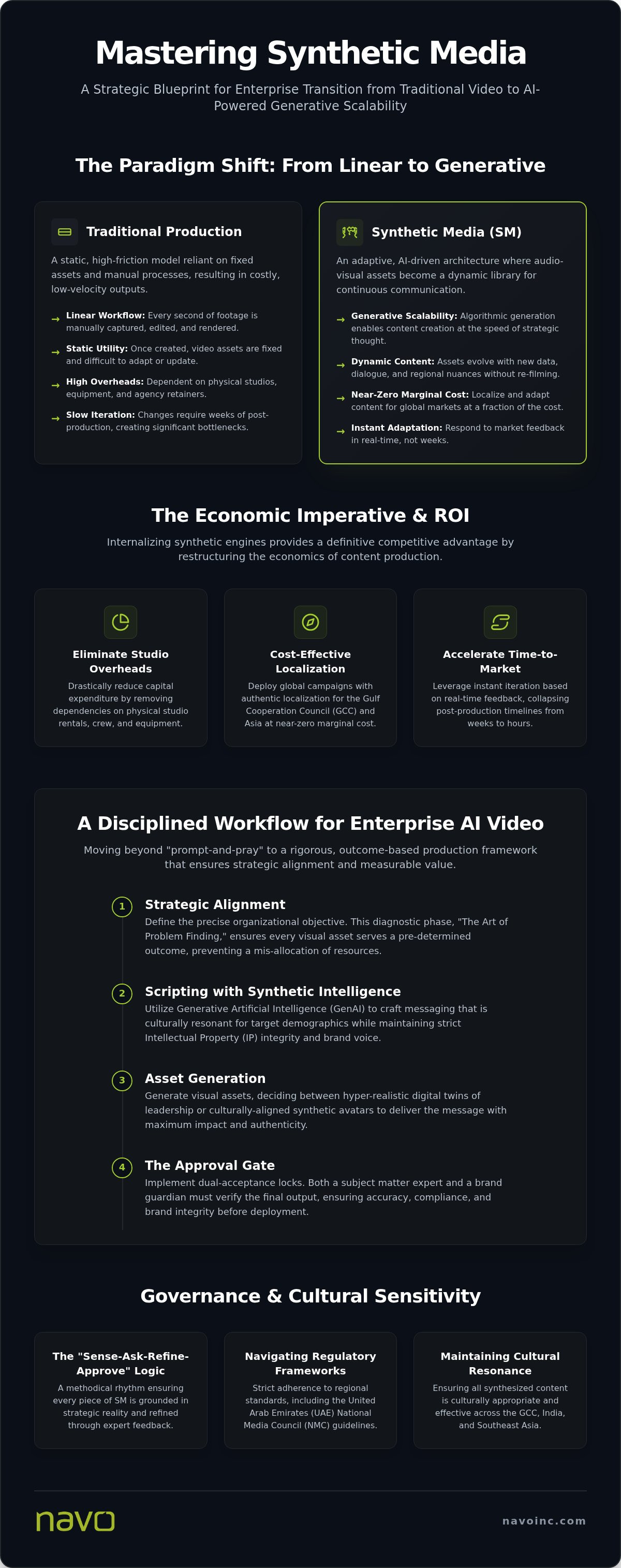
The era of viewing video as a tactical marketing expense is over. In its place, Synthetic Media (SM), which refers to the algorithmic generation and manipulation of audio-visual content, has emerged as a foundational layer for corporate communication. AI video production for business isn't just about efficiency. It's about shifting from linear production, where every second of footage is manually captured and edited, to generative scalability. By 2026, the ability to manifest high-fidelity visual communication at the speed of thought will define an organization's systemic health.
From Traditional Production to Synthetic Media (SM)
Traditional workflows rely on fixed assets. Once a video is rendered, its utility is static. Generative Artificial Intelligence (GenAI) video synthesis transforms these assets into dynamic content libraries. Instead of re-filming a CEO's address for different regional markets, SM allows for the seamless synthesis of new dialogue and visual nuances. It's the difference between building a house of stone and designing a modular digital habitat that evolves with its environment. This shift positions AI as a co-thinking partner rather than a simple tool, enabling internal and external messaging to adapt to real-time strategic shifts.
Economic Impact on Enterprise Scalability
The economic justification for this shift is undeniable. Traditional agency dependencies often result in high-cost, low-velocity outputs. By internalizing synthetic engines, enterprises can drastically reduce the cost-per-minute of high-quality video. The ability to localize content for the Middle East and Southeast Asia at near-zero marginal cost is a competitive necessity. You can now deploy global campaigns that respect local dialects and cultural nuances without the logistical nightmare of hiring regional talent for every update.
- Elimination of physical studio overheads and equipment rentals.
- Near-zero marginal cost for multi-language localization across the Gulf Cooperation Council (GCC) and beyond.
- Instant iteration based on real-time feedback loops rather than weeks of post-production.
This transition allows leadership to move away from the bottlenecks of traditional media and toward a model of continuous, high-impact engagement. It's a fundamental restructuring of how brand authority is built and maintained in a digital-first economy.
Beyond the Prompt: Implementing a Sophisticated Synthetic Media (SM) Workflow
Implementing AI video production for business requires a departure from the "prompt and pray" mentality that characterizes amateur use of Generative Artificial Intelligence (GenAI). For an enterprise, the visual is merely the final manifestation of a rigorous analytical process. This process begins with "The Art of Problem Finding," a diagnostic phase where we identify the structural communication gap before a single frame is synthesized. Without this initial alignment, even the most photorealistic output fails to deliver measurable value.
The workflow follows a logical progression for AI video production for business:
- Strategic Alignment: We define the desired outcome, ensuring the visual strategy supports the broader organizational objective.
- Scripting with Synthetic Intelligence: Utilizing GenAI to craft messaging that resonates with specific regional demographics while maintaining Intellectual Property (IP) integrity.
- Asset Generation: Deciding between hyper-realistic digital twins of leadership or culturally appropriate synthetic avatars.
- The Approval Gate: Implementing dual-acceptance locks where both a subject matter expert and a brand guardian must verify the output before deployment.
The Architecture of a Professional AI Video Workflow
The professional standard relies on a "Sense-Ask-Refine-Approve" logic. This methodical rhythm ensures that every piece of synthetic media (SM) is grounded in reality. By expanding our understanding of GenAI and securing our IP through localized hosting, we create a resilient production engine. Organizations seeking to architect such systems often find that strategic coaching can accelerate internal adoption while maintaining high standards.
Quality Assurance and Human-in-the-Loop (HITL) Protocols
Sophisticated production demands Human-in-the-Loop (HITL) protocols. High-stakes communication cannot be left to autonomous algorithms. We establish a "Source-of-Truth" brief to prevent AI hallucinations, ensuring that technical descriptors and cultural nuances remain precise. This level of oversight exceeds the standard rigor of "Big 4" firms, providing a visionary yet disciplined approach to modern media synthesis that protects the brand's reputation.
Governance and Cultural Sensitivity: Navigating the Legal and Ethical Landscape
The deployment of AI video production for business within the Middle East necessitates a profound understanding of the local legal architecture. High-stakes communication in the Gulf Cooperation Council (GCC) is governed by specific mandates that prioritize transparency and cultural preservation. For instance, the United Arab Emirates (UAE) National Media Council (NMC) requires clear disclosure when content is synthetically generated. Failure to adhere to these standards doesn't just invite regulatory scrutiny; it risks alienating a demographic that values authenticity and traditional social norms.
Cultural resonance goes beyond simple translation. It involves the meticulous calibration of synthetic avatars to reflect local attire, such as the Kandura or Abaya, and the subtle linguistic nuances of Khaleeji or Levantine Arabic. In India, Singapore, and Malaysia, similar sensitivities regarding religious and social diversity must be architected into the production pipeline. We align our visual assets with the National Institute of Standards and Technology (NIST) Privacy Framework to ensure that data safeguards are as robust as the creative output.
Regional Regulatory Compliance in the Gulf
The United Arab Emirates and the Kingdom of Saudi Arabia (KSA) have established rigorous benchmarks for media integrity. Transparency is the cornerstone of these regulations. Our approach integrates these requirements into a Corporate AI Governance Policy, transforming a potential legal hurdle into a badge of institutional trust. This framework ensures that every synthetic asset is compliant with regional mandates, protecting the organization from the reputational damage of non-disclosure.
Protecting Brand Integrity and Intellectual Property (IP)
Relying on third-party libraries for synthetic media (SM) often leads to "brand drift," where the corporate voice becomes diluted by generic outputs. To maintain structural excellence, enterprises must secure Intellectual Property (IP) ownership of their underlying models. By developing proprietary synthetic workers, organizations can ensure a consistent, authoritative presence that is immune to the volatility of external platform updates.
Transforming Strategy into Visual Assets: The Navo Approach to Outcome-Based Production
The successful implementation of AI video production for business culminates in the seamless conversion of strategic intent into high-fidelity visual assets. At Navo Inc., our commitment to profit-guaranteed outcomes ensures that synthetic media investments transcend mere experimentation. We move organizations beyond "confidentiality paralysis," the state of operational stasis caused by security concerns, toward a governed and value-driven production model that prioritizes structural excellence.
Outcome-Based Strategy: The Navo Methodology
Our proprietary Six Lanes of Working framework provides the structural discipline required for this transition. By treating video as a primary lane of communication, we align visual output with organizational health and systemic resilience. This methodology shifts the focus from the technical act of synthesis to the strategic achievement of the objective. It ensures that every asset produced is a diagnostic response to a verified business challenge, rather than a creative vanity project.
Integrating AI Video into the Synthetic Workforce
Integrating video production into a broader Synthetic Workforce strategy allows for unprecedented operational velocity. We utilize our proprietary synthetic workers, SARA and NOVA, as orchestrators for video content briefs and project management. These agents ensure that every script and visual element adheres to the "Source-of-Truth" established during the problem-finding phase. This integrated approach has demonstrated a 50% reduction in time-to-acceptance for global briefs, allowing campaigns to move from conception to deployment with surgical precision.
Building this internal capability requires a sophisticated understanding of Generative Artificial Intelligence (GenAI) leadership. Our CPD (Continuing Professional Development) Certified AI Masterclasses provide the executive standard for managing these complex systems. By empowering leadership with the tools to oversee synthetic media production, we ensure that the transition to an AI-driven communication model remains both stable and revolutionary, reflecting the high-stakes rigor required in the Gulf region and beyond.
Architecting a Resilient Future for Corporate Media
Mastering AI video production for business is no longer a peripheral creative endeavor; it's a core competency for the modern enterprise architect. By shifting from linear production to a generative model, organizations establish a foundation for systemic scalability and rapid market adaptation. We've detailed the necessity of cultural resonance within the Gulf region and the critical role of rigorous governance to ensure every synthetic asset remains compliant with regional mandates. Success depends on moving beyond experimentation toward a disciplined framework that prioritizes structural excellence.
Navo Inc. facilitates this evolution through CPD (Continuing Professional Development) UK-Certified masterclasses and outcome-guaranteed strategy consulting. Our proprietary synthetic workforce frameworks provide the stability needed to navigate complex technological frontiers while securing a clear ROI (Return on Investment). We combine the persona of a seasoned advisor with that of a bold technological pioneer to protect your brand integrity as GenAI (Generative Artificial Intelligence) reshapes the global landscape.
The future of corporate communication belongs to leaders who pair visionary innovation with analytical precision. We invite you to begin this high-stakes partnership and lead your industry into 2026 and beyond.
Frequently Asked Questions
Is AI video production for business legal in the United Arab Emirates (UAE) and Saudi Arabia?
AI-generated content is legal provided you adhere to specific transparency mandates and cultural sensitivities. The United Arab Emirates (UAE) National Media Council (NMC) requires clear disclosure when media is synthetically generated. In the Kingdom of Saudi Arabia (KSA), production must also respect regional social norms and religious values. Our governance frameworks ensure your content remains compliant with these evolving regulatory standards while protecting your institutional reputation.
How does Navo ensure that AI-generated videos match our specific corporate brand voice?
We apply "The Art of Problem Finding" to define your strategic "Source-of-Truth" before any synthesis occurs. This diagnostic phase ensures that the visual output is an extension of your existing corporate architecture rather than a generic approximation. By leveraging proprietary synthetic workers like SARA and NOVA to orchestrate briefs, we maintain a disciplined and authoritative tone that resonates with your specific executive-level audience.
What is the expected Return on Investment (ROI) of switching from traditional video production to synthetic media?
The Return on Investment (ROI) is primarily realized through the elimination of physical studio overheads and the reduction of high-cost agency dependencies. AI video production for business enables near-zero marginal cost for localizing global campaigns into multiple languages and dialects. This transition from linear production to generative scalability allows organizations to move with a deliberate pace that values depth and velocity over traditional logistical bottlenecks.
Can AI videos be used for high-stakes internal communications and CEO messaging?
High-fidelity digital twins are specifically architected to handle sensitive executive addresses and critical internal updates. We implement rigorous dual-acceptance locks and "Machine-in-the-Loop" protocols to ensure that every frame preserves the gravitas of leadership messaging. This methodical oversight prevents the "uncanny valley" effect and ensures that your most important communications reflect a position of seasoned expertise and professional composure.
What are the main risks of using generic AI video tools without a governance framework?
The primary risks include "brand drift," where your corporate identity becomes diluted, and significant legal uncertainty regarding Intellectual Property (IP) ownership. Generic tools often lack the cultural nuances required for the Middle East and Southeast Asia, potentially leading to reputational damage. Without a disciplined framework, organizations also risk non-compliance with regional transparency laws, turning a technological opportunity into a systemic liability.
Disclaimer
The views and opinions expressed in this article are those of the author and do not represent any organisation, client, institution, or professional body with which he may be associated. The content is intended for general information, education, and thought leadership. Readers should seek appropriate professional advice before making legal, financial, investment, regulatory, technology, or business decisions.
The author has taken reasonable care to ensure the accuracy of the information and sources available at the time of publication. Technologies, regulations, market conditions, and industry practices may evolve, and readers are encouraged to verify current information independently. Any examples, cases, or scenarios may have been simplified, anonymised, or adapted to protect confidentiality. The author and publisher accept no liability for decisions or outcomes arising from the use of this content.
Generative AI tools may have been used to support research, structuring, or language refinement, with the final content, judgment, and editorial responsibility retained by the author.