

What if the primary risk to your organization isn't the rapid adoption of technology, but the failure to architect a cognitive layer that actually scales? Most executives in the Gulf region find themselves trapped between the promise of innovation and the reality of confidentiality paralysis. You've likely seen the initial excitement of Generative Artificial Intelligence (GenAI) pilots fade into a lack of clear Return on Investment (ROI). Developing a robust AI strategy for c-suite leadership requires moving past the generic frameworks offered by traditional consulting firms. It demands a transition toward a high-stakes, outcome-guaranteed synthetic workforce strategy that prioritizes structural excellence and systemic health.
We understand that navigating the intersection of United Arab Emirates data residency regulations and agentic evolution feels like a high-stakes crisis. You're looking for more than a tool; you're seeking a strategic co-thinking partner. This framework provides a clear roadmap for integrating synthetic workers, such as SARA and NOVA, into your core operations while maintaining a strict Human-in-the-Loop governance model. We'll examine how "The Art of Problem Finding" serves as the foundation for this 2026 workforce framework. By the end of this guide, you'll have a governed approach to deploying agentic AI that translates into guaranteed efficiency and measurable profit outcomes in UAE Dirhams (د.إ).
Key Takeaways
- Transition from isolated technological experiments to an outcome-based strategy that establishes Generative Artificial Intelligence as a resilient core for enterprise operations.
- Utilize the proprietary "Art of Problem Finding" framework to identify high-impact opportunities, ensuring your investments avoid the common trap of efficiency waste.
- Discover how to architect a sophisticated synthetic workforce by deploying specialized Agentic AI, such as SARA and NOVA, to execute specific organizational roles.
- Implement a robust AI strategy for c-suite leadership that integrates Human-in-the-Loop governance with a focus on guaranteed commercial outcomes and net-profit growth.
- Establish a dedicated Steering Committee to maintain regulatory compliance within the Gulf region while scaling agentic solutions across your global footprint.
From Tech Pilot to Strategic Co-Thinking Partner
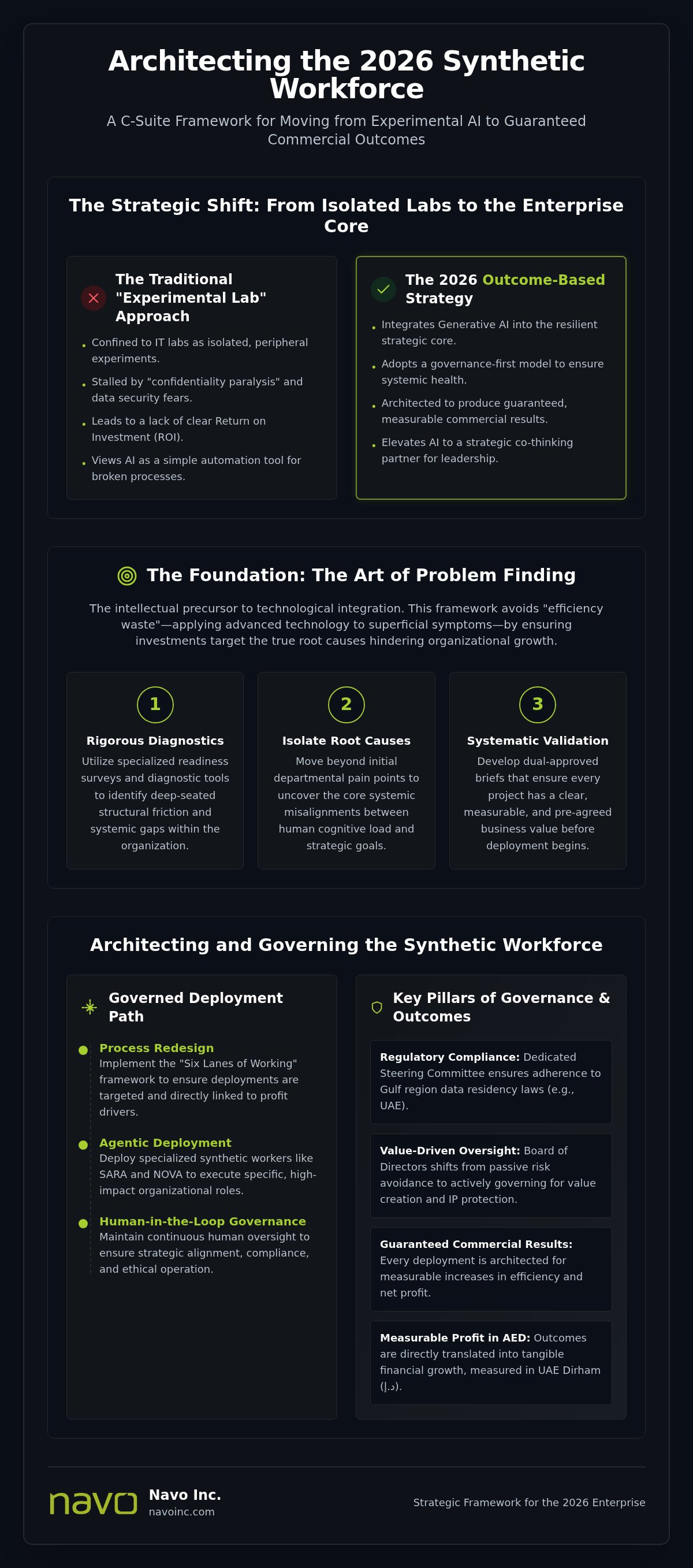
The 2026 executive imperative demands the migration of Generative Artificial Intelligence from the organizational periphery to the strategic core. For years, leadership teams treated these technologies as isolated experiments confined to Information Technology laboratories. This "Experimental Lab" approach served its purpose during the initial discovery phase, but it lacks the structural integrity required for enterprise-level resilience. A sophisticated AI strategy for c-suite leaders now requires an "Outcome-Based Strategy" where every deployment is architected to produce measurable commercial results.
This transition redefines the relationship between leadership and technology. We no longer view Artificial Intelligence as a mere automation tool; it has evolved into a strategic co-thinking partner. This partnership prioritizes cognitive augmentation, where agentic systems enhance the analytical depth of human decision-makers. By integrating this layer of intelligence into the high-level planning process, organizations can navigate complex market shifts with greater professional composure. This shift in perspective is the central pillar of the Enterprise Artificial Intelligence Adoption Framework, which serves as the architectural foundation for modern organizational evolution.
The Decline of Confidentiality Paralysis
In global financial hubs like Dubai and Singapore, the period of "wait and see" has ended. Leaders previously stalled by confidentiality paralysis and data security fears are now adopting governance-first models that prioritize systemic health. The Board of Directors plays a critical role here, moving away from passive risk avoidance toward value-driven governance. By establishing rigorous protocols that align with regional data residency regulations, organizations can protect their intellectual property while pursuing aggressive growth. This disciplined approach ensures that every technological investment is a calculated step toward increasing net profit, measured accurately in UAE Dirham (د.إ), rather than a speculative venture into the unknown.
The Art of Problem Finding: A Framework for High-Stakes AI Strategy
Success in digital evolution isn't determined by the speed of deployment, but by the precision of the diagnostic phase. Many organizations fall into the trap of applying advanced technology to superficial symptoms. This results in "efficiency waste," where a broken process is simply executed faster without contributing to the bottom line. Developing an effective AI strategy for c-suite leaders requires a shift in focus. Before investing in any agentic solution, one must master "The Art of Problem Finding." This proprietary framework serves as the intellectual precursor to any technological integration, ensuring that the problems identified are the ones actually hindering growth.
The diagnostic phase utilizes rigorous readiness surveys and specialized diagnostic tools to identify structural friction within the organization. We don't assume that the initial pain points reported by department heads are the root causes of stagnation. Instead, we look for systemic gaps where human cognitive load is misaligned with organizational goals. Once the correct problems are isolated, we transition to the "Six Lanes of Working." This process redesign framework ensures that the subsequent deployment of synthetic workers is targeted, governed, and directly linked to profit growth measured in UAE Dirham (د.إ).
Diagnostic Discipline in the C-Suite
Effective leadership requires an uncompromising evidence discipline. It's easy to be swayed by the hype surrounding Generative Artificial Intelligence. However, a seasoned strategist uses systematic validation to move from raw departmental inputs to dual-approved briefs. This ensures every project has a clear, measurable business value before a single line of code is written. If you're ready to move beyond generic consulting advice, you might consider how a structured diagnostic assessment can reveal the true drivers of your organizational performance.
Architecting the Synthetic Workforce: Beyond Traditional Human-Machine Interaction
The evolution from basic automation to a comprehensive synthetic workforce represents the next frontier in organizational design. We define the synthetic workforce as a governed layer of Agentic AI architected to execute specific, high-value roles within the enterprise. A resilient AI strategy for c-suite leaders recognizes that these systems aren't merely software applications; they're digital colleagues capable of autonomous reasoning and task execution. This shift allows human talent to move away from repetitive processing and toward high-level strategic orchestration.
In practice, this means deploying specialized agents with clear operational mandates. For instance, SARA serves as a Client-Briefing Specialist, synthesizing complex data into actionable executive summaries. Simultaneously, NOVA acts as a Project Orchestrator, ensuring that cross-departmental workflows remain aligned with strategic objectives. These aren't speculative concepts; they're functional components of a modern digital infrastructure. To understand the technical requirements for this transition, you should consult our Synthetic Workforce Development guide, which details the operational requirements for agentic integration.
Structural stability within this model depends on the Human-Ownership Mechanism. We don't advocate for unchecked autonomy. Every synthetic worker requires a human approval gate to ensure that all outputs align with organizational values and regional sensitivities. This "Human-in-the-Loop" model mitigates the risks associated with data security and operational drift. It transforms AI from a black-box technology into a transparent, accountable extension of your existing team.
Deploying Agentic AI with Governance
Governance is the bedrock of a successful synthetic workforce, particularly in highly regulated sectors like Banking, Financial Services, and Insurance (BFSI). Leadership must establish permitted-use boundaries and clear accountability rules for every autonomous agent. In the Gulf region, where data residency and compliance are paramount, every technological action must be audit-ready. By defining these boundaries early, you ensure that your agentic systems operate within a framework of professional density and legal compliance, protecting the organization from systemic health risks.
Establishing AI Governance and Measuring Outcome-Based ROI
The final stage of a mature AI strategy for c-suite involves the institutionalization of oversight. An Artificial Intelligence Steering Committee must be established, not merely as a technical advisory board, but as a body focused on commercial grounding. This committee ensures that every agentic deployment remains aligned with the high-level organizational goals discussed in previous sections. It provides the steady, expert hand needed to navigate the complexities of long-term integration while maintaining professional composure during rapid technological shifts.
Governance must be rooted in globally recognized standards while respecting local legal frameworks. We integrate the National Institute of Standards and Technology (NIST) Privacy Framework alongside specific regional data safeguards. In the United Arab Emirates, this requires strict adherence to Federal Decree-Law No. 45 of 2021 regarding the Protection of Personal Data. By architecting systems that are compliant by design, leaders protect their organizations from regulatory risks while maintaining systemic health. This disciplined approach ensures that synthetic workers operate within a secure, audit-ready environment.
Most consulting firms celebrate "successful deployment" as the terminal goal. We reject this definition of success. A truly sophisticated strategy prioritizes an outcome-based approach where profit or efficiency metrics are guaranteed. If a synthetic worker doesn't contribute to a measurable increase in net profit, the strategy hasn't met its professional standard. This commitment to structural excellence ensures that every technological investment translates into tangible value, measured accurately in UAE Dirham (د.إ).
The ROI of Generative AI: From Pilot to Profit
Predictable profit increases require moving away from speculative spend. By utilizing sophisticated ROI calculators, leadership can forecast the financial impact of agentic workflows before full-scale implementation. This methodology is detailed in our Outcome-Based AI Strategy article, which provides performance benchmarks for global leaders. It's the difference between an experimental lab and a disciplined, profit-generating cognitive layer. If you're ready to move beyond the hype and architect a resilient future, we invite you to contact Navo Inc. for a strategic diagnostic.
Architecting the Cognitive Enterprise of 2026
Transitioning toward a mature AI strategy for c-suite leadership requires a departure from speculative experimentation. It demands a commitment to "The Art of Problem Finding" to ensure that technological deployments solve structural friction rather than merely masking it. By architecting a synthetic workforce with specialized agents like SARA and NOVA, your organization gains a scalable layer of intelligence that operates under rigorous human-in-the-loop governance. This isn't just about automation; it's about building a resilient, co-thinking partnership that enhances every executive decision.
Navo Management Consultants provides the steady, expert hand needed for this high-stakes shift. Our CPD UK-certified AI masterclasses and outcome-guaranteed frameworks ensure that your transition is both secure and profitable. With expertise spanning Dubai, Singapore, and global markets, we guarantee measurable net-profit increases for our enterprise clients. Every strategic response we design is calibrated to the specific regulatory and commercial realities of the Gulf region, with results measured in UAE Dirham (د.إ).
The future of the cognitive enterprise belongs to those who view intelligence as a strategic asset rather than a technical utility. We're ready to help you lead that evolution with professional density and visionary clarity.
Frequently Asked Questions
What is the "Art of Problem Finding" in the context of C-suite AI strategy?
The "Art of Problem Finding" is a diagnostic framework designed to identify the root causes of organizational friction before any technological investment occurs. It moves beyond addressing superficial symptoms to isolate the systemic gaps where cognitive load is misaligned with commercial objectives. By prioritizing this phase, leaders ensure that their subsequent technological deployments are targeted at high-impact areas that directly contribute to net-profit growth.
How does a synthetic workforce differ from traditional automation?
A synthetic workforce utilizes Agentic AI capable of autonomous reasoning and task execution, whereas traditional automation relies on rigid, rule-based instructions. While legacy systems perform repetitive data entry, synthetic workers like SARA and NOVA analyze complex briefs and orchestrate cross-departmental workflows. This layer of intelligence acts as a cognitive extension of your human team, allowing for dynamic responses to evolving market conditions in the Gulf region.
What are the key components of a 2026 Corporate AI Governance Policy?
A robust 2026 Corporate AI Governance Policy integrates the NIST Privacy Framework with specific regional requirements, such as the UAE Federal Decree-Law No. 45 of 2021. Key components include clearly defined permitted-use boundaries, audit-ready outcome tracking, and established accountability protocols for autonomous agents. This framework ensures that any AI strategy for c-suite executives remains compliant with local data residency laws while protecting the organization’s intellectual property.
How can C-suite leaders ensure a guaranteed ROI on Generative AI consulting?
Leaders can ensure a guaranteed Return on Investment by shifting from deployment-based contracts to outcome-based engagement models that prioritize measurable net-profit increases. Navo Management Consultants provides these guarantees by linking technological success to specific commercial benchmarks, such as a documented rise in profit measured in UAE Dirham (د.إ). This approach eliminates speculative spend and ensures that every consulting hour translates into tangible organizational resilience and structural excellence.
Why is the "Human-in-the-Loop" model critical for Agentic AI in the Gulf region?
The "Human-in-the-Loop" model is essential for maintaining a successful AI strategy for c-suite leadership because it establishes a critical approval gate for every autonomous action. In the Gulf region, where cultural sensitivities and strict data regulations are paramount, this model ensures that agentic outputs remain aligned with local norms and legal requirements. It mitigates the risk of operational drift and preserves human accountability, positioning AI as a controlled extension of executive authority.
Disclaimer
The views and opinions expressed in this article are those of the author and do not represent any organisation, client, institution, or professional body with which he may be associated. The content is intended for general information, education, and thought leadership. Readers should seek appropriate professional advice before making legal, financial, investment, regulatory, technology, or business decisions.
The author has taken reasonable care to ensure the accuracy of the information and sources available at the time of publication. Technologies, regulations, market conditions, and industry practices may evolve, and readers are encouraged to verify current information independently. Any examples, cases, or scenarios may have been simplified, anonymised, or adapted to protect confidentiality. The author and publisher accept no liability for decisions or outcomes arising from the use of this content.
Generative AI tools may have been used to support research, structuring, or language refinement, with the final content, judgment, and editorial responsibility retained by the author.