

The Evolution of Professional Competency: Why Synthetic Skills Define the 2026 Workforce
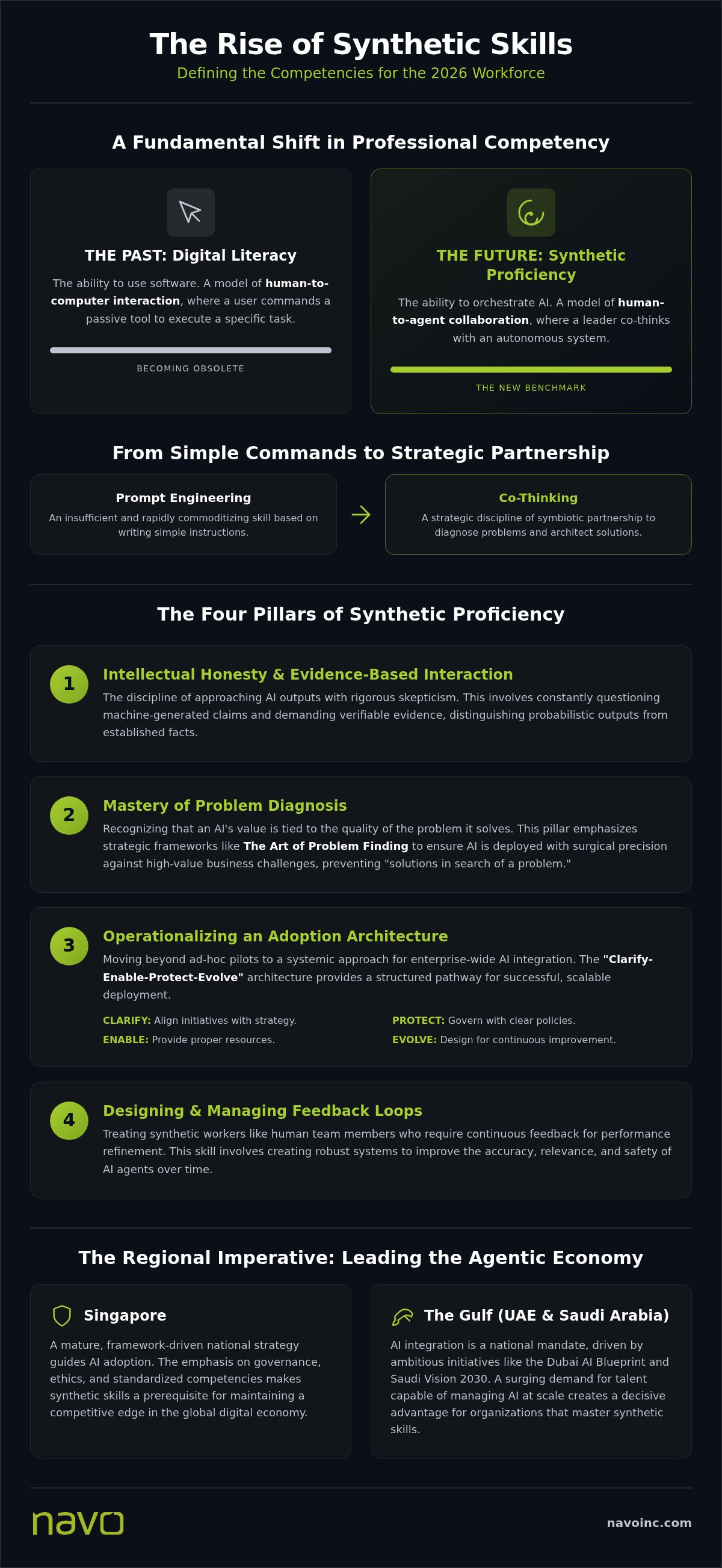
The professional landscape is undergoing a structural transformation driven by the rise of agentic Artificial Intelligence (AI). In this new reality, the established benchmarks for talent and proficiency are becoming obsolete. The conversation is no longer about digital literacy—the ability to use software—but about a new, more profound competency: synthetic skills. These skills represent the foundational ability to orchestrate, validate, and co-think with Generative Artificial Intelligence (GenAI), treating it not as a tool but as a collaborative agent within the workforce.
This evolution marks a critical departure from passive technology consumption. Digital literacy focused on human-to-computer interaction, where the user commanded a passive tool to execute a specific task. Synthetic proficiency, in contrast, involves human-to-agent collaboration. It requires a cognitive framework for managing autonomous systems that can reason, plan, and execute complex workflows. As enterprises move into the "Agentic Era," this distinction becomes the new dividing line between operational efficiency and strategic obsolescence. The demand is for a new talent benchmark that ensures human-in-the-loop accountability remains the bedrock of organizational governance, even as synthetic workers become integral to daily operations.
From Prompting to Co-Thinking
The initial hype surrounding GenAI centered on prompt engineering—the craft of writing effective instructions for a machine. While a useful starting point, this is an insufficient and rapidly commoditizing skill for the 2026 executive. The true strategic advantage lies in co-thinking, a discipline where human leaders and AI agents engage in a symbiotic partnership to diagnose problems, model scenarios, and architect solutions. This model moves beyond simple Q&A to a state of continuous, integrated dialogue.
In this co-thinking partner model, executives use AI not just to generate answers, but to challenge assumptions and pressure-test strategies. This requires a structured methodology for interaction, such as Navo Inc.’s proprietary "Six Lanes of Working" framework, which defines distinct modes of human-AI collaboration for integrated productivity. Mastering this framework enables leaders to orchestrate complex cognitive tasks, ensuring that machine-generated outputs are strategically aligned, ethically sound, and commercially viable.
The Regional Imperative: Singapore to Dubai
The global race for AI dominance is crystallizing around key innovation hubs, with distinct yet complementary approaches. In Singapore, a global leader in finance and technology, the adoption of AI is guided by a mature, framework-driven national strategy. The government’s emphasis on governance, ethics, and standardized competencies has created a sophisticated ecosystem where synthetic skills are seen as a prerequisite for maintaining a competitive edge in the global digital economy. For organizations in Singapore, developing these skills is a matter of strategic alignment with a forward-thinking regulatory environment.
Pivoting to the Gulf, the push for AI integration is not merely a corporate trend but a national mandate. Within the United Arab Emirates and Saudi Arabia, ambitious initiatives like the Dubai Universal Blueprint for Artificial Intelligence and Saudi Vision 2030 are driving unprecedented investment in agentic systems. In these rapidly diversifying economies, the demand for a workforce capable of managing AI at scale is surging. Organizations that adopt a clear framework for synthetic skills gain a decisive advantage in markets that value both innovation and stability. Early adoption ensures that firms in Dubai, Riyadh, and across the region do not just survive the transition to an agentic economy but lead it with professional composure and structural excellence.
Decoding the Core Pillars of Synthetic Proficiency
Synthetic proficiency is not an abstract concept but a concrete set of disciplines built on four core pillars. These pillars form the cognitive architecture required to effectively manage a hybrid human-AI workforce and unlock the full potential of agentic technologies. They represent a fundamental shift from merely using AI to strategically orchestrating it.
- Intellectual Honesty and Evidence-Based Interaction: This is the discipline of approaching AI-generated outputs with rigorous skepticism. It involves constantly questioning assumptions, demanding verifiable evidence for machine-generated claims, and maintaining a clear distinction between probabilistic outputs and established facts.
- Mastery of Problem Diagnosis: The value of any AI solution is directly proportional to the quality of the problem it is tasked to solve. Proficiency in strategic diagnostic frameworks, such as the Art of Problem Finding, is a prerequisite for preventing the deployment of "solutions looking for a problem."
- Operationalizing an Adoption Architecture: Successful AI integration requires a systemic approach. The "Clarify-Enable-Protect-Evolve" architecture provides a structured pathway for deploying AI, ensuring that initiatives are strategically aligned (Clarify), properly resourced (Enable), governed by clear policies (Protect), and designed for continuous improvement (Evolve).
- Designing and Managing Feedback Loops: Synthetic workers, like human employees, require continuous feedback to refine their performance. A core synthetic skill is the ability to design, implement, and manage robust feedback loops that improve the accuracy, relevance, and safety of AI agents over time.
The Art of Problem Finding
In the age of generative solutions, the most valuable human skill is no longer finding answers but defining the right problems. Corporate AI strategies often fail when they become fixated on technology deployment without a clear, underlying business challenge to address. This leads to costly pilot projects that deliver minimal Return on Investment (ROI). The Art of Problem Finding is a strategic diagnostic tool used to deconstruct complex business challenges into their fundamental components before any technological solution is considered. By mastering this discipline, leaders ensure that AI is deployed with surgical precision, targeting specific, high-value opportunities for growth and efficiency. For a deeper exploration of this methodology, see our guide on the Strategic Problem Finding Framework.
Machine-in-the-Loop Thinking
Orchestrating the Synthetic Workforce: Advanced Management Skills
As organizations integrate agentic AI, the very definition of management evolves. The 2026 leader will be less of a personnel manager and more of an orchestrator, directing a blended team of human experts and specialized synthetic workers. This requires a new suite of advanced management skills focused on designing, deploying, and governing autonomous agents like Navo Inc.’s proprietary SARA (Strategic Advisory & Research Agent) and NOVA (Narrative & Visualization Orchestration Agent).
Effective orchestration involves defining precise roles, memory retention parameters, and permitted tool usage for each AI agent. It is the manager’s responsibility to configure these agents to perform specific business functions—from market research to financial modeling—while ensuring their outputs are reliable, auditable, and aligned with corporate standards. Crucially, this model demands rigorous human ownership mechanisms, where every AI-generated outcome has a designated human accountable for its validation and impact. This ensures that as AI becomes more autonomous, accountability becomes more human-centric. To learn more about this transition, explore our analysis on scaling Generative Artificial Intelligence in the enterprise.
Agentic Governance and Ethical Oversight
The power of agentic AI must be balanced with robust governance. A critical synthetic skill for leadership is the ability to develop and enforce permitted-use boundaries and clear accountability rules for AI agents. This involves creating a comprehensive Corporate AI Governance Policy that aligns agentic workflows with established international standards, such as the NIST (National Institute of Standards and Technology) Privacy Framework, as well as the specific data sovereignty and privacy laws of regions like the Gulf Cooperation Council (GCC) and Southeast Asia. The executive’s role is to champion a culture of governed AI use, preventing "confidentiality paralysis"—a state of organizational inaction caused by fears of data breaches—by providing clear, actionable guidelines for safe and effective AI deployment.
Managing SARA and NOVA: A Case for Synthetic Orchestration
The practical application of synthetic skills is best illustrated through the management of specialized AI agents. For example, a leader with synthetic proficiency can deploy SARA to analyze market data and generate a client briefing document, then task NOVA with transforming that brief into a compelling visual presentation. This is not simple automation; it is a sophisticated workflow managed through a competency known as the "Sense-Ask-Refine-Approve" (SARA) protocol. The leader senses a business need, asks the agent to perform a task, refines the output through iterative feedback, and provides final approval. This orchestration skill allows for the precise utilization of synthetic workers, dramatically reducing budget waste and project timelines by ensuring high-accuracy validation at every stage.
Building a Synthetic Skill Development Roadmap
Transitioning an organization to a state of synthetic proficiency requires a deliberate and structured development roadmap. It is a strategic initiative that moves beyond ad-hoc training to create a sustainable, in-house capability for human-AI collaboration. This roadmap should be built on four key pillars designed to identify needs, deliver targeted training, foster the right culture, and measure tangible business impact.
- Conduct a Diagnostic Readiness Survey: The first step is to benchmark existing capabilities. A comprehensive readiness survey can identify critical skill gaps across different departments and leadership levels, providing the data needed to design a targeted upskilling program.
- Implement Modular, Accredited Development Pathways: A one-size-fits-all approach to training is ineffective. Develop modular professional development pathways that are accredited by respected bodies like CPD (Continuing Professional Development) UK. This ensures the training is rigorous, evidence-based, and globally recognized.
- Create a "Machine-in-the-Loop" Culture: Skill development must be supported by cultural change. Foster an environment that rewards intellectual honesty, critical thinking, and a disciplined approach to AI interaction. This culture should encourage employees to challenge AI outputs and prioritize human judgment.
- Measure ROI Through Business Outcomes: The success of any upskilling initiative must be measured in tangible business terms. Track key metrics such as efficiency gains, reductions in operational costs, and net-profit increases that are directly attributable to the adoption of synthetic skills.
The CPD UK Accredited Pathway
In a market saturated with superficial AI courses, formal accreditation provides a vital mark of quality and rigor. Certification from a globally recognized body like CPD UK signifies that a training program is not based on fleeting trends but on a structured, evidence-based curriculum. This is particularly important for synthetic skills, where proficiency requires a deep understanding of governance, ethics, and strategic application. Furthermore, the dynamic nature of AI necessitates a commitment to continuous learning. That is why credible certifications include renewal cycles, such as Navo Inc.’s 24-month validity period, which ensures that professionals remain current with the latest technological advancements and best practices. For executives planning this journey, our Synthetic Workforce Development Guide offers a comprehensive executive overview.
Calculating the ROI of Upskilling
Justifying investment in synthetic skill coaching requires a clear business case built on measurable Return on Investment (ROI). Leaders can utilize specialized ROI calculators to model the financial impact of upskilling initiatives before committing resources. These tools help identify "profit-leaking" processes—inefficient workflows, poorly defined project briefs, or redundant manual tasks—that can be resolved through the application of synthetic skills. For instance, a common source of budget waste in marketing departments is the endless revision cycle for creative briefs. A team trained in synthetic skills can use AI co-thinking partners to develop highly precise, data-informed briefs from the outset, dramatically reducing rework, accelerating campaign launches, and reclaiming significant portions of the marketing budget.
Future-Proofing Leadership with Navo Inc.’s Expert Coaching
The transition to an agentic enterprise is not a technological challenge; it is a leadership challenge. Future-proofing your organization requires more than just adopting new tools—it demands a new way of thinking, leading, and executing. Navo Inc. provides the expert coaching and strategic frameworks necessary to navigate this transformation with confidence and precision. Our unique value lies in our tool-agnostic, framework-led approach to GenAI. We do not sell software; we build strategic capability.
Our programs are designed to move your organization from isolated pilot projects to governed, profitable, and scalable AI value. Led by the strategic insights of author and consultant Vasudevan Kidambi, our leadership coaching bridges the critical gap between C-suite strategy and on-the-ground AI execution. We empower your teams with the synthetic skills needed to lead in the 2026 business landscape. Request a consultation for CPD-certified synthetic skill development and begin building your organization's future today.
Strategic Co-Thinking Partnerships
Navo Inc. operates on a principle of shared success. Our commitment to outcome-guaranteed consulting means we are invested in delivering measurable improvements to your bottom line. We partner with leaders in dynamic commercial hubs like Dubai, Riyadh, and Singapore, empowering them to lead the synthetic revolution in their respective markets. Our 5-week transformation journey is a structured, intensive engagement that takes leadership teams from preparation and diagnosis to activation and measurement, ensuring that the adoption of synthetic skills translates directly into a sustainable competitive advantage.
Certification and Beyond
Securing long-term organizational resilience requires a culture of continuous learning. Our CPD UK-certified masterclasses are just the beginning. We help you embed synthetic proficiency into your organizational DNA by developing robust internal structures like a Corporate AI Governance Policy, which not only mitigates risk but also serves as a powerful tool for attracting and retaining top talent. By partnering with Navo Inc., you join a global network of CPD-certified AI professionals who are not just witnessing the future of work but actively building it.
Frequently Asked Questions (FAQs)
**What exactly are synthetic skills in a professional context?
** Synthetic skills are the cognitive and technical competencies required to effectively orchestrate, validate, and collaborate with autonomous AI agents. They go beyond using AI as a tool and focus on managing AI as a co-worker, encompassing strategic problem diagnosis, ethical governance, and the ability to design and manage human-in-the-loop workflows.
**How do synthetic skills differ from prompt engineering?
** Prompt engineering is the tactical skill of writing instructions for an AI model to get a specific output. Synthetic skills are a strategic capability that includes prompt engineering but extends to the entire lifecycle of AI collaboration, including defining the business problem, validating the AI's output with intellectual honesty, integrating the AI into complex workflows, and ensuring ethical and governance compliance.
**Why is CPD UK accreditation important for AI training?
** CPD (Continuing Professional Development) UK accreditation provides an independent, globally recognized verification of quality and rigor in professional training. For a rapidly evolving field like AI, it ensures the curriculum is structured, evidence-based, and meets high educational standards, distinguishing it from unverified, trend-based courses.
**Can synthetic skills prevent job displacement within my organization?
** Synthetic skills are a key strategy for workforce augmentation rather than replacement. By upskilling employees to manage and orchestrate AI agents, organizations can redeploy human talent to higher-value tasks that require critical thinking, creativity, and strategic oversight. This approach enhances productivity and creates new roles focused on human-AI collaboration, mitigating displacement.
**How do I measure the ROI of training my team in synthetic skills?
** The Return on Investment (ROI) of synthetic skills training can be measured through specific business metrics. These include efficiency gains (e.g., reduced time on tasks), cost savings (e.g., lower project rework budgets), revenue growth (e.g., faster product-to-market cycles), and risk mitigation (e.g., improved compliance and data governance). Using an ROI calculator can help model these financial benefits.
**What is the "Art of Problem Finding" and why is it a core synthetic skill?
** The "Art of Problem Finding" is a strategic discipline for accurately diagnosing business challenges before applying a solution. It is a core synthetic skill because the effectiveness of any AI agent is determined by the quality and clarity of the problem it is assigned to solve. It prevents organizations from wasting resources on AI for its own sake and ensures technology is deployed to address genuine, high-value business needs.
**How often should synthetic skill certifications be renewed?
** Due to the rapid pace of change in AI, certifications should be renewed regularly to ensure proficiency remains current. A 24-month renewal cycle is a recommended standard, as it requires professionals to stay updated on new technologies, evolving governance frameworks, and emerging best practices in human-AI collaboration.
**Are synthetic skills relevant for non-technical leadership roles?
** Absolutely. Synthetic skills are arguably most critical for non-technical leaders (e.g., in HR, finance, marketing, and strategy). These leaders are responsible for setting strategy, managing teams, and ensuring governance. They must possess the synthetic skills to understand how to deploy AI agents effectively, measure their impact, and ensure they operate ethically and in alignment with business goals.
Disclaimer
The views and opinions expressed in this article are those of the author and do not represent any organisation, client, institution, or professional body with which he may be associated. The content is intended for general information, education, and thought leadership. Readers should seek appropriate professional advice before making legal, financial, investment, regulatory, technology, or business decisions.
The author has taken reasonable care to ensure the accuracy of the information and sources available at the time of publication. Technologies, regulations, market conditions, and industry practices may evolve, and readers are encouraged to verify current information independently. Any examples, cases, or scenarios may have been simplified, anonymised, or adapted to protect confidentiality. The author and publisher accept no liability for decisions or outcomes arising from the use of this content.
Generative AI tools may have been used to support research, structuring, or language refinement, with the final content, judgment, and editorial responsibility retained by the author.