
For innovation directors and C-suite executives, the persistent gap between high research and development (R&D) spend and a lack of breakthrough innovation is a source of significant strategic friction. Teams often expend valuable resources solving surface-level symptoms, delivering incremental improvements when the enterprise requires radical transformation. The fundamental error is not a failure in execution but a misdiagnosis of the core problem. The highest Return on Investment (ROI) in innovation is not found in the speed of the solution, but in the precision of the problem found.
This article provides a rigorous framework for conducting a strategic problem finding workshop for innovation teams. It moves beyond conventional brainstorming to introduce a structured, evidence-based methodology designed to identify the high-impact strategic opportunities that drive sustainable profit and competitive advantage. We will explore how to architect and facilitate these sessions, integrating machine-augmented insight to ensure the problems you choose to solve are the ones that truly matter.
The Strategic Imperative: Why Innovation Teams Must Pivot from Problem-Solving to Problem-Finding
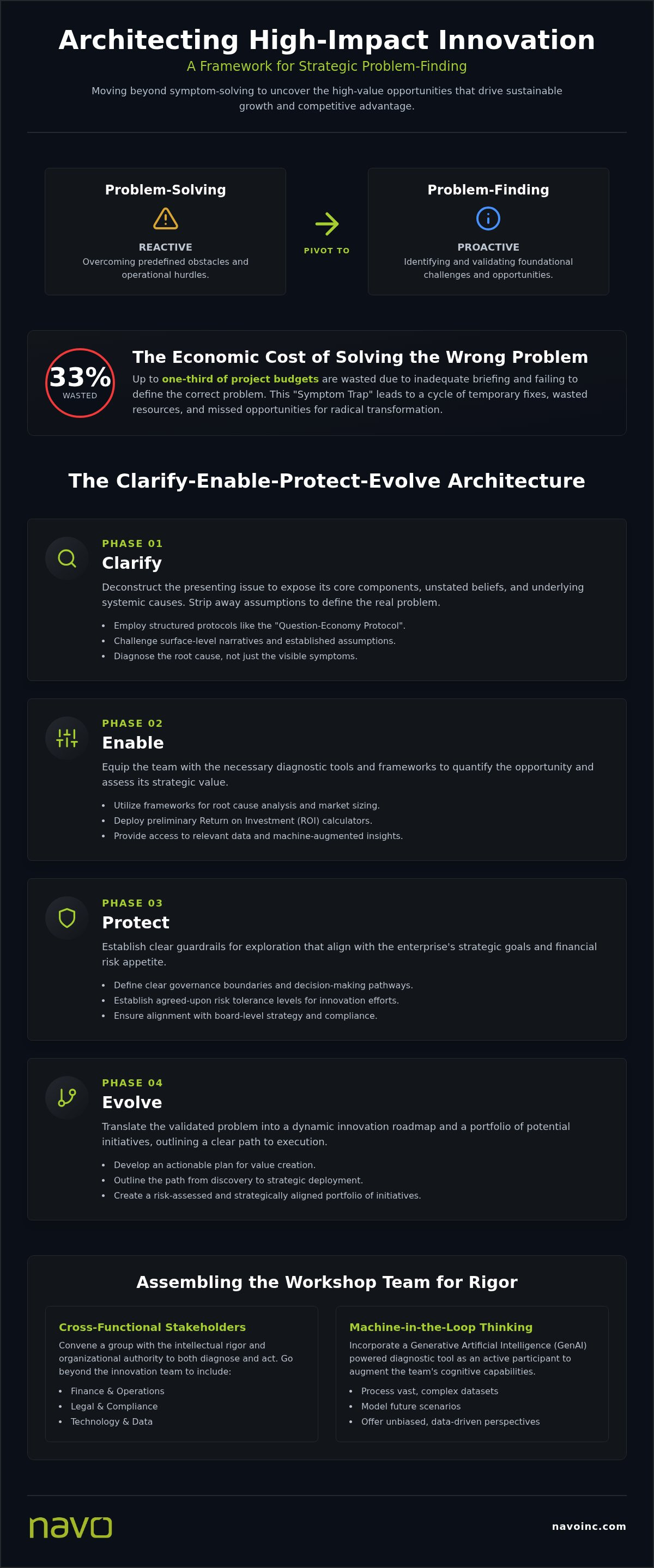
In the corporate lexicon, "problem-solving" is a celebrated, yet often misapplied, competency. It is a reactive discipline focused on overcoming predefined obstacles and operational hurdles. Problem-finding, by contrast, is the proactive, diagnostic discipline that precedes strategic execution. It is the art of identifying, articulating, and validating the foundational challenges and opportunities that, if addressed, will create disproportionate value for the organization.
Many innovation teams fall into the "Symptom Trap," dedicating their efforts to the most visible issues—declining sales, poor customer feedback, inefficient processes—without diagnosing the underlying systemic cause. This approach leads to a cycle of temporary fixes and wasted resources. The strategic imperative is to shift from treating symptoms to architecting cures, a transition enabled by a formal problem-finding methodology. This is where modern tools like Generative Artificial Intelligence (GenAI) offer a distinct advantage, capable of analyzing vast datasets to identify complex, systemic patterns that human cognition might overlook.
The Economic Cost of Solving the Wrong Problems
The financial impact of poor problem definition is substantial. Global innovation and marketing reports consistently identify that as much as 33% of project budgets are wasted due to inadequate briefing and a failure to define the correct problem from the outset. This waste is often compounded by "confidentiality paralysis," a cultural phenomenon in many large enterprises where teams are hesitant to articulate the true root causes of stagnation for fear of political repercussions. A structured problem-finding workshop creates a sanctioned, secure environment for the intellectual honesty required to uncover and address these foundational issues, turning potential waste into strategic investment.
Architecting the Problem-Finding Workshop: A Framework for High-Stakes Discovery
A successful problem-finding workshop is not an open-ended creative session; it is a meticulously architected engagement designed for high-stakes discovery. While libraries of facilitation activities exist, they often lack a cohesive executive-level framework that connects workshop outputs to board-level strategy. A robust architecture provides the necessary structure to guide teams from ambiguous symptoms to a precisely defined strategic opportunity, grounded in operational and commercial reality.
This framework is built upon four distinct, sequential phases:
- Phase 1: Clarify. This initial phase is dedicated to stripping away assumptions and surface-level narratives. Using structured protocols like the "Question-Economy Protocol," the team deconstructs the presenting issue to expose its core components and unstated beliefs.
- Phase 2: Enable. Once assumptions are cleared, the team is equipped with the necessary diagnostic tools. This includes frameworks for root cause analysis, market opportunity sizing, and preliminary ROI calculators to quantify the potential value of solving different underlying problems.
- Phase 3: Protect. Innovation involves risk, and this phase establishes the guardrails for exploration. The team defines clear governance boundaries, risk tolerance levels, and decision-making pathways, ensuring that the subsequent innovation efforts align with the enterprise's strategic and financial risk appetite.
- Phase 4: Evolve. The workshop's output is not a static problem statement but a dynamic innovation roadmap. This final phase focuses on translating the validated problem into a portfolio of potential initiatives, outlining the path from discovery to strategic execution.
The Clarify-Enable-Protect-Evolve Architecture
This proprietary architecture ensures that every problem-finding workshop remains grounded in the realities of the business. It prevents sessions from devolving into theoretical exercises by systematically connecting deep diagnosis (Clarify) with practical tools (Enable), strategic alignment (Protect), and actionable planning (Evolve). This structure provides executive sponsors with the confidence that the workshop will produce not just ideas, but a viable, risk-assessed, and strategically aligned plan for value creation. For organizations seeking to embed this capability enterprise-wide, deeper consulting on its adoption can provide a pathway to sustained innovation excellence.
Selecting Participants for Intellectual Rigor
The composition of the workshop team is critical to its success. The goal is not to assemble the most "creative" individuals but to convene a cross-functional group of stakeholders with the intellectual rigor and organizational authority to both diagnose and act. This must include representatives from finance, operations, legal, and technology alongside the core innovation team. Furthermore, modern workshops should incorporate "Machine-in-the-Loop Thinking" by treating a GenAI-powered diagnostic tool as an active participant. This AI co-thinking partner can process data, model scenarios, and offer unbiased perspectives, augmenting the team's cognitive capabilities and elevating the quality of the insights generated.
Facilitating the Session: Moving from Human Intuition to Machine-Augmented Insight
Effective facilitation of a strategic problem-finding workshop requires a departure from traditional creative techniques that prioritize open brainstorming. In high-stakes environments, where intellectual discipline and evidence are paramount, the session must be guided by structured diagnostic protocols. This approach mitigates common biases, such as the "loudest-voice" phenomenon, and ensures that conclusions are based on data-driven analysis rather than subjective opinion.
A key technique in this modern approach is the use of synthetic perspectives. AI agents can be configured to simulate "adversarial" stakeholders—such as a skeptical CFO, a risk-averse compliance officer, or a disruptive market competitor—to stress-test the validity of a problem statement. This process uncovers weaknesses in the team's logic before significant resources are committed. For enterprises operating in the Gulf (UAE, KSA) and Singapore, this facilitation must also explicitly incorporate regional governance standards and executive expectations, ensuring that any identified problem and its subsequent solution pathways are compliant with local regulatory frameworks and cultural norms.
The session culminates in a "Dual-Approval Lock," a final validation gate where both human intelligence (the executive sponsor) and machine intelligence (the AI diagnostic model) must concur on the final problem brief. This dual validation provides an unprecedented level of confidence in the strategic direction.
Leveraging Synthetic Workers in the Workshop Environment
The integration of AI can extend beyond analytics to include synthetic workers, or AI agents, in the workshop process itself. For example, an agent like SARA can be used to manage the initial client-brief intake, systematically asking clarifying questions to ensure the initial prompt is well-defined before the workshop even begins. Furthermore, synthetic workers can serve as a repository for organizational memory. By retaining the context and outcomes of past innovation efforts, they prevent teams from inadvertently "re-solving" problems that have been addressed before, ensuring that each new initiative builds upon cumulative institutional knowledge.
Evidence Discipline and Intellectual Honesty
The ultimate goal of the workshop is to produce an output with a standard of quality that mirrors the intellectual rigor of top-tier management consulting firms like McKinsey, BCG, and Bain (MBB). This requires a commitment to evidence discipline and intellectual honesty from all participants. All assumptions must be challenged, all data sources must be vetted, and all conclusions must be logically sound. To maintain this professional density, all abbreviations should be expanded upon first use, and final outputs must be articulated with the clarity and precision expected at the board level.
From Discovery to Deployment: Ensuring Measurable ROI through Strategic Problem-Finding
A problem-finding workshop is only valuable if it leads to measurable outcomes. Unlike conventional workshops that conclude with action plans and improved team alignment, a strategic problem-finding engagement must directly connect to profit or efficiency guarantees. The transition from discovery to deployment is where the true value is realized.
This transition involves several critical steps:
- Translating the "Found Problem" into a Certified Action Plan: The validated problem brief is converted into an actionable plan, structured to meet the standards of a Continuing Professional Development (CPD) certified framework. This ensures the plan is not just a list of tasks but a professional-grade strategic document.
- Calculating Potential Profit Impact: Using the ROI diagnostic tools introduced during the workshop, the team must quantify the projected financial impact of solving the identified problem. This provides a clear business case for investment and a baseline for measuring success. For a detailed guide on this process, leaders can explore frameworks for calculating the ROI of Generative AI.
- Establishing Human-Ownership Mechanisms: For AI-driven innovation outcomes, it is crucial to establish clear lines of human accountability. A dedicated owner must be assigned to oversee the initiative, ensuring that machine-generated insights are translated into real-world action and that the project remains aligned with enterprise goals.
- Closing the Loop to Implementation: The workshop should conclude with a clear pathway to the next phase, which often involves implementation or further development. For many organizations, this means transitioning from problem-finding to building the capabilities to solve it, such as through architecting a synthetic workforce.
The Navo Approach to Outcome-Guaranteed Strategy
Our methodology is rooted in a commitment to delivering tangible business results. We focus on providing enterprise clients with guaranteed profit or efficiency outcomes, transforming the innovation process from a cost center into a reliable value driver. This approach requires a deep investment in building internal capabilities. We invite leaders to solidify these skills and master the frameworks for modern innovation through our CPD certified AI courses, which are designed to establish an executive standard for strategic leadership in the age of AI.
Next Steps: Securing a Strategic Co-Thinking Partner
Navigating the complexities of strategic innovation in the GenAI era requires more than transactional consulting; it demands a high-level partnership with a firm that can serve as a strategic co-thinking partner. By combining deep industry expertise with cutting-edge AI capabilities, the right partner can help you architect the breakthroughs your organization needs. If you are ready to move beyond incrementalism and unlock transformative growth, the first step is to ensure you are solving the right problems.
Architect your next breakthrough. Request a consultation for a tailored Problem Finding Workshop today.
Frequently Asked Questions (FAQs)
What is the primary difference between a problem-solving and a problem-finding workshop?
A problem-solving workshop focuses on generating solutions for a pre-defined problem. A problem finding workshop for innovation teams is a more strategic, diagnostic session designed to uncover, validate, and prioritize the most valuable problems the organization should be solving, ensuring resources are directed toward high-impact opportunities.
How long should a strategic problem-finding workshop for innovation teams last?
While the duration can be tailored, a comprehensive strategic problem-finding workshop typically requires a dedicated engagement of one to two full days. This allows sufficient time for deep diagnosis, assumption testing, data analysis, and the development of a robust, validated problem brief and initial roadmap.
Can GenAI (Generative AI) truly assist in the problem-finding phase?
Absolutely. GenAI excels at identifying patterns in large, unstructured datasets, simulating complex scenarios, and providing unbiased "adversarial" perspectives to stress-test human assumptions. It acts as a powerful co-thinking partner, augmenting the team's ability to diagnose root causes and identify non-obvious strategic opportunities.
What are the essential KPIs to measure the success of an innovation workshop?
Key Performance Indicators (KPIs) should be tied to business outcomes, not just workshop activities. Essential KPIs include: the projected ROI of the identified problem, the level of C-suite confidence in the final problem brief, the speed of transition from workshop to project funding, and, ultimately, the realized profit or efficiency gains from the resulting innovation initiative.
How do we ensure the problems identified are aligned with corporate governance and regulations in the Gulf region?
Alignment is ensured by making regional governance a formal component of the workshop's "Protect" phase. This involves explicitly mapping potential problem areas against the legal, regulatory, and cultural frameworks of key markets like the UAE and KSA. A legal or compliance stakeholder should be included in the workshop to provide real-time guidance and ensure all outputs are compliant from the outset.
Disclaimer
The views and opinions expressed in this article are those of the author and do not represent any organisation, client, institution, or professional body with which he may be associated. The content is intended for general information, education, and thought leadership. Readers should seek appropriate professional advice before making legal, financial, investment, regulatory, technology, or business decisions.
The author has taken reasonable care to ensure the accuracy of the information and sources available at the time of publication. Technologies, regulations, market conditions, and industry practices may evolve, and readers are encouraged to verify current information independently. Any examples, cases, or scenarios may have been simplified, anonymised, or adapted to protect confidentiality. The author and publisher accept no liability for decisions or outcomes arising from the use of this content.
Generative AI tools may have been used to support research, structuring, or language refinement, with the final content, judgment, and editorial responsibility retained by the author.