

If your board asks for a line-item justification of the 750,000 د.إ spent on Generative AI pilots last quarter, could you provide a figure tied directly to net profit, or would you offer a slide deck on "innovation sentiment"? The current enterprise landscape in the United Arab Emirates reveals a pattern where executive teams subsidize high-cost experimentation without a definitive architectural map for financial recovery. It's a precarious position that leaves leadership vulnerable to the ambiguity of attributing specific gains to specific AI interventions.
We understand that the initial excitement of adoption has been replaced by a demand for rigorous accountability. You're likely seeking a method to ensure that every synthetic agent deployed functions as a high-performance financial asset rather than a recurring expense. This guide provides the diagnostic frameworks required for measuring AI impact on profit, ensuring your investments translate into measurable enterprise value. We'll explore the transition from surface-level efficiency to a structured metric architecture that governs the productivity of a hybrid human-synthetic workforce.
Key Takeaways
- Distinguish between superficial efficiency gains and systemic net profit expansion to effectively close the "Impact Gap" within your enterprise financial reporting.
- Adopt "The Art of Problem Finding" as a foundational diagnostic layer to uncover deep-seated structural inefficiencies that traditional organizational audits often overlook.
- Establish a rigorous metric architecture for measuring AI impact on profit by quantifying the operational speed and accuracy of autonomous agents like NOVA.
- Transition from high-cost experimental pilots toward governed, outcome-guaranteed AI strategies that align technological deployment with long-term financial health.
Why Traditional Return on Investment Models Fail to Capture Generative AI Profit
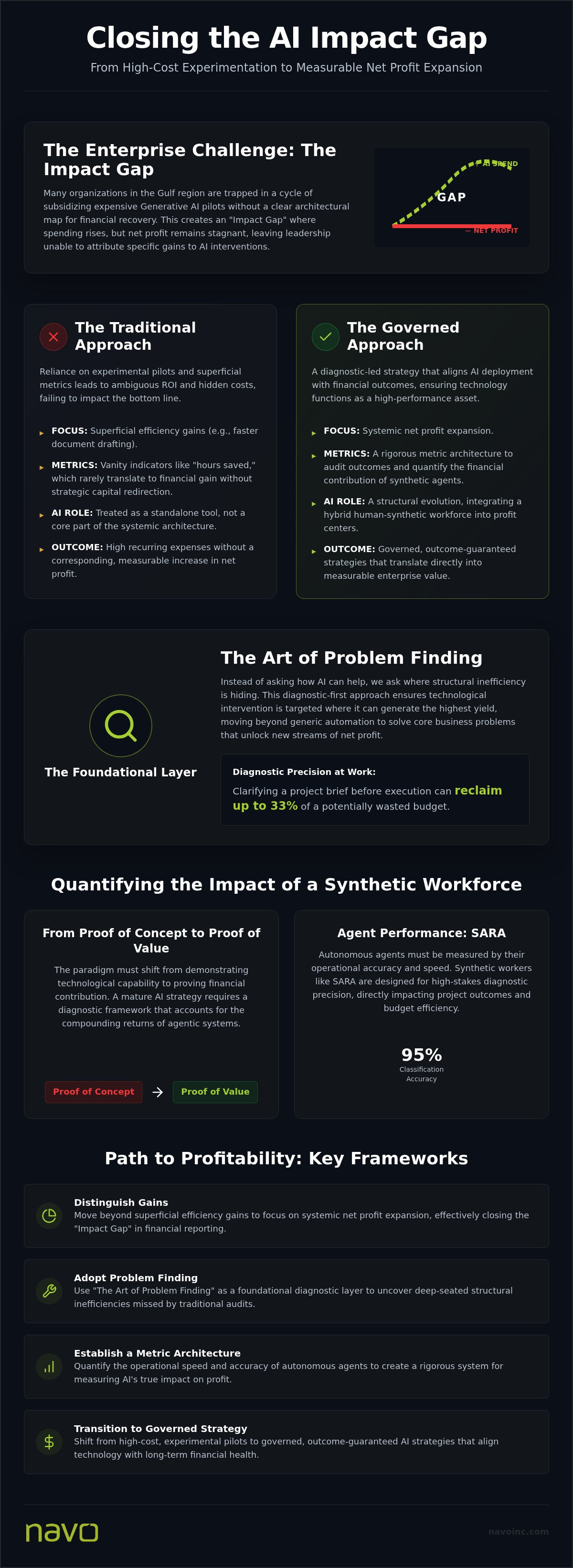
Traditional Return on Investment calculations often collapse under the weight of Generative AI's non-linear value creation. Most executive teams in the Gulf region are currently trapped in a cycle of measuring efficiency gains, such as reduced call handling times or faster document drafting. While these metrics look impressive in a quarterly review, they frequently fail to move the needle on net profit expansion. This Impact Gap persists because organizations treat AI as a standalone tool rather than a structural evolution of their systemic architecture. To bridge this divide, leadership must shift from tracking activity to auditing outcomes within a 2026 landscape defined by synthetic workforce integration.
Measuring AI impact on profit requires a move beyond the era of proof of concept into an era of proof of value. This necessitates a diagnostic framework that accounts for the compounding returns of agentic systems. Unlike traditional software, Generative AI capabilities expand as they ingest more organizational context, meaning their financial contribution isn't a fixed percentage of cost reduction but a dynamic driver of revenue growth. Organizations that fail to adapt their financial models will continue to see high Generative AI spend without a corresponding increase in the bottom line.
The Limitation of Time-Saving Metrics
Executive teams often celebrate "hours saved" as a primary success indicator. This is a vanity metric. If an employee in a Dubai International Financial Centre firm saves five hours a week through AI-assisted research but redirects that time into low-margin administrative tasks, the enterprise realizes zero financial gain. Time recovery only translates to the bottom line when it's strictly diverted into high-margin, revenue-generating activities. Without a strategic redirection of human capital, efficiency is merely a hidden cost.
Attribution in a Hybrid Human-Machine Ecosystem
Attributing financial success in a hybrid environment presents a unique challenge for governance. When an autonomous agent identifies a market inefficiency and a human executive executes the strategic move, the value creation is shared. Measuring AI impact on profit necessitates a multi-touch attribution model that recognizes the synthetic agent's role in the intellectual property chain. Navigating these complexities is essential for firms looking to scale AI agents based on proven, rather than perceived, value.
The Art of Problem Finding: A Diagnostic Approach to High-Stakes AI Profitability
Most organizations fail because they rush to solve symptoms without identifying the root cause. This is where "The Art of Problem Finding" becomes the foundational layer of a profitable strategy. Instead of asking how AI can help, we ask where the structural inefficiency is hiding. By mapping the "Six Lanes of Working" against enterprise profit centers, we uncover gaps that traditional audits miss. This diagnostic rigor ensures that technological intervention is targeted where it can generate the highest yield rather than just automating existing friction.
Consider the logic applied by SARA, a synthetic worker capable of 95% classification accuracy. In many instances, clarifying a project brief before a single line of code is written can reclaim up to 33% of a wasted budget. This level of diagnostic precision is non-negotiable for measuring AI impact on profit at scale. You can consult with our strategists to identify these high-stakes opportunities within your own operations and move beyond the limitations of generic automation.
Diagnostic Precision vs. Tool-Agnostic Strategy
Selecting a Large Language Model, the foundational engine driving Generative AI capabilities, is secondary to defining the organizational "ask". A tool-agnostic strategy ensures that technology serves the business objective, not the other way around. High-register corporate inquiry allows leadership to uncover use cases where AI doesn't just automate, but radically evolves the value proposition. It's about finding the specific problem that, once solved, unlocks a new stream of net profit.
The Continuing Professional Development Standard for AI Leadership
Developing these synthetic skills requires more than a casual understanding of technology. It demands a structured approach to leadership. Continuing Professional Development certified AI courses provide the rigorous training necessary to align leadership capability with the "Clarify-Enable-Protect-Evolve" architecture. This alignment ensures that measuring AI impact on profit becomes a standard executive competency, allowing for the deployment of governed, high-value synthetic agents across the enterprise.
Quantifying the Impact of a Synthetic Workforce on Enterprise Bottom Lines
Transitioning from diagnostic rigor to operational execution requires a shift in how we perceive human capital. We're no longer managing just a human team; we're orchestrating a synthetic workforce. This evolution moves beyond simple automation into the territory of autonomous AI agents like NOVA. These agents don't just follow static scripts; they reason through complex organizational goals. By integrating synthetic workforce development into the traditional profit and loss statement, executives can begin measuring AI impact on profit with the same granularity as standard labor costs.
Central to this quantification is the "Question-Economy Protocol". This metric evaluates the speed and accuracy of the inquiry-to-resolution cycle. In high-stakes environments, the ability of an agent to provide a precise answer reduces the cognitive load on senior leadership, accelerating the pace of business. However, this efficiency must be governed. Human-in-the-loop approval gates act as a critical safeguard, ensuring that agentic decisions remain strictly aligned with financial governance and regional regulations across the Gulf and beyond.
Measuring SARA and NOVA: Agent-Specific Performance Metrics
Evaluating agents like SARA requires tracking classification accuracy, where we target a 95% benchmark, and measuring the time-to-acceptance in client-briefing cycles. When agents utilize memory and tool-use to orchestrate complex projects, the resulting reduction in cycle time becomes a direct contributor to the enterprise bottom line. We track these metrics to ensure that measuring AI impact on profit is based on hard data rather than speculative efficiency.
The Economics of Scalability in the Agentic Era
The agentic era allows firms in hubs like Dubai, Singapore, and Mumbai to decouple revenue growth from headcount increases. Traditionally, scaling an enterprise required a proportional rise in personnel costs. Synthetic workers break this linear relationship. This shift is vital for regional players looking to maintain agility while expanding their global footprint without the burden of traditional overhead expansion.
Bridging the Impact Gap: Transitioning from Experimental Pilots to Guaranteed Profit
Navo Inc. provides a definitive departure from the standard consulting model by aligning fees directly with measurable net-profit increases. This outcome-guaranteed approach addresses the primary executive pain point: the ambiguity of high Generative Artificial Intelligence spend without visible returns. Transitioning from experimental pilots to guaranteed profit requires a shift in mindset, moving from treating technology as a cost center to viewing it as a co-thinking partner. By implementing a strategic AI roadmap, organizations can prioritize high-stakes outcomes over superficial efficiency gains.
Overcoming "Confidentiality Paralysis" is essential for measuring AI impact on profit within the strict regulatory environments of the United Arab Emirates and broader Gulf region. Instead of allowing security concerns to stall progress, governed activation protocols ensure that data remains protected while synthetic agents drive value. This systemic health is maintained through a structured architecture where every intervention is audited for its contribution to the bottom line. It's a methodical process that values depth over brevity, leading the enterprise toward a state of synthetic excellence.
Corporate Governance and Auditability
Structural excellence in deployment necessitates rigorous oversight. Ensuring that profit is achieved within permitted-use boundaries requires human-in-the-loop safeguards and clear data governance. The role of the "Certified Independent Director" becomes pivotal here, providing the analytical perspective needed to oversee high-stakes organizational shifts while maintaining professional composure and systemic integrity. Auditability isn't just a compliance requirement; it's a financial necessity for scaling agentic systems with confidence.
Next Steps: Diagnostic Engagement
Moving forward requires a logical assessment of your current technological reality. C-suite leaders are encouraged to undergo an Artificial Intelligence readiness survey to identify structural gaps and potential profit centers. When selecting an artificial intelligence consulting firm, prioritize partners who understand profit-first strategy rather than those who focus purely on tool implementation. This steady, expert hand is what separates fleeting innovation from sustained, measurable success in the agentic era.
Architecting the Future of Enterprise Profitability
The transition from speculative experimentation to structural excellence requires a disciplined commitment to diagnostic rigor. We've explored why traditional efficiency metrics fail and how the Art of Problem Finding serves as the only reliable foundation for identifying high-margin opportunities. By deploying autonomous agents like NOVA and integrating them into a governed profit and loss framework, your organization can finally move beyond vanity metrics toward genuine financial recovery.
Measuring AI impact on profit is no longer a theoretical exercise but a core competency for the 2026 executive. Navo Inc. stands ready as your steady, expert hand, offering outcome-guaranteed strategy consulting backed by bestselling authorship in Generative AI transformation. Our CPD UK-certified executive masterclasses ensure your leadership team possesses the synthetic skills necessary to navigate this complex organizational shift with professional composure.
The era of the co-thinking profit driver has arrived, and those who architect their systems for accountability will define the next decade of regional leadership in the Gulf and beyond.
Frequently Asked Questions
How do we distinguish between efficiency gains and actual net profit in AI projects?
Distinguishing between these two requires a transition from activity-based metrics to outcome-based accounting. Efficiency gains, such as reduced cycle times or "hours saved", are merely leading indicators that don't always reach the bottom line. Net profit expansion only occurs when these reclaimed resources are strictly redirected into high-margin activities or result in the permanent removal of structural costs from the enterprise.
What are the most critical KPIs for measuring the performance of synthetic workers like SARA?
The most critical Key Performance Indicators for SARA include its 95% classification accuracy and the rate of brief-to-execution alignment. Executives should also track the time-to-acceptance for outputs generated within client-facing cycles. These specific metrics ensure that the synthetic worker is operating as a high-precision financial asset rather than a source of operational friction that requires constant human correction.
Can Generative AI impact on profit be guaranteed in a consulting engagement?
Profit can be guaranteed when a consulting firm aligns its remuneration directly with the client's measurable financial success. This model moves away from traditional hourly billing toward a shared-risk framework that prioritizes measuring AI impact on profit as the primary success indicator. By anchoring the engagement in verified financial outcomes, enterprises in Dubai and Singapore can scale their AI investments with absolute fiscal confidence.
How does 'The Art of Problem Finding' reduce the risk of wasted AI investment?
The Art of Problem Finding reduces investment risk by ensuring that AI is applied to the root cause of systemic inefficiency rather than its symptoms. This diagnostic approach identifies structural gaps that are often invisible to traditional audits. By clarifying the organizational "ask" before selecting a technology, firms avoid subsidizing expensive tools that don't address a high-stakes problem, ensuring every dirham spent is targeted toward recovery.
What role does CPD UK certification play in the financial governance of AI initiatives?
CPD UK certification provides a standardized framework for executive leadership to oversee the ethical and financial governance of synthetic systems. It ensures that leadership teams possess the specialized skills required for measuring AI impact on profit with professional composure. This certification establishes a rigorous baseline for AI governance, aligning technological deployment with international standards of accountability and transparency required by boards and regulatory bodies.
Disclaimer
The views and opinions expressed in this article are those of the author and do not represent any organisation, client, institution, or professional body with which he may be associated. The content is intended for general information, education, and thought leadership. Readers should seek appropriate professional advice before making legal, financial, investment, regulatory, technology, or business decisions.
The author has taken reasonable care to ensure the accuracy of the information and sources available at the time of publication. Technologies, regulations, market conditions, and industry practices may evolve, and readers are encouraged to verify current information independently. Any examples, cases, or scenarios may have been simplified, anonymised, or adapted to protect confidentiality. The author and publisher accept no liability for decisions or outcomes arising from the use of this content.
Generative AI tools may have been used to support research, structuring, or language refinement, with the final content, judgment, and editorial responsibility retained by the author.