

The primary obstacle to enterprise AI (Artificial Intelligence) maturity in 2026 is not a lack of compute, but a surplus of aimless experimentation. While global spending on AI is projected to reach د.إ 9.5 trillion this year, the reality remains that 70% to 85% of AI initiatives fail to transition from pilot to production. You likely recognize this friction; it manifests as fragmented adoption across departments and a distinct lack of measurable ROI (Return on Investment) on GenAI (Generative Artificial Intelligence) investments. Building an internal AI center of excellence requires a fundamental shift from technical curiosity to the "Art of Problem Finding." This article provides a strategic framework for architecting a governed, scalable infrastructure that integrates synthetic workers like SARA and NOVA into your core business processes. We'll examine how to move beyond experimental pilots to secure a measurable net-profit increase through disciplined agentic orchestration and rigorous corporate governance.
Key Takeaways
- Shift from tool-centric deployment to a diagnostic-led strategy by anchoring your Artificial Intelligence Center of Excellence (AI CoE) in the "Art of Problem Finding" framework to resolve systemic organizational friction.
- Discover the architectural blueprint for building an internal AI center of excellence that utilizes a hub-and-spoke model to scale agentic orchestration across diverse business units.
- Learn how to integrate a specialized Synthetic Workforce, including agents like SARA and NOVA, to automate brief intake and production workflows with sophisticated human-AI collaboration.
- Establish a rigorous Corporate AI Governance Policy that enables your organization to move beyond experimental pilots toward measurable, guaranteed increases in net profit.
Structural Architecture: Rooting the AI CoE in the Art of Problem Finding
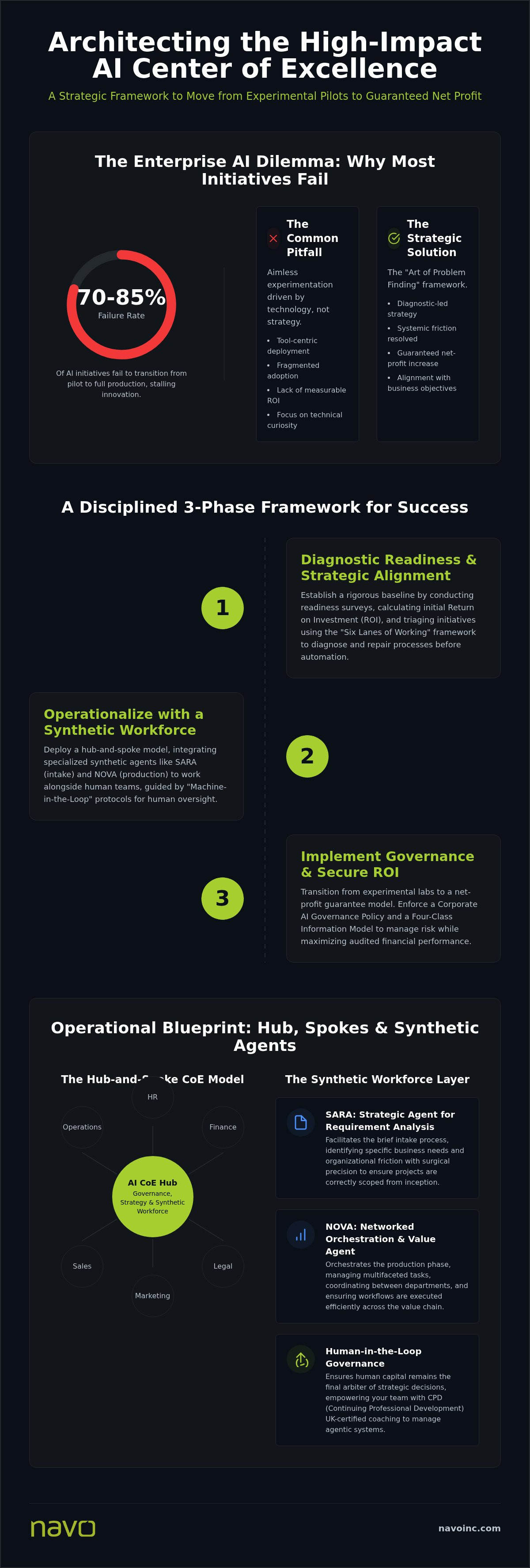
An Artificial Intelligence Center of Excellence (AI CoE) isn't a mere repository for software licenses or a sandbox for technical hobbyists. It's a strategic co-thinking partner designed to align silicon intelligence with high-level human objectives. Most organizations stumble because they lead with technology, treating AI as a "plug-and-play" solution. By the time they realize the tool doesn't address the underlying friction, they've joined the 70% to 85% of failed AI projects. Building an internal AI center of excellence requires a diagnostic-first architecture. We utilize the "Art of Problem Finding" framework to strip away the hype and identify the systemic bottlenecks that actually hinder your enterprise value.
Phase 1: Diagnostic Readiness and Strategic Alignment
Meaningful transformation begins with a rigorous baseline when building an internal AI center of excellence. We conduct comprehensive readiness surveys and initial ROI (Return on Investment) calculations to ensure every dirham (د.إ) allocated has a clear path to measurable recovery. This phase establishes the "Six Lanes of Working," a proprietary framework that categorizes AI initiatives by their strategic impact and operational risk profile. It's a process of triage. You shouldn't automate a broken workflow; you must diagnose and repair the process first. This disciplined approach is a cornerstone of the Executive Guide to Generative AI Consulting Services, which assists Dubai-based leaders in selecting partners who prioritize systemic health over superficial features. By establishing these guardrails early, the CoE functions as a steady, expert hand throughout the organizational shift.
Operationalizing the Hub-and-Spoke: Integrating Synthetic Workers and Agentic AI
Transitioning from a diagnostic framework to operational reality requires a structural shift. While traditional consulting often focuses solely on human talent, building an internal AI center of excellence in 2026 demands a hybrid workforce model. The CoE (Center of Excellence) serves as a central hub, deploying "spokes" of intelligence into functional units like HR, Finance, and Legal. This isn't merely about software; it's about the integration of a Synthetic Workforce that operates alongside your executive leadership to drive systemic efficiency.
Specialized agents like SARA and NOVA redefine the parameters of productivity. SARA facilitates the brief intake process, identifying specific business needs with surgical precision. NOVA then orchestrates the production phase, managing multifaceted tasks across departments. This orchestration relies on "Machine-in-the-Loop" protocols. We ensure that while agents execute complex cognitive tasks, human ownership remains the final arbiter of strategic decisions. If you're ready to architect this balance, consult with our strategists to begin your deployment.
Phase 2: Orchestrating the New Workforce Layer
This phase focuses on the precise definition of roles within Synthetic Workforce Development. In the UAE (United Arab Emirates), where digital transformation aligns with national vision, Agentic AI governance is essential for managing the lifecycle of these digital entities. We implement rigorous audit trails for every deployment. To resolve the "synthetic skills" gap, we provide CPD (Continuing Professional Development) UK-certified coaching. This training empowers your human capital to manage agentic systems with the same rigor they apply to traditional management, ensuring the CoE delivers consistent, high-register value.
Governance and ROI: Transitioning from Experimental Labs to Profit Guarantees
The terminal phase of building an internal AI center of excellence involves the rigorous translation of technological capability into audited financial performance. While many organizations remain trapped in a cycle of perpetual "innovation labs" that produce soft Key Performance Indicators (KPIs), a sophisticated CoE (Center of Excellence) demands a net-profit guarantee model. This transition requires a Corporate AI Governance Policy that doesn't stifle progress but instead desensitizes risk through systemic controls. Central to this is the implementation of a Four-Class Information Model, which categorizes data from Public to Restricted. This structure ensures that confidential-transformable data is shielded, particularly under the evolving data sovereignty regulations of the UAE (United Arab Emirates), while allowing the organization to exploit lower-risk information for rapid prototyping.
Phase 3: Scaling with Evidence Discipline
Scaling the framework for building an internal AI center of excellence requires a shift in the CoE's identity from a centralized gatekeeper to a strategic advisor. By utilizing Agentic AI Services, the hub automates the heavy lifting of governance, including real-time audit trails and compliance reporting. This automation allows human leadership to focus on high-level orchestration rather than manual oversight. As organizational literacy matures, the CoE evolves into a consultative body that empowers individual departments to own their AI lifecycles. We conclude this journey by securing board-level alignment through a CPD Certified AI Course. This ensures that the architects of the organization possess the synthetic workforce leadership skills, rooted in Continuing Professional Development (CPD) standards, necessary to navigate the high-stakes shifts of the 2026 landscape with professional composure and visionary clarity.
Architecting the Autonomous Enterprise
The transition from fragmented AI experiments to a unified strategic engine defines the boundary between organizational obsolescence and systemic health. Building an internal AI center of excellence is the definitive strategic response to the 2026 landscape. It requires a commitment to the "Art of Problem Finding," ensuring every deployment addresses a verified diagnostic need. By integrating a synthetic workforce layer with agents like SARA and NOVA, your organization moves beyond automation into full agentic orchestration. We provide the steady, expert hand needed for this high-stakes shift, supported by CPD (Continuing Professional Development) UK-certified masterclasses. This disciplined framework ensures your transformation is financially sound, delivering a guaranteed net-profit increase for your enterprise.
The future belongs to the disciplined architects who master technology as an extension of structural excellence.
Frequently Asked Questions
What is the primary role of an AI Center of Excellence in 2026?
The primary role of an AI (Artificial Intelligence) Center of Excellence in 2026 is to serve as a strategic co-thinking partner for the enterprise. It functions as a diagnostic engine that utilizes the "Art of Problem Finding" to identify systemic friction. This ensures that technological deployments are not speculative experiments but targeted responses to verified organizational challenges.
How do I measure the ROI of an internal AI CoE?
Measuring ROI (Return on Investment) involves a transition from soft metrics to hard financial recovery. We utilize a net-profit guarantee model that calculates the direct impact on the bottom line in Dirhams (د.إ). By establishing a rigorous baseline of operational costs before intervention, the CoE (Center of Excellence) can demonstrate measurable increases in net profit through efficiency gains.
Who should lead the AI Center of Excellence: IT or Business?
Leadership should be a sophisticated partnership, but the strategic direction must reside with Business. While IT (Information Technology) provides the essential infrastructure and security, a business-led mandate ensures that AI initiatives align with P&L (Profit and Loss) goals. This prevents the CoE from becoming a technical silo and keeps it focused on high-stakes organizational shifts.
What is the difference between a traditional CoE and an Agentic AI CoE?
A traditional CoE manages software tools and data repositories, whereas an Agentic AI CoE orchestrates a Synthetic Workforce. This evolution moves from static automation to dynamic agents that perform cognitive tasks. These systems, such as NOVA for production orchestration, act as digital coworkers rather than passive tools, requiring a higher level of governance and strategic oversight.
How can a synthetic workforce be integrated into a hub-and-spoke model?
A synthetic workforce is integrated through a hub-and-spoke model where the central CoE (Center of Excellence) defines the operational logic and governance. Specialized agents, such as SARA for brief intake, are then deployed into functional "spokes" like HR (Human Resources) or Legal. This allows for departmental specialization while maintaining a unified, governed infrastructure across the entire enterprise.
What are the common pitfalls when building an internal AI center of excellence?
Common pitfalls when building an internal AI center of excellence include adopting a "tool-first" mentality and neglecting the diagnostic readiness phase. Many organizations fail because they attempt to automate inefficient processes without first utilizing the "Art of Problem Finding." Additionally, a lack of clear Corporate AI Governance Policy often leads to fragmented adoption and significant risk exposure.
Disclaimer
The views and opinions expressed in this article are those of the author and do not represent any organisation, client, institution, or professional body with which he may be associated. The content is intended for general information, education, and thought leadership. Readers should seek appropriate professional advice before making legal, financial, investment, regulatory, technology, or business decisions.
The author has taken reasonable care to ensure the accuracy of the information and sources available at the time of publication. Technologies, regulations, market conditions, and industry practices may evolve, and readers are encouraged to verify current information independently. Any examples, cases, or scenarios may have been simplified, anonymised, or adapted to protect confidentiality. The author and publisher accept no liability for decisions or outcomes arising from the use of this content.
Generative AI tools may have been used to support research, structuring, or language refinement, with the final content, judgment, and editorial responsibility retained by the author.