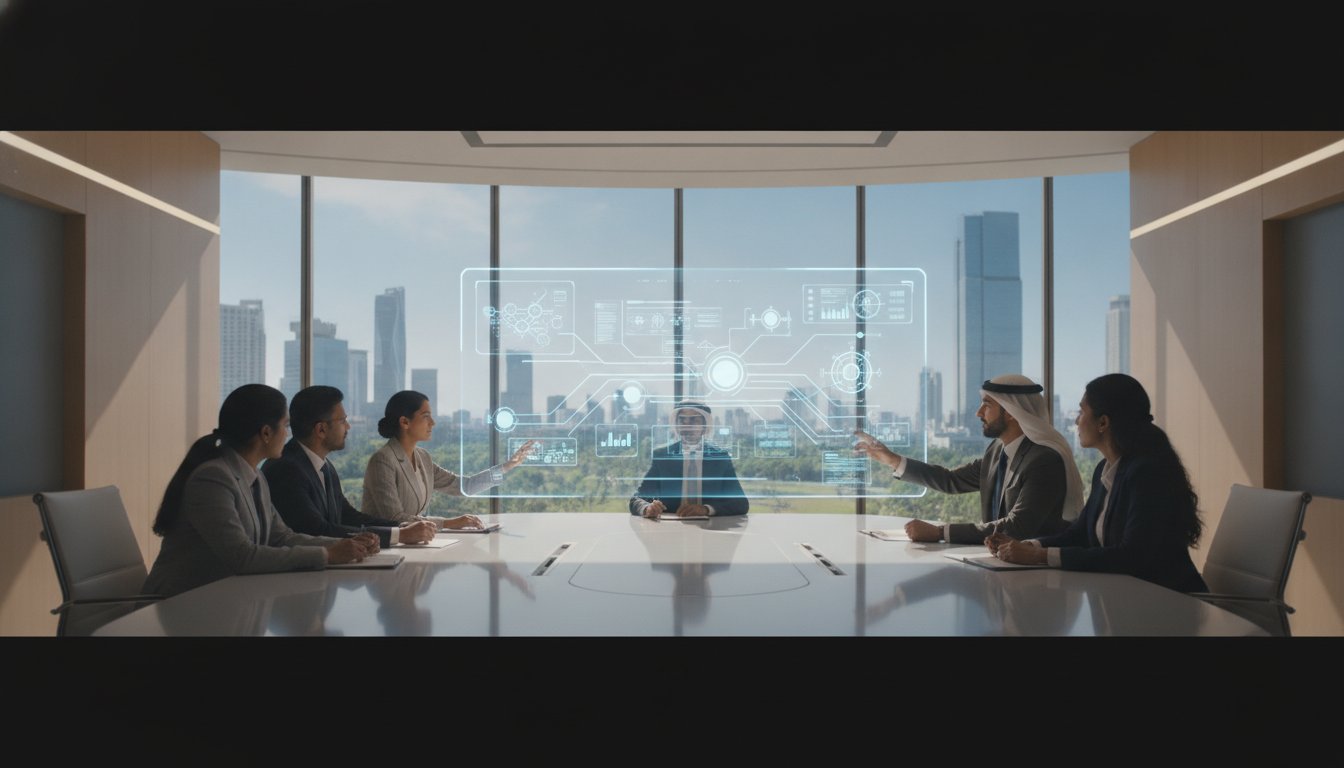

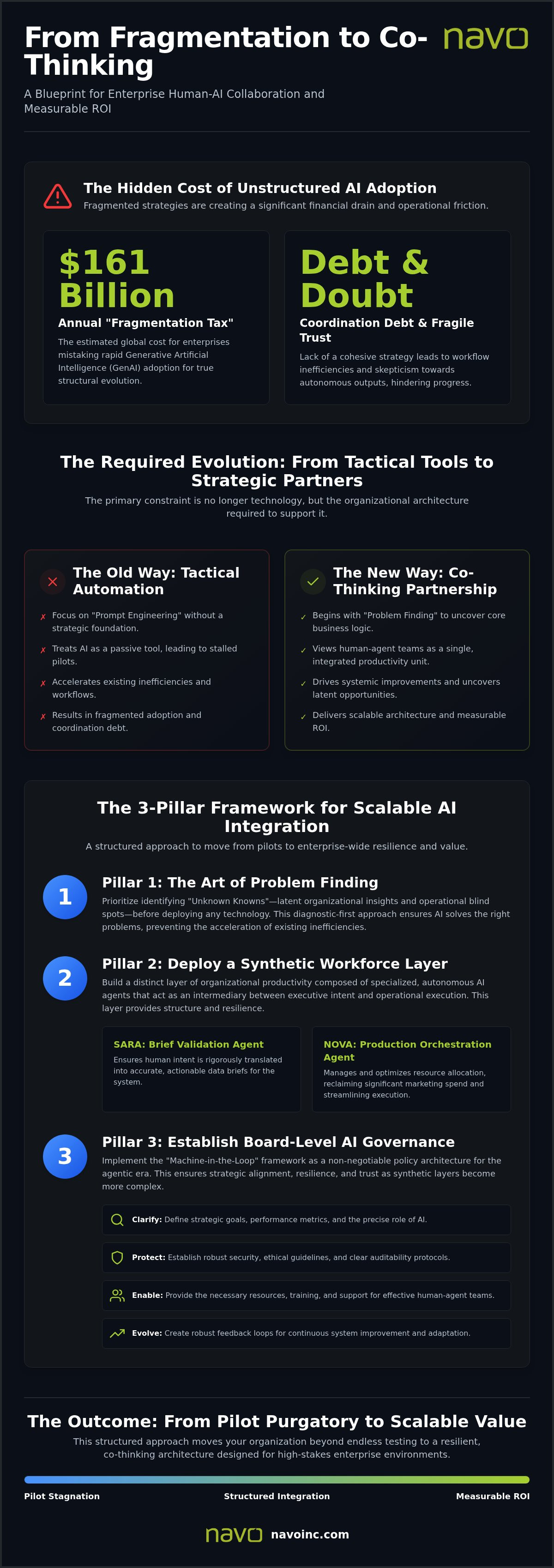
Most enterprises are currently paying a "Fragmentation Tax" estimated at $161 billion annually because they've mistaken rapid Generative Artificial Intelligence (GenAI) adoption for structural evolution. In markets like the Gulf and India, the lack of a cohesive strategy for human-AI collaboration in the workplace often leads to coordination debt. You've likely observed that trust in autonomous outputs remains fragile. Many teams still review synthetic results with skepticism, despite supportive national frameworks. The primary constraint is no longer the technology, but the organizational architecture required to support it.
This article provides a blueprint for shifting from tactical automation to a sophisticated co-thinking partnership that delivers a measurable Return on Investment (ROI). We'll examine how proprietary frameworks like the Art of Problem Finding can stabilize agentic systems. You'll gain a strategic roadmap to integrate synthetic workers, such as SARA or NOVA, into high-stakes environments with professional composure.
Key Takeaways
- Transition from passive tool utilization to active human-AI collaboration in the workplace by implementing the Art of Problem Finding framework to uncover organizational "Unknown Knowns."
- Deploy a specialized Synthetic Workforce layer using agentic systems like SARA and NOVA to automate brief validation and production orchestration.
- Establish a Board-level Artificial Intelligence (AI) Governance policy using the Clarify-Enable-Protect-Evolve framework to ensure systemic resilience.
- Secure measurable Return on Investment (ROI) by moving beyond pilot-stage stagnation toward a scalable, co-thinking architecture designed for high-stakes enterprise environments.
Beyond Automation: The Art of Problem Finding in Human-Artificial Intelligence (AI) Collaboration
The enterprise landscape has matured beyond the era of basic task automation. By 2026, the primary competitive differentiator isn't the mere adoption of technology, but the structural depth of human-AI collaboration in the workplace. Many organizations remain trapped in a cycle of "Prompt Engineering," attempting to extract value from systems without first interrogating the underlying business logic. This tactical approach often ignores the critical phase of problem discovery, leading to stalled pilots and fragmented workflows.
True strategic advantage stems from the framework established in "The Art of Problem Finding" by Vasudevan Kidambi. This methodology prioritizes identifying "Unknown Knowns," those latent organizational insights and operational blind spots that remain unarticulated, before any technology is deployed. Clarity in this discovery phase is the primary driver of Generative Artificial Intelligence (GenAI) success. Without it, even the most advanced systems simply accelerate existing inefficiencies. This diagnostic approach is a cornerstone of our generative AI consulting services.
From Passive Tools to Agentic Co-Thinking Partners
Leadership must facilitate a transition from reactive automation to proactive co-thinking. This shift requires viewing the human-agent team as a single, integrated unit of strategic productivity. By applying "The Art of Problem Finding" to diagnostic tools such as readiness surveys and Return on Investment (ROI) calculators, firms can uncover systemic opportunities that simple automation misses. The co-thinking partner model is a structural business evolution that redefines the relationship between human agency and synthetic intelligence rather than a mere software update. This evolution ensures that human-AI collaboration in the workplace remains a disciplined, high-stakes partnership.
The Synthetic Workforce Layer: Deploying Agentic AI for Strategic Enterprise Orchestration
The realization of effective human-AI collaboration in the workplace requires more than individual tool adoption. It necessitates the construction of a Synthetic Workforce, a distinct layer of organizational productivity composed of specialized Artificial Intelligence (AI) agents. Unlike traditional automation, this layer operates with a high degree of autonomy and strategic alignment. It functions as a resilient intermediary between executive intent and operational execution.
Navo’s proprietary Six Lanes of Working framework provides the necessary structure for positioning Generative Artificial Intelligence (GenAI) alongside core corporate strategy. Central to this architecture are synthetic workers like SARA and NOVA. SARA focuses on rigorous brief validation, ensuring that human intent is accurately translated into actionable data. NOVA then handles production orchestration, reclaiming significant marketing spend by optimizing resource allocation. This systematic approach is detailed in our guide to synthetic workforce development.
Orchestrating Agentic AI Services
Transitioning from isolated chatbots to integrated agentic AI services is essential for enterprise resilience. In the Middle East and Association of Southeast Asian Nations (ASEAN) markets, synthetic skills are becoming a primary talent benchmark. These systems must include robust feedback loops and clear auditability to maintain trust. Organizations that fail to build these governance layers risk significant coordination debt. If your leadership team is ready to move beyond pilot stages, you might consider how a tailored strategic consultation could align these agents with your specific operational goals. This ensures that human-AI collaboration in the workplace remains both scalable and secure.
Governing the Agentic Era: The Machine-in-the-Loop Framework for Enterprise Resilience
Board-level policy architecture has become a non-negotiable requirement for the Agentic Era. As enterprises integrate complex synthetic layers, the Clarify-Enable-Protect-Evolve framework offers a sophisticated strategic response to high-stakes organizational shifts. This structure ensures that human-AI collaboration in the workplace isn't just an operational experiment but a governed asset. Operating models like Trinity One, which provide an AI-native operating system uniting machine operations and people management, demonstrate how organizations can structurally coordinate these systems. To maintain systemic health, firms must utilize a rigorous Classification Framework and a Desensitization Toolkit to manage confidential information safely. These protocols allow leaders to deploy agentic systems without compromising intellectual property or regulatory compliance. By 2026, the focus has shifted from mere ethics to the hard engineering of trust through verifiable data safeguards.
The Machine-in-the-Loop Thinking Model
Maintaining human ownership is critical to preventing the "black box" effect often associated with autonomous decision-making. By implementing strict approval protocols and comprehensive audit trails, organizations ensure that human agents remain the final arbiters of strategic outcomes. This approach aligns with regional nuances, such as the voluntary Model Artificial Intelligence (AI) Governance Framework in Singapore or the United Arab Emirates (UAE) National AI Strategy 2031. Unlike the risk-based legal framework of the European Union (EU), the Gulf Cooperation Council (GCC) and Singaporean markets favor innovation-led guidelines that prioritize organizational adaptability. Effective governance transforms confidentiality from a restrictive barrier into a disciplined, managed asset. Leaders who wish to master these complexities should ensure their teams are equipped with a CPD (Continuing Professional Development) certified AI course to set the executive standard for synthetic workforce leadership. This ensures that human-AI collaboration in the workplace remains resilient against both technological and regulatory shifts.
Architecting the Agentic Future
The transition toward a synthetic workforce requires more than technological curiosity; it demands a fundamental redesign of organizational architecture. Success in 2026 depends on mastering the Art of Problem Finding to identify systemic bottlenecks before deploying agentic solutions. Developing a robust framework for human-AI collaboration in the workplace ensures that your firm moves beyond coordination debt toward a seamless co-thinking partnership. Navo Inc. anchors this evolution with our proprietary Synthetic Worker Architecture and CPD (Continuing Professional Development) UK-Certified Masterclasses.
We provide a net-profit increase guarantee for consulting clients, ensuring that strategic innovation delivers measurable enterprise resilience. It's time to transform operational complexity into a disciplined competitive advantage.
Frequently Asked Questions
What is the primary difference between AI automation and human-AI collaboration?
Artificial Intelligence (AI) automation typically involves the mechanical execution of repetitive tasks to improve speed. In contrast, human-AI collaboration in the workplace functions as a sophisticated co-thinking partnership where synthetic agents and humans share agency. This model moves beyond reactive tool usage toward an integrated workforce layer where strategic judgment remains human-led while complex execution is agent-driven.
How does the Art of Problem Finding framework improve AI outcomes in the workplace?
The Art of Problem Finding framework shifts the focus from tactical prompt engineering to strategic discovery. By identifying "Unknown Knowns," which are latent organizational insights, leaders ensure that Generative Artificial Intelligence (GenAI) deployments address structural needs rather than superficial symptoms. This diagnostic approach minimizes coordination debt and ensures that technological investments align with verified business challenges before implementation begins.
What are synthetic workers like SARA and NOVA, and how do they interact with human teams?
Synthetic workers are specialized Artificial Intelligence (AI) agents with defined roles, memory, and workflows. SARA handles brief intake and validation to reclaim marketing spend, while NOVA manages production orchestration through auditable feedback loops. These agents don't replace human roles but function as a workforce layer that handles high-volume processing while humans provide the necessary approval gates and strategic direction.
How should a Board of Directors approach governance for Agentic AI services?
The Board of Directors should adopt the Clarify-Enable-Protect-Evolve framework to manage Agentic Artificial Intelligence (AI) services. This involves establishing rigorous policy architecture, data safeguards, and audit trails that align with regional regulations in the Gulf Cooperation Council (GCC) and Singapore. Governance must prioritize human ownership and accountability protocols to ensure that autonomous systems remain transparent and legally compliant.
Disclaimer
The views and opinions expressed in this article are those of the author and do not represent any organisation, client, institution, or professional body with which he may be associated. The content is intended for general information, education, and thought leadership. Readers should seek appropriate professional advice before making legal, financial, investment, regulatory, technology, or business decisions.
The author has taken reasonable care to ensure the accuracy of the information and sources available at the time of publication. Technologies, regulations, market conditions, and industry practices may evolve, and readers are encouraged to verify current information independently. Any examples, cases, or scenarios may have been simplified, anonymised, or adapted to protect confidentiality. The author and publisher accept no liability for decisions or outcomes arising from the use of this content.
Generative AI tools may have been used to support research, structuring, or language refinement, with the final content, judgment, and editorial responsibility retained by the author.