

What if the primary obstacle to your organization’s scaling isn't a deficiency in technology, but an accumulation of isolated AI pilots that fail to deliver a unified impact? In high-growth markets from Dubai to Singapore, many executives find themselves trapped in a state of confidentiality paralysis regarding data security. You've likely seen the potential of generative tools, yet the lack of a clear, AI enabled business transformation strategy often leaves substantial investments stuck in the experimentation phase without a clear path to measurable net-profit increases. It's a common frustration to see capital deployed without the structural guardrails necessary for true operational resilience.
We understand that moving from a fragmented digital footprint to a sophisticated, governed synthetic workforce requires more than just new software; it demands a rigorous architectural shift. This 2026 strategic guide offers a tool-agnostic roadmap to help you master this transition, focusing on CPD-certified leadership capability and systemic health. We'll explore how proprietary frameworks like the Art of Problem Finding and the strategic deployment of synthetic workers can move your firm from uncertainty to a position of authoritative market leadership across the Middle East and Southeast Asia.
Key Takeaways
- Transition from fragmented pilot projects to a systemic integration where generative technology serves as a disciplined, strategic co-thinking partner for your leadership team.
- Implement the proprietary Clarify-Enable-Protect-Evolve architecture to execute a secure and governed AI enabled business transformation that scales across the Middle East and Southeast Asia.
- Deploy a synthetic workforce utilizing advanced agents like SARA and NOVA to automate complex workflows while maintaining rigorous memory retention and audit-ready precision.
- Shift organizational focus from vanity metrics to measurable commercial outcomes, ensuring every investment in agentic AI contributes to a guaranteed increase in net-profit.
The Paradigm Shift: Defining AI Enabled Business Transformation in 2026
By 2026, the distinction between a digitally native firm and a legacy enterprise has dissolved into a single, critical metric: the successful execution of an AI enabled business transformation. This evolution is no longer characterized by the sporadic adoption of isolated software tools. Instead, it represents a systemic integration where Generative Artificial Intelligence (GenAI) functions as a strategic co-thinking partner rather than a mere utility. Organizations that remain trapped in "Pilot Purgatory" frequently suffer from a lack of measurable outcomes because they prioritize technological novelty over structural realignment. In contrast, an outcome-guaranteed transformation model treats Artificial Intelligence (AI) as a foundational layer of the organizational architecture, ensuring that every deployment correlates directly with a net-profit increase.
Central to this shift is a proprietary methodology known as the Art of Problem Finding. Before a single line of code is written or an agent is deployed, leadership must move beyond superficial symptoms to identify the high-impact enterprise use cases that drive systemic health. This diagnostic phase prevents the common pitfall of applying sophisticated solutions to the wrong problems. By 2026, the operating model must transition from human-only workflows to a human-machine collaborative framework, where synthetic workers handle the heavy lifting of data orchestration and process validation. This transition is essential for maintaining operational resilience in an increasingly volatile global market.
From Tools to Co-Thinking Partners
The transition from task-based applications to co-thinking partnerships marks the end of the era where technology was viewed as a simple plugin. Executive leadership now employs "Machine-in-the-Loop Thinking" to synthesize vast datasets into actionable strategic insights. This isn't about replacing human intuition; it's about augmenting it with agents that provide real-time, audit-ready validation for high-stakes decision-making. It's a shift from asking what technology can do for us to determining how it can think with us to solve complex organizational challenges.
The Regional Imperative: Dubai to Singapore
In markets spanning from Dubai to Singapore, economic drivers are uniquely aligned with rapid technological evolution. For firms operating within the United Arab Emirates (UAE), alignment with the National Artificial Intelligence Strategy 2031 isn't just a regulatory requirement; it's a strategic necessity for regional resilience. These markets demand a sophisticated approach to data security and governance, moving past confidentiality paralysis to embrace a regulated, high-performance digital economy. Navo Inc. provides the steady, expert hand required to navigate these shifts, ensuring that technological progress remains anchored in structural excellence and local compliance.
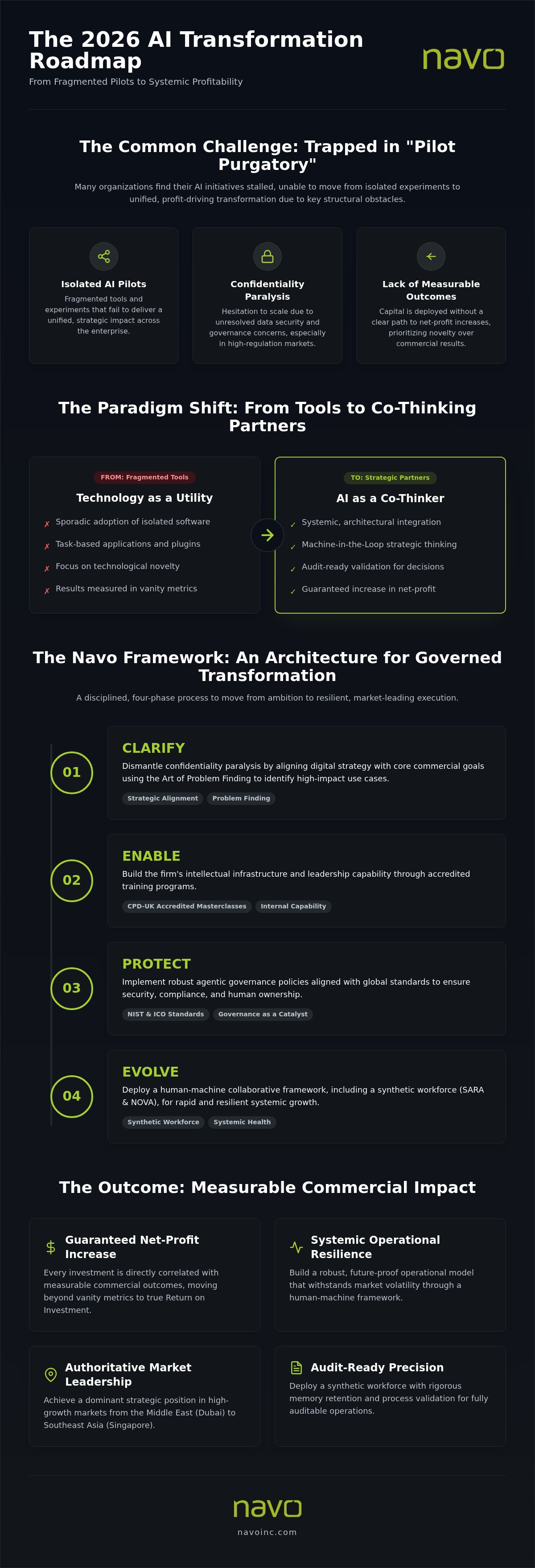
The Navo Framework: Clarify, Enable, Protect, and Evolve
Moving beyond the high-level paradigm shift requires a disciplined adoption architecture that translates visionary intent into operational reality. The Navo framework serves as this blueprint, structured around four critical pillars: Clarify, Enable, Protect, and Evolve. In the Clarify phase, we dismantle the confidentiality paralysis that often prevents organizations in Dubai and Singapore from defining a governed value proposition. This isn't merely a technical audit; it's a strategic alignment of the digital layer with core commercial goals. By establishing this foundation, an AI enabled business transformation moves from a theoretical ambition to a structured, low-risk reality.
The Enablement pillar focuses on the intellectual infrastructure of the firm, utilizing Continuing Professional Development (CPD) United Kingdom accredited masterclasses to build internal capability. Protection follows, where we implement agentic governance policies aligned with the National Institute of Standards and Technology (NIST) Privacy Framework and the Information Commissioner's Office (ICO) standards. This ensures that as the organization begins to Evolve through the Six Lanes of Working, the growth is both rapid and resilient, anchored in a culture of systemic health rather than fragmented experimentation.
Governance as a Catalyst for Scale
Effective governance isn't a restrictive barrier; it's the primary catalyst for scaling autonomous systems. Without clear human-ownership mechanisms, the deployment of autonomous agents creates unacceptable risk profiles for the modern enterprise. We implement risk-based decision paths that allow executives to delegate complex tasks to synthetic workers with full auditability. This structural clarity eliminates the ambiguity that leads to project stagnation, allowing the organization to move at the speed of the market while maintaining rigorous security standards.
The CPD-UK Standard for Executive Leadership
In 2026, the competitive edge belongs to those who view learning as a structural investment. Certified training is no longer optional for leaders navigating a comprehensive AI enabled business transformation. The Continuing Professional Development (CPD) United Kingdom Certified AI Course serves as the definitive benchmark for talent orchestration. It ensures that leadership remains the steady, expert hand behind every technological shift. For organizations seeking to build this internal capability, engaging with a strategic partner can accelerate the transition from theory to measurable net-profit growth.
Deploying the Synthetic Workforce: A New Operational Reality
The practical execution of an AI enabled business transformation culminates in the deployment of a synthetic workforce. This isn't merely the introduction of automated scripts; it's the integration of autonomous agents designed to function as persistent digital employees. These synthetic workers possess long-term memory, adhere to complex organizational workflows, and generate audit-ready outcomes that meet the rigorous standards of modern enterprise governance. Successfully embedding these agents into existing Human Resources (HR) and operational frameworks across the United Arab Emirates and Southeast Asia requires a disciplined, five-step deployment architecture.
- Role Definition: Identifying specific cognitive tasks and decision-making boundaries for the agent.
- Tool Integration: Establishing secure connections between the agent and the enterprise data stack.
- Workflow Mapping: Designing the logical sequences the agent must follow to achieve consistent results.
- Approval Gates: Implementing human-in-the-loop checkpoints to maintain quality and ethical alignment.
- Performance Metrics: Measuring agent output against hard financial indicators and net-profit targets.
The Architecture of an AI Agent
Our proprietary agents, such as SARA, utilize a methodical Sense-Ask-Refine-Approve workflow. This architecture addresses a critical inefficiency in corporate communications. Industry data suggests that approximately 33% of marketing budgets are lost to poor or incomplete briefs. SARA mitigates this by interrogating the strategic intent of a brief before resources are deployed, ensuring the "ask" is logically sound. This reclamation of wasted capital directly strengthens operational resilience and bottom-line performance.
Scaling with Agentic AI Services
True scalability emerges when you move beyond single agents to orchestrate multiple synthetic workers for cross-functional efficiency. While SARA validates strategic intent, agents like NOVA manage complex project orchestration, ensuring that timelines are met and resources are optimized without constant human oversight. This systemic approach allows the organization to move beyond isolated pilots toward a fully integrated digital layer. For a deeper analysis of these capabilities, see our guide on Mastering Agentic AI Services.
Measuring Transformation Success: ROI and Net-Profit Impact
The final measure of a successful AI enabled business transformation isn't found in the number of tools deployed or the completion rates of staff training modules. It resides exclusively in hard commercial outcomes. While many firms focus on vanity metrics, we prioritize a rigorous analysis of cost reduction, risk mitigation, and productivity gains. The Navo Guarantee reflects this commitment by positioning transformation as a definitive net-profit increase for enterprise clients. To ensure clarity for board-level reporting, we employ sophisticated diagnostic tools, including ROI calculators and readiness surveys that translate technological shifts into financial performance.
Long-term success requires an evolution beyond initial implementation toward a self-sustaining culture of AI literacy. This involves mastering "Natural Prompting," where the human workforce interacts with the synthetic layer as a standard operational reflex. It's a shift from viewing technology as an external addition to seeing it as an internal capability. This cultural maturity ensures that the organization remains resilient and capable of evolving as the agentic landscape continues to shift through 2026 and beyond.
The Economics of Synthetic Work
Analyzing the cost-per-outcome of synthetic workers reveals a significant advantage over traditional labor models for high-volume, cognitive tasks. While human talent remains the primary driver of strategic intent, synthetic agents handle the orchestration and validation phases with audit-ready precision. This structural change doesn't just improve the bottom line; it fundamentally alters the enterprise's long-term valuation by creating a scalable, high-margin operating model. You can explore these shifts in detail through our analysis of AI Business Model Innovation.
Strategic Coaching for the C-Suite
Navigating the "Agentic Era" demands a level of high-stakes coaching that addresses the complexities of executive leadership in a hybrid environment. Our consultants provide the steady, expert hand required to manage these organizational shifts without sacrificing professional composure. This partnership allows leaders to move with confidence, ensuring that the transition from human-only to human-machine collaboration is both seamless and profitable. For those ready to lead this evolution, it's time to act.
Architecting the Future of Enterprise Intelligence
Transitioning to a high-performance operating model in 2026 requires more than technical adoption; it demands a total structural realignment. We've explored how moving beyond pilot purgatory into a fully governed synthetic workforce can secure your firm's operational resilience. By applying proprietary agentic AI frameworks, your leadership can move from confidentiality paralysis to a position of decisive market authority across the Gulf region and beyond.
The path to a successful AI enabled business transformation is anchored in measurable commercial outcomes. Whether you're orchestrating agents like SARA to validate strategic briefs or utilizing NOVA for project coordination, the objective remains a guaranteed increase in net-profit. As a CPD-UK Accredited Training Provider, we ensure your C-suite possesses the capability to lead this shift with professional composure and analytical depth.
Your organization's evolution into a human-machine collaborative powerhouse is the most significant competitive advantage of the decade. We're here to provide the steady, expert hand needed to navigate this complex technological frontier and ensure your long-term systemic health.
Frequently Asked Questions
What is the difference between AI integration and AI-enabled business transformation?
AI integration typically involves the tactical deployment of specific tools to automate existing tasks, whereas an AI enabled business transformation represents a fundamental rearchitecting of the organizational operating model. Transformation focuses on systemic health and long-term resilience by embedding Generative Artificial Intelligence into the strategic decision-making layer. It moves the enterprise beyond isolated efficiency gains to a state where technology and human intuition function as a unified, co-thinking partnership.
How does Navo Inc. guarantee a net-profit increase for enterprise clients?
We provide a guaranteed net-profit increase by utilizing proprietary frameworks like the Art of Problem Finding to identify and eliminate high-cost inefficiencies before deployment. By focusing on measurable commercial outcomes rather than vanity metrics, we ensure that every synthetic worker or agentic workflow directly contributes to the bottom line. This outcome-guaranteed approach shifts the risk from the client to the consultant, ensuring a serious, high-level partnership dedicated to structural excellence.
What are synthetic workers, and how do they differ from standard AI chatbots?
Synthetic workers are sophisticated autonomous agents, such as SARA and NOVA, that possess long-term memory and the ability to follow complex, multi-step workflows. Unlike standard chatbots that provide reactive, one-off responses, synthetic workers provide proactive, audit-ready outcomes and can orchestrate cross-functional projects. They function as a governed digital workforce layer, capable of validating strategic briefs and managing resource allocation with minimal human intervention, thereby reducing operational waste.
Is the CPD-UK certified masterclass suitable for non-technical executives?
The CPD-UK accredited masterclasses are specifically designed for executive leadership and don't require a background in computer science or programming. The curriculum focuses on the strategic orchestration of technology rather than technical execution, equipping leaders with the capability to govern a synthetic workforce effectively. Executives learn to move past confidentiality paralysis by understanding the architectural guardrails necessary for a secure and profitable AI enabled business transformation.
How does Navo ensure AI governance across different regional regulations like those in Dubai and Singapore?
Navo ensures regional compliance by aligning our agentic AI governance policies with international standards like the NIST Privacy Framework and local regulations such as the United Arab Emirates National Artificial Intelligence Strategy 2031. We implement rigorous data safeguards and human-ownership mechanisms tailored to the legal requirements of jurisdictions like Dubai and Singapore. This methodical approach allows firms to scale across diverse geographic regions while maintaining total regulatory alignment and operational security.
Disclaimer
The views and opinions expressed in this article are those of the author and do not represent any organisation, client, institution, or professional body with which he may be associated. The content is intended for general information, education, and thought leadership. Readers should seek appropriate professional advice before making legal, financial, investment, regulatory, technology, or business decisions.
The author has taken reasonable care to ensure the accuracy of the information and sources available at the time of publication. Technologies, regulations, market conditions, and industry practices may evolve, and readers are encouraged to verify current information independently. Any examples, cases, or scenarios may have been simplified, anonymised, or adapted to protect confidentiality. The author and publisher accept no liability for decisions or outcomes arising from the use of this content.
Generative AI tools may have been used to support research, structuring, or language refinement, with the final content, judgment, and editorial responsibility retained by the author.